



Colorado home sales slide in September as smaller, cautious pool of buyers gain negotiating power
Statewide sales fall 15.1% and Denver metro transactions drop 18.7% despite lower inventory and stable prices; price reductions and seller concessions reshape the fall housing market
Colorado’s housing market continued to lose momentum in September as declining sales, cautious buyers, and affordability challenges created growing pressure on sellers, even as home prices remained relatively stable, according to the September 2026 Market Trends Housing Report from the Colorado Association of REALTORS® (CAR).
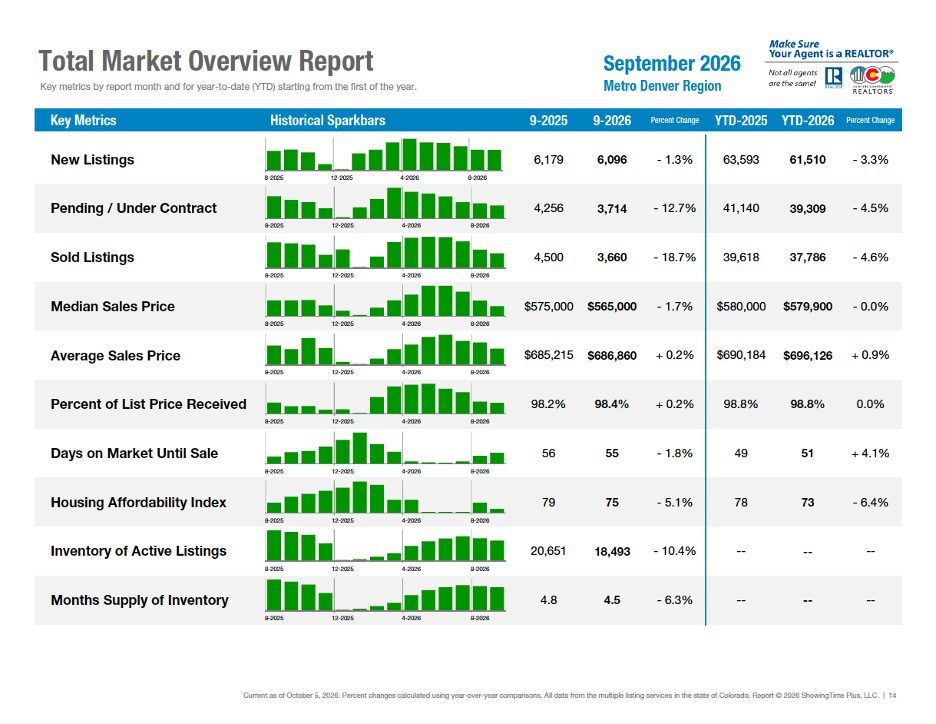
Statewide closed sales fell 15.1% year over year, while pending contracts declined 10.9%. The seven-county Denver metro market experienced an even sharper slowdown, with closed sales dropping 18.7% and pending contracts down 12.7%.
Despite fewer transactions, statewide median prices declined just 1.6% to $540,000, while Denver metro prices slipped 1.7% to $565,000. With inventory also declining in both markets, the slowdown reflects weakening buyer demand rather than an oversupply of homes. As buyers become increasingly selective, price reductions, seller concessions, and longer selling times are reshaping market conditions, creating new negotiating opportunities for buyers while reinforcing the importance of realistic pricing and flexibility for sellers heading into the final quarter of 2026.
Seven- County Denver-metro area
Despite the slowdown, home prices remain relatively stable. The median sales price declined 1.7% to $565,000, while the year-to-date median held virtually unchanged at $579,900. However, significant differences are emerging between property types. Single-family median prices slipped just 1.3% to $610,000, with four months of inventory. Condo and townhome prices fell 6.2% to $375,000, with 6.4 months of supply and an average of 67 days on market. Rising HOA fees, insurance costs, and affordability challenges continue to weigh heavily on attached housing.
Sellers are increasingly adjusting expectations to attract buyers. Nearly 49% of September sales involved an asking-price reduction, while approximately 64% included seller concessions. Overall, 80% of transactions involved one or both, highlighting buyers’ growing negotiating power. Homes requiring price reductions spent considerably longer on the market than those priced competitively from the beginning.
“September’s Denver-metro housing market is a reminder that you do not need an inventory glut to have a difficult market for sellers. Across the seven-county metro area, closed sales fell 18.7% year-over-year to just 3,660 transactions, while pending contracts declined 12.7%. Yet active inventory was also down 10.4% from last September, and new listings were nearly flat, declining just 1.3%. It is a counterintuitive combination: fewer homes for sale, substantially fewer homes selling, and buyers with increasingly little urgency to act. The imbalance is not being driven by an overwhelming supply of homes, but by demand weakening faster than supply. Buyers do not necessarily need more choices to gain negotiating leverage. Sometimes they just need less competition from one another,” said Denver County-area REALTOR® Cooper Thayer.
Total Market Overview – Seven-County Denver Metro
Statewide
Closed sales fell 15.1% year over year to 6,526 transactions, while pending contracts declined 10.9%. New listings remained virtually unchanged, increasing just 0.3%, while active inventory dropped 2.7% to 34,824 properties. The combination of fewer sales and relatively steady inventory suggests buyers remain cautious despite having more negotiating opportunities.
“Sellers in the attached market really pulled back, with nearly 31% fewer new listings, which led to a 10.6% drop in active listings. It was a bit of a roller coaster year for the attached market, and I think many sellers are punting and hoping (or praying) for better conditions in 2027. Median value dropped to $402,500, which was an 11.7% drop as compared to 2025 however, September 2025 was an anomalous peak in values. Affordability is not improving in the attached market, another indicator that the condo and townhome market is continuing to get beat up,” said Fort Collins-area REALTOR® Jared Reimer.
Statewide median home prices declined 1.6% to $540,000, although the year-to-date median remained virtually unchanged at $549,000. However, significant differences continue to emerge between property types. Single-family median prices slipped just 0.9% to $575,000, while townhouse and condo prices fell 7.1% to $395,000, highlighting the greater challenges facing attached housing.
“Colorado continues to set a trend for more inventory and less sales, and September was no different. We were up 2.1% on inventory and sales dropped a whopping 13.1% across the Pikes Peak Region. The grip sellers once had is now gone, and we are seeing incentives, price drops and homes moving into the rental market. With rentals increasing, rents continue to soften. The continuous up cycle year over year is now finally releasing some of that momentum and, in many areas, we are seeing significant price improvements,” said Colorado Springs-area REALTOR® Patrick Muldoon.
Total Market Overview – Statewide
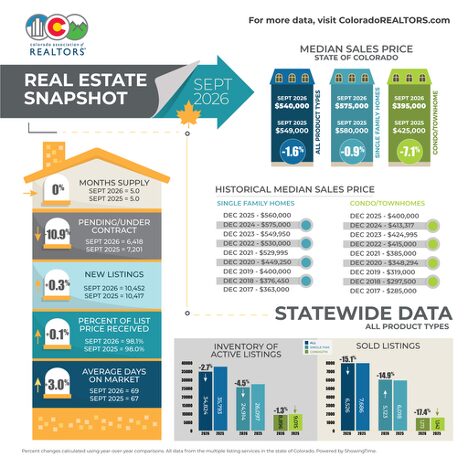
Colorado Housing Markets Snapshot – September 2026
Based on analysis from REALTORS® working in markets across the state
(for a more in-depth analysis by market, see full content in report below):
Aurora – Home prices across Aurora and Centennial continue to decline despite lower inventory, with year-over-year decreases of 3% to 5% and September median prices averaging $25,000 below August. Some neighborhoods experienced even sharper declines. Homes that sell are averaging 35 days on the market, while buyers benefit from improved affordability and seller concessions. For sellers, competitive pricing, preparation and flexibility are essential. This market correction is creating opportunities for buyers while requiring sellers to adjust expectations.
Boulder and Broomfield counties – While much of Colorado’s housing market is struggling, Boulder and Broomfield counties remain relatively stable, with prices flat since the beginning of the year. Homes are averaging 44 days on the market in Broomfield and 64 in Boulder. However, condo and townhome values have declined 7% and 2.5%, respectively. Higher mortgage rates, HOA fees and cautious buyers continue to challenge the market. As the holidays approach, sellers are increasingly offering price reductions and concessions, creating opportunities for buyers.
Colorado Springs – The Colorado Springs-area housing market continues to favor buyers, with September inventory reaching 4,253 single-family and patio homes, up 6.1% year over year. Sales declined 9.7%, while average prices fell 3.5% to $545,660. Homes averaged 53 days on the market, with 4.6 months of inventory available. Nearly half of El Paso County listings experienced price reductions, reinforcing the importance of realistic pricing and attractive, well-maintained properties. Despite softer conditions, competitively priced homes are still attracting multiple offers.
Crested Butte/Gunnison – The Gunnison-Crested Butte housing market continues to show contrasting trends, with year-to-date sales down 5.6% overall but dollar volume up 11% to $443 million. Crested Butte remains strong, particularly in luxury properties, with sales volume up nearly 19% and single-family median prices climbing 27% to $2.3 million. Meanwhile, Gunnison sales declined 23%, although single-family prices remain relatively stable. Growing inventory across both markets offers buyers more choices, while sellers must remain realistic about pricing as market conditions vary significantly by location and property type.
Denver Metro – Denver metro’s housing market continues to favor buyers despite declining inventory. September closed sales fell 18.7% year over year, while active listings dropped 10.4%. The median price declined just 1.7% to $565,000, although condo-townhome prices fell 6.2%. Nearly half of sold homes experienced price reductions, while 64% included seller concessions. With mortgage rates climbing, additional pressure on sales activity is expected. Sellers face an increasingly selective buyer pool, making realistic pricing and flexibility essential to securing a sale in today’s challenging market.
Durango/LaPlata County – The Durango and La Plata County housing market continued slowing in September, with declining sales and growing inventory. Single-family home supply increased 15% year over year to 7.7 months, while condo-townhome inventory climbed 28% to 8.8 months. Although median prices rose 23% for single-family homes and 13% for attached properties, those increases largely reflect higher-priced transactions rather than broad appreciation. Sales below $500,000 have weakened significantly, while cash purchases increased to 44%. Purgatory Resort sales remain stable despite elevated inventory.
Evergreen/Foothills – The Colorado foothills housing market saw renewed activity in September, particularly in Evergreen and Conifer, where single-family contracts increased 36.2% and closed sales rose 10.4% year over year. However, the broader four-county market experienced declining sales, highlighting increasingly localized conditions. Homes are taking longer to sell, while prices per square foot have declined 3% to 4%. With inventory stabilizing at 3.2 months’ supply, buyers have more choices. Realistic pricing, property condition and flexibility are helping motivated buyers and sellers complete transactions.
Fort Collins – The Fort Collins housing market remains relatively stable heading into the final months of 2026, although rising mortgage rates and softer buyer demand are prompting sellers to pull back. Single-family new listings declined nearly 20% year over year, while median prices dipped 1.7% to $590,000. Condo and townhome listings fell nearly 31%, with median prices declining 11.7% to $402,500. Despite improving single-family affordability, the attached market continues to struggle. Buyer confidence and mortgage rates will be key factors influencing market activity moving forward.
Grand County – Grand County’s housing market continues to favor buyers, with 668 active listings, 10 months of inventory and a median 75 days on market in September. Homes are selling at approximately 97% of asking price, reflecting greater negotiating power for buyers. However, market conditions vary significantly by price range, with luxury properties above $2 million experiencing tighter inventory. As ski season approaches, buyer interest remains steady but selective. Competitive pricing, property condition and realistic seller expectations remain essential to successful transactions.
Mesa County – Mesa County’s housing market slowed in September, with new listings increasing while pending and closed sales declined. Despite rising median and average prices, sellers are increasingly offering reductions and concessions or withdrawing listings. Inventory reached 5.2 months, although conditions remain challenging. Lenders are introducing creative financing and down payment assistance programs to stimulate buyer activity, particularly for homes priced between $300,000 and $500,000.
Pagosa Springs – Pagosa Springs’ September housing market reflected shifting conditions, with buyers seeking value and sellers adjusting prices amid a 10-month inventory supply. Pending sales rose 6.5% year-over-year, while closed sales declined 20.5%. The median sales price climbed 23.9% to $695,000, and new listings fell 28.3%. Year-to-date sales reached 265 homes, up 0.8%. Luxury properties face continued pricing pressure, while affordability challenges persist for buyers seeking homes under $600,000.
Pueblo County – Pueblo County’s housing market cooled in September, with new listings declining 9.8% and closed sales falling 6.2% year over year. Despite slower activity, the median sale price increased 1.2% to $332,950, while average prices rose 6.3%. Inventory declined 10.2% to 1,132 homes, representing 5.7 months of supply. Homes averaged 89 days on market, giving buyers additional negotiating opportunities. With mortgage rates near 7%, realistic pricing and seller concessions remain important factors in completing transactions.
San Luis Valley – The San Luis Valley housing market showed mixed results in September, with single-family sales declining from 48 to 32 year over year, although year-to-date sales increased 8.6% to 315. Market conditions varied significantly across the six counties, with Alamosa’s median price declining 10.1% to $315,000, while Rio Grande’s rose 48.8% to $465,000. Conejos County recorded particularly strong year-to-date sales growth of 78.9%. Limited monthly transactions contributed to significant price fluctuations, reinforcing the importance of year-to-date comparisons and realistic pricing.
Steamboat Springs/Routt County – Routt County’s housing market continues to normalize, with longer selling times and seven to 10 months of inventory favoring buyers. Steamboat Springs recorded 17 single-family sales in September at a median price of $2.57 million, up 24.3% year over year, driven largely by luxury transactions. Year-to-date single-family sales increased 7%, while condo and townhome sales rose 14.3%. Despite slower transactions, prices remain relatively stable, with sellers receiving 96% to 98% of asking price. Competitive pricing remains essential as buyers gain more choices and negotiating power.
Summit, Lake, and Park counties – Summit County’s housing market showed contrasting trends in September, with single-family sales declining 25% and average prices falling 20.6%, while multifamily sales dropped 31.7% despite an 8.7% increase in average prices. Growing inventory and longer selling times are giving buyers more choices and negotiating power. Properties near ski resorts with short-term rental opportunities continue to outperform those in more restricted locations. Across Summit, Park and Lake counties, realistic pricing, property location and rental flexibility remain important factors influencing buyer demand and sales activity.
Telluride – San Miguel County’s housing market continues to see fewer transactions but stronger luxury sales, with 38 September closings generating $121.9 million. Telluride and Mountain Village accounted for 96% of sales volume. Rising mortgage rates have slowed transactions below $5 million, while Telluride continues to significantly outperform Mountain Village in sales activity.
Weld County – Weld County’s housing market slowed in September, with single-family sales declining 19.1% year over year while median prices remained relatively stable at $500,625. Homes averaged 73 days on market, with inventory down 2.1%. Condo and townhome sales fell 6.4%, with median prices declining 1.9% to $356,250 and marketing times increasing to 91 days. Despite fewer transactions, prices remain relatively resilient. Buyers have more time to evaluate options, while sellers must emphasize realistic pricing, preparation and patience.
Taking a more in-depth look at some of the state’s local market data and conditions, the Colorado Association of REALTORS® Market Trends spokespersons provided the following assessments:
AURORA
“Pricing remains one of the most important factors in today’s Aurora/Centennial housing market, where home values continue to decline despite inventory levels being lower than a year ago in most ZIP codes. Typically, lower inventory helps stabilize prices, but we’re seeing year-over-year declines of 3% to 5%, with September median prices dropping an average of $25,000 from August.
“In some neighborhoods, the changes are even more dramatic. In ZIP code 80015, the median sales price fell from $582,000 in August to $515,000 in September. In ZIP code 80111, the median dropped from $1.53 million to $1.1 million over the same period. While monthly median prices can fluctuate based on the mix of homes sold, these numbers illustrate the significant pricing adjustments taking place across the market.
“Homes that are selling are spending an average of about 35 days on the market, and buyers are finding opportunities that simply weren’t available a year ago. Not only are prices becoming more affordable, but many sellers are also offering concessions, giving buyers additional negotiating power.
“For buyers, this market presents an opportunity to secure a home at a more competitive price and negotiate favorable terms. While no one can predict exactly where prices or interest rates are headed, a future decline in mortgage rates could bring more buyers back into the market, increasing competition and putting upward pressure on prices. Buyers who purchase now may also have the option to refinance if rates decline.
“For sellers, the message is also clear. The market is changing quickly, and pricing realistically from the start is essential. Well-maintained, attractive homes that are priced appropriately are still finding buyers, but sellers need to pay close attention to local market conditions and be prepared to adjust their expectations.
“Ultimately, we’re seeing a market correction that is creating new opportunities for buyers while requiring sellers to be more strategic. Pricing, preparation, and flexibility are the keys to success in today’s market,” said Aurora REALTOR® Sunny Banka.
BOULDER/BROOMFIELD COUNTIES
“While much of Colorado’s real estate market is losing ground, Boulder and Broomfield counties are holding their own. Prices in both markets remain flat compared to the beginning of the year. In this environment, that’s no small feat.
“High interest rates, low consumer confidence, and buyers who seem in no hurry to pull the trigger have put a damper on the market. Prices aren’t climbing, but they aren’t falling either. Sellers who get the message and price aggressively are still getting deals done, averaging 44 days on the market in Broomfield and 64 days in higher-priced Boulder.
“For condos and townhomes, that’s a different story. Values are down about 7% in Broomfield and 2.5% in Boulder since the beginning of the year. High HOA fees, combined with mortgage rates, continue to make these properties a tough first step for first-time buyers.
“And now, with the holidays approaching, some sellers are starting to feel the pressure. Price cuts and concessions to help buyers manage interest rates are becoming part of the conversation.
“The bottom line. Buyers have an opportunity right now. Sellers are getting more realistic, and some are willing to deal. Wait until spring, and you could be competing with everyone else who had the same idea. Savvy buyers might want to make their move before the crowd wakes up,” said Boulder/Broomfield-area REALTOR® Kelly Moye.
COLORADO SPRINGS
“Colorado continues to set a trend for more inventory and less sales, and September was no different. We were up 2.1% on inventory and sales dropped a whopping 13.1% across the Pikes Peak Region. The grip sellers once had is now gone, and we are seeing incentives, price drops, and homes moving into the rental market. With rentals increasing, rents continue to soften. The continuous up cycle year over year is now finally releasing some of that momentum and, in many areas, we are seeing significant price improvements.
“Jumping into the new home market is important as well. Standing inventory for builders will often have rate buydowns, price reductions and other massive incentives tossed in. Often, we can calculate a builder having 10-13% of purchase price being tossed into total concessions package with their buydowns. The resale market cannot compete in these new home areas, and these sellers with newer homes are losing value faster as the incentives are so great from the direct competition of the builder.
“The real takeaway now is that the Colorado market is under a major shift. We are in the top five states for price reductions. The unemployment side nationally is also under pressure. We now have 1.93 million Americans who have been jobless for 27 weeks, the third highest number since the great recession. I have often said math always wins, and if wages don’t support values, something has to change. With rates moving up, prices will have to succumb if buyers are going to come back to the market. And we can hope that unemployment stays low, or we have another factor that will continue to put downward pressure on the market. Sellers had their time. But even with this shift buyers are not coming back to the market. We remain stagnant, at best,” said Colorado Springs-area REALTOR® Patrick Muldoon.
COLORADO SPRINGS
“In ‘The 7 Habits of Highly Effective People,’ Stephen Covey includes a simple line drawing that can be interpreted in two different ways. Some viewers may see an aristocratic young lady with her head turned away, showcasing her jawline, ear, and a feather in her hat. Others might perceive an elderly woman looking downward, characterized by a large nose, a scowling mouth, and wearing a shawl or fur coat. This illustrates how our personal perspectives and conditioning influence our interpretations of what we observe.
“Similarly, our individual viewpoints, shaped by factors such as the state of the national economy, rampant inflation, the expensive Iran war, and high interest rates, will influence how we perceive what is good, bad, and challenging in this month’s housing market statistics.
“In September, single-family and patio home supply hit a record high of 4,253 homes, up 6.1% from the previous year. This figure is also 260% higher than September 2021, giving buyers a much wider selection to choose from.
“The inventory increase has led to a 3.5% decrease in the average home price from last year. However, it is up 150% since September 2011. Home sales have declined 7.0% month over month and 9.7% year over year. Monthly sales volume fell 7.6% from the previous month and 13.1% from the same time last year. Year-to-date, sales volume is down 2.1% compared to last year, but it remains 53.0% higher than in September 2016 and 262.7% higher than in September 2011.
“Even in this market, some sellers are listing their homes at realistic prices and are receiving multiple offers, sometimes exceeding the asking price. Therefore, buyers should use this information carefully and avoid applying a single month’s market data universally to every home,” said Colorado Springs-area REALTOR® Jay Gupta.
Key Data Points in September 2026 for single family/patio homes:
- Active Listings – Supply: 4,253 homes, compared to 4,297 in August (down 1% from August) and 4,010 last year (up 6.1% year over year).
- Sales – Demand: 926 homes compared to 996 in August (down 7% from August) and 1,026 last year (down 9.7% year over year).
- Under Contract: 1,277 homes compared to 1,386 last year (down 7.9% year over year).
- Average Price: $545,660 compared to $547,521 in August (down 0.3% from August) and $565,356 last year (down 3.5% year over year).
- Median Price: $479,000 compared to $470,000 in August (up 1.9% from August) and $479,450 last year (down 0.1% year over year).
- Sales Volume: $504,159,110 compared to $545,331,728 August (down 7.6%) and $580,055,722 last year (down 13.1%).
- Days on the Market: 53 days compared to 49 in August and 54 days last year.
Current supply of single-family and patio homes is at 4.6 months across all price ranges. Generally, four to six months’ supply is considered good. However, for the higher-priced tier homes, six to eight months’ supply is more desirable. Breakdown of the current supply by price tier:
- Homes priced under $400,000 have 3.9 months’ supply,
- Homes priced between $400,000 and $600,000 have 4.4 months’ supply,
- Homes priced between $600,000 and $1 million have 5.1 months’ supply,
- Homes priced over $1 million have 7.6 months’ supply.
Looking at the sales by price tier:
- Homes priced under $400,000 accounted for 29.3% (down 6.6% year over year),
- Homes priced between $400,000 and $600,000 represented 42.4% of all sales (down 10.9% year over year).
- Homes priced between $600,000 and $1 million made up 22.5% (down 14.4% year over year).
- Luxury homes priced above $1 million comprised 5.8% (down 16.9% year over year).
“In the current highly competitive market with plentiful supply, 46.4% of active listings in El Paso County and 36.4% in Teller County had price reductions in September. To achieve the highest possible sale price in the shortest time and avoid multiple price cuts, sellers ought to price their properties realistically from the start. Additionally, properties need to be well-maintained and show attractively to draw and wow potential buyers,” added Gupta.
CRESTED BUTTE/GUNNISON
“The Gunnison Crested Butte area real estate market continues to be a tale of two areas with the Crested Butte market exceeding 2025 and Gunnison lagging behind in most metrics. As predicted, September sales were down from last September which washed out the gains made from a higher-than- average August.
“The overall Gunnison Crested Butte market has seen 438 sales this year vs. 464 last year (down 5.6%), but dollar volume is up 11% from $398M to $443M. Sales of single-family homes match the percentage decrease and increase. Condo/townhome sales are a bit stronger with sales down 3.9% and dollar volume up 16%. These condo gains are from the Crested Butte area and specifically at the ski base area in Mt. Crested Butte. Single family home prices continue to go up overall with median prices at $875,000 (from $807,000 in 2025) and average prices at $1,515,841 (from $1,302,316 in 2025). Condo/townhome median prices are also up to $642,500 (from $584,000 in 2025) and average prices at $867,948 (from $718,365 in 2025). Active listings are down from August as is typical in this time of year, but they are up compared to this time last year. Overall, there are 5.6% more listings, but there are 15% more single-family homes and 23% more condos.
“The Crested Butte area market is strong, especially in the luxury segment. A recent Wall Street Journal article focused on this with homeowners laying out why they decided Crested Butte was a good place to invest in real estate and to spend time. The article mentioned that the most expensive home ever listed in the area is now under contract so we are all waiting to see what the $25 million home will sell for. As you might imagine from this story, the market has had $50 million more in sales this year which is almost 19% more than last year. The number of sales is actually down two, demonstrating the level of sales we are seeing. For single family homes, we have 9% more sales this year (71 vs. 65) for 22% more dollar volume ($96 million vs. $75 million). The median price for homes is up 27% over last year to $2,325,000 and the average price is up 12% to $2,764,906. Condo and townhome sales are also up – with 7% more sales (93 vs. 87) and a whopping 28% more dollar volume. The median price for condos/townhomes is up 4% to $790,000 with the average price reaching $1,030,225 (up 20%). The market is ready for more sales with a 19% increase in all listings from this time last year, 7% more homes and 30% more condos. These strong numbers should not be taken to tell every seller to increase their price. Some segments are seeing price reductions and longer days on the market. It is important to be priced correctly from day one to attract buyers and offers. Buyers should look at the days on the market to know more about the situation for a specific listing they are interested in. Overall trends are good to know, but they don’t tell the whole story.
“The Gunnison market has slowed, but value seems to be holding steady. The number of total sales is down 23%, and dollar volume is down 19%. Single-family home sales are down 18% from 98 to 80, and dollar volume dropped 15% ($64,500,245 from $75,747,850). Prices for homes are up a bit. The median price is now $688,500 (up 2.5%) and the average price is $806,253 (up 4.3%). Condo and townhome sales are down 32.5% from 40 to 27, and dollar volume is down 41% from $16 million to $9.7 million. Median prices are down 3% for the median (now $365,000) and -12% for the average (now $360,325). Gunnison provides more affordable options, but buyers here are more likely to need a loan, so the 7-plus percent interest rates have had an impact. This area is beautiful with a vibrant downtown and proximity to ski areas, hiking and biking trails, Western Colorado University and more so the more affordable prices make it a place to consider for a Colorado home or getaway. There are 24% more homes for sales than this time last year and 53% more condos so now is a great time to be a buyer in the Gunnison area.
“Although we don’t have a huge volume of sales, the Gunnison Crested Butte area has a lot of micromarkets where the numbers may or may not follow the larger trends,” said Crested Butte-area REALTOR® Molly Eldridge.
DENVER METRO (Seven County)
“September’s Denver-metro housing market is a reminder that you do not need an inventory glut to have a difficult market for sellers. Across the seven-county metro area, closed sales fell 18.7% year-over-year to just 3,660 transactions, while pending contracts declined 12.7%. Yet active inventory was also down 10.4% from last September, and new listings were nearly flat, declining just 1.3%. It is a counterintuitive combination: fewer homes for sale, substantially fewer homes selling, and buyers with increasingly little urgency to act. The imbalance is not being driven by an overwhelming supply of homes, but by demand weakening faster than supply. Buyers do not necessarily need more choices to gain negotiating leverage. Sometimes they just need less competition from one another.
“The encouraging news is that weaker demand has not translated into widespread price deterioration. September’s median sale price was $565,000, down 1.7% from last year, while the year-to-date median remains virtually unchanged at $579,900. But that stability masks a growing divide between property types. The single-family median declined just 1.3% to $610,000, with four months of inventory, while the condo-townhome median fell 6.2% to $375,000, with 6.4 months of supply and an average of 67 days on market. Attached housing continues to face a more difficult adjustment as HOA dues, insurance, and other ownership costs compound affordability pressures. We are increasingly seeing two distinct housing markets operating under one set of metro-wide statistics.
“The more revealing story, however, is what sellers are having to do to complete transactions. Nearly 49% of homes sold in September had undergone an asking-price reduction, up from roughly 37% in June. Almost 64% included seller concessions, and a remarkable 80% involved either a price reduction or a concession. Only about one in five homes sold without either. The difference in marketing time is equally striking: homes that reduced their asking price spent a median of 68 days on the market, compared with just nine days for those that did not. By closing, the median net sale price after concessions for reduced listings was approximately 8.3% below the original asking price, compared with just 1.7% for listings without a recorded reduction. These are not necessarily losses caused by reducing prices, but they illustrate how much more difficult the path to closing becomes when sellers begin with expectations buyers are unwilling to support.
“What concerns me most heading into the final quarter is that September’s numbers may not yet reflect the full impact of the latest mortgage rate spike. According to Mortgage News Daily, the average 30-year fixed rate climbed from roughly 6.9% at the beginning of September to 7.6% by month’s end, a significant deterioration in affordability in just a few weeks. Most September closings originated from contracts negotiated before the sharpest increases, meaning the effects may become more visible in October and November. I still do not see sufficient evidence for a broad housing price collapse, particularly with inventory remaining below last year’s levels. But the decline in transaction activity is real, and the growing reliance on price reductions and concessions shows just how selective buyers have become. This is a market where prices can appear remarkably stable even as the actual business of selling a home becomes materially harder. For sellers, the greatest risk right now may not be falling home values, but entering the market with an expectation of value that buyers no longer share,” said Denver County-area REALTOR® Cooper Thayer.
DURANGO/LA PLATA COUNTY
“Despite a strong first half of the year in Durango and La Plata County, sales have again remained down in September, as they have been since July. With rates increasing and the economy stagnating, it’s not looking like it will turn around before the end of the year. The boost of early-in-the-year sales kept totals in the county ahead of 2025 until this month, but we will soon fall behind.
“More remote areas of our county show very little activity in September. Vallecito Lake had 0 sales, the town of Ignacio had 0 sales, rural Bayfield is -47% in the number of sales year over year; the entirety of San Juan County north of La Plata, including the town of Silverton, had one single-family and no condo sales.
“There is a much larger supply of homes for sale across the county than in the past few years: a 7.7-month supply of single-family homes (+15% year over year) and an 8.8-month supply of condos and townhomes (+28% year over year) in the county overall. Even in in-town Durango, where inventory is usually slimmest for single-family homes, there is 4.1 months’ supply, up 41% year over year. Rural Bayfield has 100% more inventory year over year.
“There is a huge median increase of 23% year over year in single-family homes to $807,000, and 13% for condos/townhomes to $588,000, while REALTORS® know prices are steady or falling slightly. The increase has to do with the price point of what is selling and who is still able or willing to purchase given the high interest rates.
“What price point is hurting the most? There are significant drops in the number of home sales under $500,000, significant increases in the $500,000-$1 million range, and no change in the number of sales over $1 million. Notably, cash sales in La Plata County have risen from 40% in September 2025 to 44% in September 2026.
“Remarkably, the Purgatory Resort market is holding up with an exactly equivalent number of sales of both single-family and condo/townhome sales year over year. Whether the headache that is being felt countywide hasn’t yet reached the resort or if it is weathering the storm with predictions of a big winter season, we aren’t sure. There is, however, a 19-month supply of single-family homes and a 16-month current supply of condos and townhomes in the resort area,” said Durango-area REALTOR® Heather Erb.
EVERGREEN/MOUNTAIN METRO
“After a busy spring and a quieter midsummer, portions of the Colorado foothills housing market are experiencing a second wave of activity heading into fall. Evergreen and Conifer saw September single-family contracts increase 36.2% compared with September 2025, while closed sales rose 10.4%. The renewed activity is encouraging, but it doesn’t necessarily signal a return to the highly competitive markets of recent years. Instead, buyers and sellers appear to be finding more common ground.
“In my own business and among local agents, the pattern has been particularly noticeable. Following a strong March-through-June selling season and the typical midsummer slowdown, September brought renewed buyer interest, more contracts and, in some cases, backup or multiple offers on homes that had previously struggled to attract attention. Buyers haven’t suddenly become less selective, but sellers appear increasingly willing to meet the market, and that’s helping transactions come together.
“The resurgence is not uniform throughout the foothills. Across the broader four-county market, September single-family contracts declined 4.7% from a year ago, and closed sales fell 11.7%. However, year-to-date sales remain 1.4% ahead of 2025. Evergreen and Conifer are outperforming that broader trend, with year-to-date contracts up 10.3% and sales up 8%. These differences reinforce how increasingly localized the foothills market has become.
“The renewed activity is also occurring in a market where homes are generally taking longer to sell. Across the foothills, the rolling median marketing time is approximately 21 days, compared with an average of 46 days. Evergreen and Conifer have experienced an even greater increase in marketing time, with year-to-date average days on market up nearly 22% from last year. Some homes are still moving quickly, while others may spend months waiting for the right buyer or the right adjustment in expectations.
“Getting from contract to closing remains another challenge. In my experience, more properties are returning to the market after an initial contract falls apart, only to secure a second buyer and ultimately close. Inspection concerns, financing considerations, and differing expectations can still complicate transactions. That means an increase in contracts doesn’t always translate into an equally smooth path to closing, and both buyers and sellers need to remain realistic and flexible throughout the process.
“Pricing continues to reflect that adjustment. Across the broader foothills, rolling average price per square foot is approximately 3% below a year ago, while the rolling median is down about 4%.
“Inventory also appears to be settling into a healthier rhythm. Rolling months of supply is approximately 3.2 months, compared with 3 months a year ago, giving buyers more options than they had during the exceptionally tight markets earlier this decade. That choice continues to make location, condition, insurability and overall value important considerations, particularly in the foothills, where properties can differ dramatically even within the same price range.
“As we move into the final quarter of the year, this second wave of activity is a reminder that the foothills market doesn’t always follow a smooth seasonal pattern. Motivated buyers are still looking, and motivated sellers are increasingly finding ways to make transactions work.
“The Colorado foothills market isn’t necessarily getting hotter, but in some communities, it is becoming more productive. Buyers are recognizing value, sellers are adjusting expectations, and when those two things come together, homes are selling,” said Evergreen-area REALTOR® Julia Purrington Paluck.
FORT COLLINS
“Diving into the numbers of the Fort Collins market, we aren’t seeing anything out of the ordinary. Nothing indicates any regression or advancement in the market as we continue status quo heading into the home stretch in 2026. The major trend in both the single family and attached markets showed that sellers are pulling back from the market – active listings are down somewhat substantially. This is likely due to the quick upward shift in interest rates and perceived drop in buyer demand. As a result, sales have also dipped as compared to 2025; however, just a few home sales either way can sway the figures. When in doubt, zoom out.
“In the single-family market, new listings were down nearly 20% and total active listings were down 9% as compared to September 2025. Median value is holding essentially steady, down just 1.7% to $590,000. While I don’t think there are any true bright spots in the market indicating any kind of upward momentum, days on market fell to just 73 days (-13.1%), monthly supply is down to 3.1 months (-8.8%) and the affordability index, if you can believe it, is improving.
“Sellers in the attached market really pulled back, with nearly 31% fewer new listings, which led to a 10.6% drop in active listings. It was a bit of a roller coaster year for the attached market, and I think many sellers are punting and hoping (or praying) for better conditions in 2027. Median value dropped to $402,500, which was an 11.7% drop as compared to 2025 however, September 2025 was an anomalous peak in values. Affordability is not improving in the attached market, another indicator that the condo and townhome market is continuing to get beat up.
“We will likely limp across the finish line in 2026 and nose out sales and median values from 2025, however, with rates climbing, it could dampen any potential momentum we have left. Growing concern about the state of housing in Fort Collins, both in consumers and real estate professionals, is looming. Buyer confidence and demand will be the key driver,” said Fort Collins-area REALTOR® Jared Reimer.
GRAND COUNTY
“As September brought golden aspens, cooler mountain mornings, and the transition toward another ski season, Grand County’s real estate market continued to tell a story of change.
“Buyers are still interested in the Colorado mountain lifestyle, but they are approaching purchases with greater patience, more choices, and stronger negotiating power.
“The days when almost any mountain property could attract multiple offers simply because of its location are largely behind us. Today’s buyers are comparing properties carefully, studying ownership costs, evaluating condition, and expecting prices to reflect the realities of the current market.
September stats show that it is still primarily a buyers’ market
- 668 Active listings
- Median asking price $595,000 for multifamily and $1.1 million for single-family homes
- 10 months of inventory
- 113 properties under contract
- 75 median days on market
- 97% sale-to-list price ratio
- 65 closed sales
“These figures show a slower pace of transactions and a more competitive environment for sellers. The median sold-price decline should not automatically be interpreted as an equivalent decline in individual property values, because the mix of properties sold can change substantially from month to month.
One interesting distinction is the luxury segment. Although Grand County overall had 10 months of inventory, properties priced above $2 million showed approximately 3.9 months of inventory using the report’s August sales pace.
“This demonstrates why it is important not to describe every Grand County price range as experiencing the same market. A desirable luxury property can face a very different competitive environment than a mispriced condominium.
“For sellers, September reinforced the importance of realistic pricing from the beginning. Properties that are updated, professionally presented, and competitively positioned have a better opportunity to stand out. Overpricing can lead to extended marketing periods and eventual price reductions.
“For buyers, the market offers more room to evaluate options, negotiate, and complete thorough due diligence. Yet desirable properties in strong locations may still attract competition, especially when priced appropriately.
“As Grand County moves into October and prepares for the winter season, I expect buyers to remain selective, particularly when comparing resort condominiums and second homes. Ski-season anticipation may help sustain interest in Winter Park and Granby Ranch, but sellers should not assume that seasonal demand alone will overcome an unrealistic asking price.
“The broader message is that Grand County has not lost its appeal. What has changed is the way buyers evaluate that appeal. The mountain lifestyle still creates desire. But in today’s market, value creates the transaction. Our market is becoming more deliberate, more price-sensitive, and increasingly dependent on knowledgeable pricing and negotiation,” said Grand County-area REALTOR® Monica Graves.
MESA COUNTY
“It was a quiet September for the Mesa County housing market with new listings up year over year but pending sales and closed sales down. However, the median and average prices year over year were up. Sellers are holding on to the prices despite the slow number of sales, eventually taking price reductions, advertising concessions or taking their listing off the market. We now have a 5.2-month inventory supply which is supposed to indicate a balanced market however, that is not the case. Some lenders are promoting creative products and down payment assistance to help buyers qualify and hoping to spark sales, especially in the $300,000-500,000 range,” said Mesa County REALTOR® Ann Hayes.
PAGOSA SPRINGS
“Changing leaves result in slowly falling leaves and evolution of winter. The Pagosa Springs real estate market reflects the same, as a changing September market resulted in falling prices and fewer listings. Buyers, both full-time and part-time, tightened their budgets and sought value pricing. They found sizable price adjustments enticing a purchase. Pending sales are up 6.5% over this time last year and up 3.9% year to date. Sellers made those price adjustments to meet their selling time desires and address home buyer competition with a 10-month home inventory supply (same as 2025) and 128 days on market. Price adjustments often placed sellers closer to buyer’s price expectations. Buyers looking to purchase a single-family home under $600,000 are still struggling to find a home not requiring updates and meeting their wants and needs. Waiting has been costly for these buyers as price adjustments are slimmer and if financing -increased interest rates elevated their monthly mortgage. Cash sales are driving all price ranges. Historically, new listings decline in the last quarter of the year and represented by the down 28.3% new listings. Some sellers chose not to renew listings or take their properties off the market and simply continue to enjoy the Pagosa Springs rural mountain lifestyle a little longer. Whether or not they will re-enter the selling market next year is yet to unfold. August and September brought a number of condo, manufactured, and townhome pending sales as they are priced below the Average and median prices. After a tame summer sale season, sellers are happy to see some gains in median and average sales prices and year to date pending sales increase (+3.9%) equalizing year to date listings sold at 265 homes (up 0.8%) (2025 year to date 263 homes).
Pagosa Springs
- Median sales price $695,000 (+23.9%) – year to date $625,000 (+9.6%)
- Average sales price $831,795 (+5.7%) – year to date $750,173 (+2.8%)
- Pending sales 33 (up 6.5%) – year to date 293 (+3.9%)
- Sold listings 35 (down 20.5%) – year to date 265 (+0.8%)
“Buyers are coasting in the slower (less price) lane versus speeding down the higher priced $1 million plus lane. Buyers are seeking value comfort pricing to enjoy their beautiful rural Pagosa Springs lifestyle. The highest year to date 2026 gains in homes sold are priced $700,000-$999,999 at 65 homes (+54.8%) and signal higher average sales prices.
“To date, there are 295 homes for sale. Of the 66 homes pending, only six are $1 million plus (with an inventory of 74 homes for sale) setting the trend (just as last month) sales price numbers in the luxury price point will continue to adjust to entice a sale. The harsh fact is many $1-mllion plus homes will remain on the market through 2026 and into 2027 searching for a buyer,” said Pagosa Springs-area REALTOR® Wen Saunders.
PUEBLO COUNTY
“Pueblo County’s single-family market showed signs of cooling activity, tighter inventory, and steady price trends in September.
“Comparing the data with September 2025, new listings fell 9.8%, from 369 to 333, and sales declined 6.2%, from 211 to 198. In short, compared to a year ago, fewer homes came onto the market, and fewer transactions closed. Despite slower sales, prices statistics moved slightly in positive directions from a year ago. The median sale price rose 1.2% to $332,950, while the average sale price increased 6.3% to $351,399.
“Homes on average took slightly longer to sell as the average time on market rose from 84 in September 2025 to 89 days in 2026. Yet, that number is improved from August 2026. At 89 days on market, sellers have had plenty of time to gauge market activity and reconsider their asking price. The bigger question facing buyers and sellers is, with fewer homes for sale and continued slower activity, will the next shift come from more prices adjusting or from buyers and sellers finally meeting in the middle? It is worth noting, Sellers received 97.9% of their most recent list price, which may not reflect their original list price. This number is slightly below last September’s number of 98.2%.
“Months of supply, estimates how long it would take to sell the available homes at the current sales pace. Lower supply can mean fewer choices and more competition among buyers; higher supply can give buyers more options and put more pressure on sellers. These statistics are useful when considered alongside sales, prices, and days on market. When looking at local inventory for Pueblo County, inventory fell 10.2% to 1,132 homes, and months of supply declined from 6.4 to 5.7. This means, buyers had fewer homes to choose from than a year ago coupled with slower sale trends. This combination of longer selling times and lower inventory points to a market where buyers may have more time to consider individual listings. However, the reduced supply may ultimately limit their choices.
“The year-to-date picture for 2026 is steadier on sales: closings were up 0.2% to 1,809, while new listings were down 2.8% to 3,283. Average sale price was up 0.3% year to date, but the median was down 2.8%. This data show relatively stable sales volume, new listings, and selling time frames with modestly adjusted price changes.
“Lastly, for buyers wondering if waiting may save money, the September 2026 statistics highlight a real trade-off. With mortgage rates fluctuating near 7%, buying now could leave room to negotiate on price, closing costs, repairs, or seller credits. If rates fall, refinancing may become an option down the road, but lower rates could also bring sidelined buyers back into the market and increase competition,” said Pueblo-area REALTOR® David Ramirez.
SAN LUIS VALLEY
“The San Luis Valley real estate market showed mixed results in September 2026, with fewer single-family home sales than a year earlier but stronger sales activity overall through the first nine months of the year. Across the six counties, 32 single-family homes sold in September, compared with 48 in September 2025, while year-to-date sales increased 8.6% to 315.
“Alamosa County recorded nine September sales with a median price of $315,000, down 10.1% from a year earlier; its year-to-date median was $299,900, and available inventory declined 31.1% to 51 homes.
“Conejos County had three sales with a September median of $645,000, although the small number of transactions makes that figure particularly sensitive to the properties sold. Its year-to-date median was $280,000, up 12%, with sales increasing 78.9% to 34.
“Costilla County recorded six sales with a median price of $235,000, up 23.7% for September, while its year-to-date median declined 2.1% to $235,000; inventory rose to 77 homes.
“Mineral County had two sales with a median price of $411,000, down 11.6%, while its year-to-date median increased 7.2% to $471,500. Homes sold in Mineral averaged 235 days on the market during September, compared with 62 days a year earlier.
“Rio Grande County recorded 10 single-family sales with a median price of $465,000, up 48.8%, while its year-to-date median remained relatively steady at $352,500. Despite fewer September closings, Rio Grande’s year-to-date sales increased 14.6% to 102, and inventory declined 17% to 83 homes.
“Saguache County had two sales with a median price of $352,500, up 3.5%, while its year-to-date median rose 12.8% to $356,500; 96 homes remained available. Overall, inventory and sales trends varied considerably by county, reinforcing the importance of local comparisons and realistic pricing. Small monthly sales counts can produce substantial swings in median prices, making year-to-date figures useful context for interpreting the market,” said San Luis Valley-area REALTOR® Megan Bello.
STEAMBOAT SPRINGS/ROUTT COUNTY
“As the aspen leaves fall and Steamboat looks ahead to ski season, Routt County’s real estate market has also been transitioning. Days on market for the year are up over last year. Single-family inventory now stands at seven to 10 months’ supply, a level that generally favors buyers. Sellers are still getting about 96–98% of list price, so prices are holding up better than the pace of sales. Homes take longer to sell, but new construction or well-priced ones still receive near asking price.
“In Steamboat Springs, 17 single-family homes sold at a median price of $2.57 million, up 24.3% from a year ago. Single-month medians swing on the mix of homes that sell, and that is what happened here: seven of September’s 17 closings were $3 million or more, the most of any month this year. Year to date, 107 homes have sold, 7% more than last year, at a median of $1.8 million (down 11.9%). New listings fell 47.6% to just 11, and months’ supply eased to 7.9.
“Luxury is where the story gets interesting. The first eight months of 2025 included 11 single-family closings above $5 million, compared with only three this year. September added two more sales with a home at Catamount Ranch selling for $8.39 million (the highest single-family sale for 2026 thus far), and the other in The Sanctuary at $5.55 million. Homes at $3 million and up now make up a quarter of this year’s closings and 45% of dollar volume. The $3–5 million range is the busiest part of the luxury market, with homes selling in a median of 17 days at 97.1% of list. Above $5 million, buyers may have more negotiating power. September realized one home over $5 million going under contract and two others listed over $11 million; October saw a quick start to the month with an 11,317 square-foot, ski-in/ski-out estate listed at $13.95 million go under contract after 71 days. If all four of these pending homes close, that will make nine sales above $5 million so far for 2026, in comparison to 2025 which finished the year with 19 sales of that scope, seven occurring in the fourth quarter. If this fall’s pace holds, 2026 would more than double the five properties that closed through September however, it will fall short of 2025. At the very top of the market, the gap is closing with four sales in 2025 above $10 million, and this year’s pending contracts at three – with buyers committing to four, $5 million-plus homes in just five weeks, the luxury market is heading into ski season with some momentum.
“Steamboat’s multi-family market sold 39 units in September – the same as a year ago. Year to date, sales are up 14.3% to 288. Median sales price for the year is $875,000, slightly higher than last year with 113 days on market until a sale for the period and 10% more inventory. Volume is healthy and prices are stable, but units are sitting much longer. The highest sale was a new construction, walk-to-ski condo for $5 million ($2,173 per square foot).
“Outside Steamboat, Hayden has the highest single-family months’ supply in the county at 10, up 69.5%. Four homes sold there in September at a median of $521,850, and the year-to-date median of $633,700 is essentially flat. Oak Creek continues to draw buyers looking for more attainable prices than Steamboat. Single-family sales are up 42.1% year-to-date, median price is $960,000 with days on market doubling to 83. The Clark (Steamboat Lake) area has the least activity for Routt County, with 11 sales year to date and a median of $925,000.
“The theme remains a market that is normalizing rather than retreating. For sellers, pricing correctly from day one matters more than ever. For buyers, there could be more inventory to choose from and possibly more room to negotiate, especially on properties that have days on market that exceed the average,” said Steamboat Springs-area REALTOR® Marci Valicenti.
SUMMIT, PARK AND LAKE COUNTIES
“Every fall, Summit County’s aspens put on a spectacular show, turning our mountains brilliant shades of gold. But while the leaves seem to change color together, our real estate market is showing a much more varied palette this September. Single-family home prices have fallen, while multifamily prices continue to climb. Yet those higher condominium prices don’t tell the whole story. Properties near ski resorts and those offering short term rental opportunities are experiencing a different market than communities farther from the slopes, where rental restrictions can limit buyer appeal. The market is reminding us that not everything turning gold is necessarily gaining value,” said Summit-area REALTOR® Dana Cottrell.
Summit County – September 2026 compared to September 2025
Single-Family Homes
- Number of Sales: Down 25%, from 60 to 45
- Average Sales Price: $2,189,142, down 20.6%
- Year-to-Date Average Price: $2,313,019, down 5.6%
- New Listings: Up 25%
- Inventory: 271 homes, up 2.7%
Multi-Family Homes
- Number of Sales: Down 31.7%, from 101 to 69
- Average Sales Price: $1,022,392, up 8.7%
- Year-to-Date Average Price: $1,060,321, up 15.5%
- New Listings: Up 30.1%
- Inventory: 672 properties, up 24.7%
“Summit County single-family prices fell 20.6%, but the median declined only 4.2%. This is an important distinction. The sharp drop in the average may reflect fewer high-end transactions rather than a comparable decline in individual home values.
“While the average multifamily sales price increased, the number of sales dropped considerably, and properties took longer to sell. Average days on market climbed from 67 to 97, an increase of nearly 45%. With inventory growing and buyers becoming more selective, location and rental flexibility are increasingly important. Communities – such as Wildernest – where short term rentals are restricted, and properties are farther from the ski resorts, are experiencing a softer market than the countywide averages suggest. This growing disparity highlights how location, rental opportunities, and buyer preferences are shaping distinctly different market conditions across Summit County,” added Cottrell.
Park County – September 2026
Single-Family Homes
- Active Listings: 413
- Active Single-Family Listings: 410
- Single-Family Sales: 49
- Average Sales Price: $690,025
- Year-to-Date Sales: 373
- Year-to-Date Average Price: $624,142
Lake County – September 2026
- Active Listings: 96
- Active Single-Family Listings: 78
- Single-Family Sales: 9
- Average Sales Price: $1,078,875
Includes a 3.4 and 1.5 million-dollar sale
- Year-to-Date Sales: 82
- Year-to-Date Average Price: $666,442
“As the last golden leaves drift from the aspens and the mountains prepare for winter, our real estate market is settling into a season of its own. Buyers have more choices, sellers face greater competition, and pricing a property correctly has become more important than ever. While some segments continue to command premium prices, others are adjusting to changing buyer expectations and a slower pace of activity,” said Cottrell.
TELLURIDE/SAN MIGUEL COUNTY
“The market trend with less transactions and greater luxury sales continued in September with 38 sales generating $121.9 million in volume. For perspective, in September 2021 there were 93 sales and September 2022 there were 60 sales in San Miguel County. The number of sales has dropped every year since with dollar amount of sales down only about 10%. Also, in September this year, the resort communities of Telluride and Mountain Village combined sales were $117.5 million comprising 96% of all of San Miguel County sales. Interest rates approaching 7% has really knocked down sales below $5 million. For the last few months, the Town of Telluride sales are clearly ahead of Mountain Village sales increasing to 79% of sales with the Mountain Village only increasing 1%,” said Telluride-area REALTOR® George Harvey.
WELD COUNTY
“Weld County’s September numbers reflect a slower market, with fewer closings and more time needed to sell. For sellers, patience, preparation and realistic pricing remain essential. For buyers, the longer selling timeline offers more room to evaluate their options.
“Single-family home sales declined 19.1% compared with September 2025, with 356 homes sold. The median sales price remained relatively steady at $500,625, down just 0.3%. Homes averaged 73 days on the market, compared with 69 days last September. These numbers show that the slowdown in sales activity has been more pronounced than the change in prices.
“Single-family inventory fell 2.1% year over year, while months’ supply edged up to 3.7. The slower pace is not being driven by a surge in available homes. New listings declined 4.8%, suggesting sellers are approaching the market cautiously.
“The townhouse and condo market faced longer selling timelines, averaging 91 days on the market compared with 76 last September. Median prices declined 1.9% to $356,250, and sales fell 6.4%. Despite inventory dropping 34.1%, this segment still carried 4.8 months’ supply.
“Year to date, single-family sales are down 6.5%, and the median sales price is down 2.9%. September’s sharper decline in closings underscores the importance of setting expectations around a longer selling process.
“There is still reason for optimism. Homes continue to sell, and single-family prices have remained relatively resilient compared with last September. Sellers can strengthen their position through thoughtful preparation, competitive pricing and consistent marketing. Buyers have an opportunity to make deliberate decisions, with guidance that considers both their monthly costs and long-term goals,” said Weld County-area REALTOR® Amy Tallent.
The Colorado Association of REALTORS® Monthly Market Statistical Reports are prepared by Showing Time, a leading showing software and market stats service provider to the residential real estate industry and are based upon data provided by Multiple Listing Services (MLS) in Colorado. The September 2026 reports represent all MLS-listed residential real estate transactions in the state. The metrics do not include “For Sale by Owner” transactions or all new construction. CAR’s Housing Affordability Index, a measure of how affordable a region’s housing is to its consumers, is based on interest rates, median sales prices and median income by county.
The complete reports cited in this press release, as well as county reports are available online at: https://www.coloradorealtors.com/market-trends/
###
CAR/SHOWING TIME RESEARCH METHODOLOGY
The Colorado Association of REALTORS® (CAR) Monthly Market Statistical Reports are prepared by Showing Time, a Minneapolis-based real estate technology company, and are based on data provided by Multiple Listing Services (MLS) in Colorado. These reports represent all MLS-listed residential real estate transactions in the state. The metrics do not include “For Sale by Owner” transactions or all new construction. Showing Time uses its extensive resources and experience to scrub and validate the data before producing these reports.
The benefits of using MLS data (rather than Assessor Data or other sources) are:
Accuracy and Timeliness – MLS data are managed and monitored carefully.
Richness – MLS data can be segmented
Comprehensiveness – No sampling is involved; all transactions are included.
Oversight and Governance – MLS providers are accountable for the integrity of their systems.
Trends and changes are reliable due to the large number of records used in each report.
Late entries and status changes are accounted for as the historic record is updated each quarter.
The Colorado Association of REALTORS® is the state’s largest real estate trade association representing over 22,000 members statewide. The association supports private property rights, equal housing opportunities and is the “Voice of Real Estate” in Colorado. For more information, visit https://www.coloradorealtors.com.