



Colorado housing market hits the brakes as October sales fall nearly 19%
Sharp declines in closed sales and pending contracts reflect affordability challenges, cautious buyers, and a growing volume of seller concessions heading into 2027
Colorado’s housing market experienced a significant slowdown in October, as declining sales, fewer pending contracts, and long-term affordability challenges overshadowed relatively stable home prices. With buyers increasingly cautious and sellers adjusting expectations, the market continued shifting toward greater negotiating opportunities for buyers, according to the October 2026 Market Trends Housing Report from the Colorado Association of REALTORS® (CAR).
Statewide
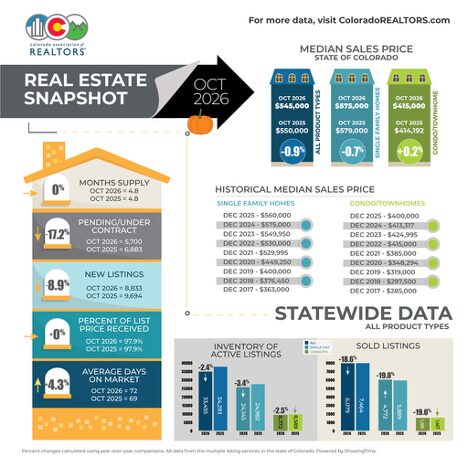
Statewide, 6,079 homes sold in October, down 18.6% from a year earlier, while pending contracts fell 17.2%, showing continued weakness in buyer demand heading into the final months of the year. New listings fell 8.9% and active inventory was down 2.4% to 33,455 properties. Despite the slowdown, the statewide median sales price dipped just 0.9% to $545,000, remaining relatively stable even as homes took longer to sell.
Single-family home sales declined 19%, with the median price slipping 0.7% to $575,000. Condo and townhome sales also fell 19%, although the median price edged up 0.2% to $415,000. Attached homes faced greater challenges, averaging 84 days on market compared to 68 days for single-family properties, with a 6.4-month inventory supply compared to 4.4 months for detached homes.
While year-to-date statewide sales are down 4.2%, October’s sharper decline highlights growing market pressures. With affordability falling 8.4% year over year, competitive pricing, seller flexibility, and improved purchasing power will be critical to restoring buyer confidence and housing market momentum heading into 2027.
“Although median prices remain flat, there are far fewer transactions happening. With Colorado ranked in the top 5 for sellers dropping prices, as well as the top 5 for homeowners selling below what they purchased the home for; Colorado is really setting the pace for a housing correction that needs to happen,” said Colorado Springs-area REALTOR® Patrick Muldoon. “Sellers are on borrowed time, and the markets do not care about the ‘net’ that may be needed. Prices are set by the consumer, and in this case, that is a buyer that would rather rent than buy because Front Range real estate is too expensive.
Total Market Overview – Statewide
Drilling down to the seven-county Denver-metro area housing market, October reflected a growing divide between relatively stable home prices and sharply declining sales activity, as affordability challenges and cautious buyers continued to shape market conditions.
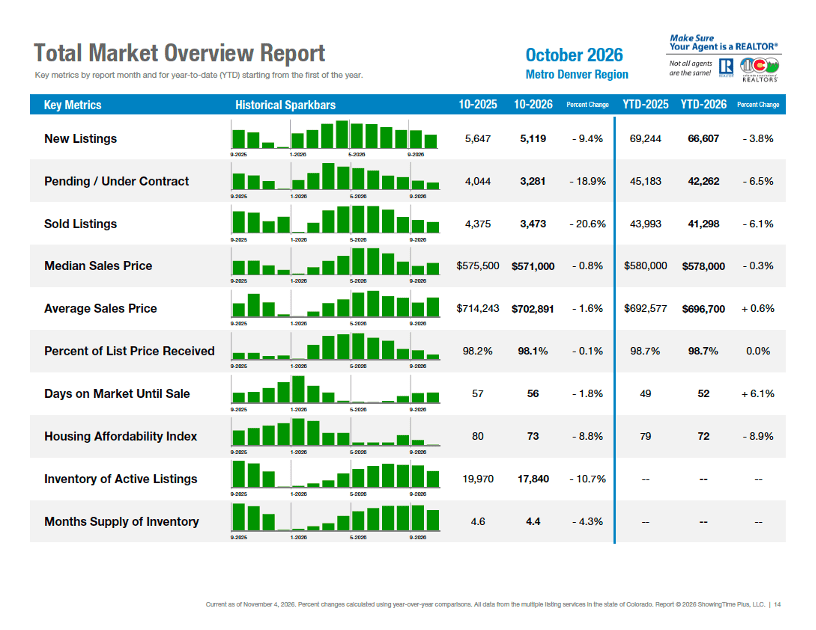
Closed sales fell 20.6% year over year to 3,473 transactions, while pending contracts declined 18.9%. Despite the slowdown, the median sales price dipped just 0.8% to $571,000, with the year-to-date median holding steady at $578,000.
Single-family homes demonstrated resilience, with a median price of $619,000, down just 0.9%, and 3.9 months of inventory. Condos and townhomes faced greater challenges, with 6.2 months of inventory and longer selling times.
Active listings declined 10.7% to 17,840 homes, while new listings fell 9.4%. Rather than an oversupply of homes, the market reflects buyers increasingly reluctant or unable to purchase at current prices and financing costs and sellers facing growing pressure to adjust expectations. Nearly 64% of October transactions included seller concessions, while 49% involved price reductions, and about 80% involved one or both, highlighting the importance of competitive pricing and flexibility in attracting buyers.
“That pressure is especially apparent in the negotiations preceding closing,” said Denver County-area REALTOR® Cooper Thayer. “Homes that eventually reduced their asking prices spent a median of 66 days on the market, compared with just nine days for those that did not. While these differences do not establish causation, they illustrate how consequential initial pricing expectations have become. October’s average sale-to-list-price ratio of 98.1% may appear reassuring, but it does not account for earlier asking-price reductions or the value of seller concessions. The final sale price tells us what a home sold for, but not necessarily what it took to get there.”
Total Market Overview – Seven-County Denver Metro
Colorado Housing Markets Snapshot – October 2026
Based on analysis from REALTORS® working in markets across the state
(for a more in-depth analysis by market, see full content in report below):
Boulder and Broomfield counties – Boulder and Broomfield home prices remain relatively stable, but longer selling times and growing seller concessions reveal a more challenging market. Approximately 52% of transactions include concessions averaging 5% of the purchase price, effectively reducing sellers’ returns. Homes average 44 days on market in Broomfield and 64 in Boulder, while condo and townhome prices have declined 8% and 3%, respectively. Buyer hesitation continues amid affordability concerns and economic uncertainty, giving buyers greater negotiating leverage.
Colorado Springs – October brought continued challenges for Front Range home sellers, with sales declining nearly 10% year over year and active listings increasing 1.5%. Despite relatively flat median prices, fewer transactions, growing price reductions and rising foreclosures signal continued market adjustments. Affordability remains a significant obstacle, with many prospective buyers choosing to rent rather than purchase. Until mortgage rates, wages and home prices reach a more sustainable balance, sellers will need to adjust expectations and price competitively to attract increasingly cautious buyers.
Denver Metro – October’s seven-county Denver metro housing market experienced a sharp slowdown, with closed sales falling 20.6% year over year to 3,473 and pending contracts declining 18.9%. Despite weakening demand, the median price remained relatively stable at $571,000, down just 0.8%. Active listings declined 10.7%, while nearly 64% of sales included seller concessions and 49% involved price reductions. With affordability challenges persisting, particularly for condos and townhomes, competitive pricing and buyer incentives remain critical heading into 2027.
Durango/LaPlata County – Durango and La Plata County’s housing market faces new uncertainty following devastating November flooding that damaged homes, roads and infrastructure, displacing hundreds of residents. Before the storms, inventory had returned to pre-pandemic levels, giving buyers greater negotiating power. October median prices declined 25% year over year for single-family homes to $670,500 and 30% for condos and townhomes to $478,000. Flood recovery, housing displacement, insurance availability and infrastructure repairs could significantly influence market conditions in the months ahead.
Evergreen/Foothills – Evergreen and Conifer saw increased sales activity in October, with 80 single-family homes closing, up 45% from September, reflecting stronger buyer activity in the previous month. However, half of those sales involved price reductions, and approximately half included seller concessions averaging more than $12,000. New contracts declined from 78 in September to 51 in October, signaling slowing momentum. Buyers remain active in touring properties, but competitive pricing and concessions continue to play a critical role in closing transactions.
Fort Collins – Fort Collins housing activity slowed significantly in October as higher mortgage rates and affordability challenges kept buyers on the sidelines. Single-family sales declined 32.6% year over year, with pending contracts down 30.5%, despite active inventory increasing 1.6%. The median price rose to $624,950. Attached-home sales fell 30.6%, while pending contracts dropped 38.1% and the median price declined 5.1% to $403,500. Renewed buyer confidence and more favorable mortgage rates will be critical to improving market activity.
Fremont County – Fremont County single-family prices were mixed in October. The median sales price slipped 3.2% to $319,500, while the average rose 9.7% to $356,485. Closed sales held steady at 58, and homes for sale eased 2.1% to 418, bringing months’ supply to 6.9, down from 9 a year ago. Homes took 78 days to sell, 14% faster than last October, and sellers received about 96% of list price. Supply is easing but remains a little above a balanced market.
Grand County – Grand County’s October housing market saw active listings increase 11.2% year over year to 652 properties, while pending sales declined more than 19%, reflecting softer buyer demand. The median listing price fell 5.9% to $799,000. Well-maintained, competitively priced homes continued to attract buyers, often selling within 30–45 days, despite significantly longer average market times. Granby and Grand Lake showed stronger single-family activity, while increased new-construction showings suggest renewed buyer interest heading into ski season.
Mesa County – Mesa County’s October housing market reflected mixed conditions, with new listings increasing 5% year over year to 306 and active inventory reaching 1,231 homes, representing a 5.2-month supply. Despite pending and closed sales declining more than 22% and affordability dropping 17%, median prices rose 7.4% and average prices climbed 11.4% to $502,444. With 70% of available homes priced above $400,000, elevated prices and mortgage rates continue to challenge buyers.
Pagosa Springs – Pagosa Springs’ October housing market saw inventory rise 15.2% to 286 homes, while the median sales price increased 18.6% to $575,000. Despite modest price gains, sales continue trailing 2025 as affordability challenges, elevated mortgage rates and limited moderately priced homes discourage buyers. Nearly half of sales involved price reductions, with concessions increasingly common. Recent flooding and significant highway damage have further complicated access for prospective buyers, reinforcing cautious market conditions heading into year-end.
Pueblo County – Pueblo County’s October housing market showed resilient prices but slower sales activity. The median single-family home price rose 5.5% year over year to $290,000, while closed sales declined nearly 20% to 129. Homes averaged 100 days on market, up from 96 last year. Active inventory fell 7.1% to 912 homes, representing a 5.7-month supply. Buyers have more time to negotiate, while competitive pricing and presentation remain essential for sellers navigating a slower market.
Steamboat Springs/Routt County – Routt County’s housing market rebounded in October, driven by renewed luxury sales in Steamboat Springs. Twenty single-family homes sold, with the median price rising 3.4% year over year to $2.22 million. Several high-end transactions ranged from $7.28 million to $13 million. However, year-to-date median days on market increased from 67 to 94. Condo and townhome sales rose 9.6% year to date, with median prices holding steady at $875,000, reflecting continued demand despite longer selling times.
Summit, Lake, and Park counties – Summit County’s October housing market continued to cool, with single-family sales declining 15.6% year over year and average prices falling 2.5% to $2.28 million. Condo and townhome sales dropped 10.9%, while average prices declined 17.3% to $743,165. Multifamily inventory surged 31.2%, creating an 8.2-month supply and greater negotiating opportunities for buyers. As ski season approaches, sellers face increased competition, making competitive pricing, property condition and location increasingly important in attracting buyers.
Telluride – The Telluride regional housing market slowed in October, with San Miguel County recording 39 transactions totaling $65.8 million, down 13% and 17%, respectively, from October 2025. Year-to-date dollar volume remains up 10%, despite a 7% decline in transactions. The average sale price was $2.9 million, below the year-to-date average of $3.6 million, reflecting fewer ultra-luxury transactions. Despite the overall slowdown, single-family and multifamily sales volume increased 8% and 16%, respectively.
Taking a more in-depth look at some of the state’s local market data and conditions, the Colorado Association of REALTORS® Market Trends spokespersons provided the following assessments:
BOULDER/BROOMFIELD COUNTIES
“Boulder and Broomfield home prices appear to be holding steady, but seller concessions and longer selling times tell a different story.
“At first glance, the Boulder and Broomfield real estate markets appear to be holding their own, with home prices flat or slightly higher than at the beginning of the year. But a closer look at the numbers reveals a market that is much tougher than the headlines might suggest.
“The biggest indicator? Seller concessions. Approximately 52% of all transactions in Boulder and Broomfield counties involve seller concessions averaging 5% of the purchase price. These incentives, often used to help buyers buy down their mortgage interest rates, are effectively reducing what sellers take home. In other words, homes may be selling close to asking price on paper, but many sellers are giving back roughly 5% to get the deal done. The market isn’t necessarily showing price declines, but sellers are making concessions behind the scenes. The real story is that buyers are paying less than the sales prices suggest, and sellers are feeling the difference.
“Broomfield continues to outperform its Boulder neighbor, with an average of 44 days on market compared to Boulder’s 64 days. However, those numbers can be misleading. Days on market are calculated from the most recent list price, meaning they don’t account for the weeks or months a home may have spent on the market before multiple price reductions. Homes are taking longer to sell than the statistics indicate, testing the patience of both sellers and their agents.
“The condo and townhome market is facing even greater challenges. Prices are down approximately 8% in Broomfield and 3% in Boulder. These properties are taking nearly twice as long to sell as single-family homes, largely because first-time buyers, who traditionally make up a significant portion of this market, remain especially sensitive to monthly payments and uncertain about making a major financial commitment.
“Higher interest rates, economic uncertainty, and geopolitical tensions surrounding the war in Iran have all contributed to buyer hesitation. Even sellers who price competitively and present their homes beautifully are finding that getting buyers off the sidelines is no easy task.
“Some of this correction was expected after the extraordinary appreciation during COVID. However, the depth of the slowdown has surprised many sellers and real estate professionals.
“With mortgage rates beginning to ease and the recent election behind us, there is hope that greater stability and renewed buyer confidence could bring more activity in the coming months. For now, the message is clear: This is a market where buyers have leverage, sellers have to be realistic, and the asking price is only part of the story,” said Boulder/Broomfield-area REALTOR® Kelly Moye.
COLORADO SPRINGS
“The squeeze continued for sellers through October leaving many sellers frustrated as sales dipped nearly 10% year over year and active listings rose 1.5% as we continue to see the real estate industry getting pressure from all sides.
“Many sellers continue to put greed in front of logic and buyers continue to put personal finances in front of home purchases. In the middle is an entire industry getting iced out of what was once a very busy market.
“Although median prices remain flat, there are far fewer transactions happening. With Colorado ranked in the Top 5 for sellers dropping prices, as well as the Top 5 for homeowners selling below what they purchased the home for; Colorado is really setting the pace for a housing correction that needs to happen. Housing markets in many parts of the United States are beginning to show corrections. The trend is negative with banks seizing 5,794 homes in August, a 42% increase over the previous year. Although low, the trend is not our friend if this continues.
“Foreclosures are on the rise with a dramatic uptick in volume, according to several media reports. Private equity defaults hit their highest level since 2008 at 40-50%, according to Jon Brooks on X. My opinion remains, the math will have its way and if wages don’t support prices something has to give. Whether rates drop, wages rise or home prices correct, this market is not maintainable in the long run if we are going to have housing available for the average American.
“Sellers are on borrowed time and the markets do not care about the ‘net’ that may be needed. Prices are set by the consumer, and in this case, that is a buyer that would rather rent than buy because Front Range real estate is too expensive,” said Colorado Springs-area REALTOR® Patrick Muldoon.
DENVER METRO (Seven County)
“October’s Denver-metro housing market highlights an increasingly important distinction between stable home prices and weakening market activity. Just 3,473 homes closed across the seven-county metro area, down 20.6% from last October, while pending contracts fell 18.9%. Yet the median sale price declined just 0.8% to $571,000, and the year-to-date median remains nearly unchanged at $578,000. Total sales are down a more modest 6.1% through the first 10 months of the year, making October’s slowdown particularly notable. Price stability does not necessarily indicate market strength. A home can retain much of its value while becoming considerably more difficult to sell, and October illustrates that distinction exceptionally well.
“Perhaps most revealing is that this slowdown is occurring alongside declining inventory. Active listings finished October at 17,840, down 10.7% from last year, while new listings declined 9.4%. Months’ supply of inventory actually decreased from 4.6 to 4.4. This is not a market overwhelmed by excess inventory. Rather, demand has weakened even as supply has contracted. Fewer listings may help support prices, but they do not automatically create competition among buyers constrained by affordability. Buyers don’t necessarily need more choices to gain negotiating leverage. Sometimes they simply need less competition from one another. The absence of an inventory glut should not be mistaken for the absence of pressure on sellers.
“That pressure is especially apparent in the negotiations preceding closing. Nearly 64% of October sales included seller concessions, approximately 49% had undergone an asking-price reduction, and about 80% involved one or both. Homes that eventually reduced their asking prices spent a median of 66 days on the market, compared with just nine days for those that did not. While these differences do not establish causation, they illustrate how consequential initial pricing expectations have become. Concessions are also increasingly important in helping buyers overcome financing and closing-cost constraints. October’s average sale-to-list-price ratio of 98.1% may appear reassuring, but it does not account for earlier asking-price reductions or the value of seller concessions. The final sale price tells us what a home sold for, but not necessarily what it took to get there.
“The divergence between single-family and attached housing remains significant. Single-family homes sold for a median of $619,000 in October, down just 0.9% year-over-year, while the year-to-date median remains unchanged at $625,000. With 3.9 months of inventory and an average of 52 days on market, this segment continues to demonstrate greater resilience. Condos and townhomes, meanwhile, have 6.2 months of inventory, an average of 71 days on market, and a year-to-date median price down 2%. Historically, a more accessible entry point into homeownership, attached housing faces growing affordability challenges from HOA dues, insurance premiums, and other recurring expenses. Unlike mortgage principal, many of these costs do little or nothing to build household wealth. Buyers are increasingly evaluating not just what a property costs to purchase, but what it costs to own, particularly in segments where monthly budgets are already stretched.
“October’s slowdown also deserves perspective beyond the usual seasonal explanation. Housing activity naturally moderates heading into winter, but October 2025 faced those same seasonal forces. The sharp increase in mortgage rates during September likely contributed to weaker activity, but the broader affordability problem has persisted for years. October’s Housing Affordability Index declined 8.8% year-over-year, despite relatively little movement in home prices. For all the attention given to whether values will rise or fall, the more consequential question may be how long transaction activity can remain this subdued. Fewer transactions have implications beyond individual buyers and sellers, limiting household mobility and reducing the turnover that brings existing homes back onto the market. The challenge heading into 2027 is not simply restoring confidence in home prices. It is restoring enough affordability and mobility for the housing market to function at a healthier level of activity,” said Denver County-area REALTOR® Cooper Thayer.
DURANGO/LA PLATA COUNTY
“Any news about Durango and La Plata County’s real estate market in October pales in comparison to what our communities have faced since November 1, when historic flooding began. Floods, mud and debris knocked out bridges and county roads, undercut major highways, and destroyed and/or flooded homes. Hundreds of residents were displaced, while others were unable to leave their subdivisions.
“Many of the homes affected by mud and water were not in traditional floodplains, meaning they had no flood insurance. Much of the damage was from creeks, where waterlogged ground couldn’t contain up to eight inches of rain received over a few days. On top of creek flow, mudslides occurred around the county, including one at Purgatory Resort that tore through the third floor of a condo complex.
“Whole subdivisions were flooded and inaccessible. Three subdivisions are mobile home parks, representing homeowners just able to squeeze into homeownership in Durango already.
“For many years, our county has increased its resilience and preparation for wildfire, but not for floods. Bridges were not built for as much debris as the creeks carried; water backed up and floods and muck diverted into neighborhoods.
“Before the storms began, buyers were gaining control over the real estate market overall. There were eight months of active listing inventory overall in September, +22% year over year for single-family homes and +25% year over year for condos and townhomes. Active inventory has finally climbed to the level of pre-COVID years, with condo/townhome inventory exceeding this. Our October market was still strong, with the number of sales in 2026 almost equal to 2025 year to date.
“Our county median in October was -25% year over year for single-family homes ($670,500 vs. $890,000) and -30% year over year for condos/townhomes ($478,000 vs. $685,000). The median swung almost as wildly up the month before. Currently, median price change has to do with whole-house affordability; the cost of mortgages, insurance and HOA fees has risen enough that it has caused buyers to purchase less costly homes. Sellers this time of year, seeking to capture buyers with less ability to purchase, are also lowering their prices beyond what they might have a year ago. It’s too early to put a finger on how much lower a home’s price is than earlier this year, if at all, and it would be regionally specific.
“How will the floods change the housing market? Will there be a change to a buyer’s priorities and choices in homes? Many places affected by the floods were super coveted locations in the county. Living on or near a creek can be a dream of buyers; maybe this will change, as it has with home buyers’ concerns about fire. The length of time it takes to fix our infrastructure will possibly be the most determining factor in where our housing market goes from here, which has to do with how much help is available at the state and federal levels to quickly get people back into their homes or a safe alternative. With residents scrambling to find shelter until homes can get repaired, a squeeze is already being put on our rental market. How will that affect people trying to save for a home? Will it become even harder to obtain homeowner insurance? There are many things left unanswered at this time, but we pick up our shovels and help our community dig out,” said Durango-area REALTOR® Heather Erb.
EVERGREEN/MOUNTAIN METRO
“The second wave of buyer activity we saw in the foothills in September carried through to October’s closing table. In Evergreen and Conifer, September’s single-family contracts were up 36.2% from a year earlier. By October, 80 homes closed across the two communities, up 45% from 55 in September.
“Last month, I wrote that buyers and sellers were beginning to find more common ground. In October, we could see what that meant in practice – an increase in closings. With the holidays approaching and a typically quieter stretch ahead, some sellers lowered their asking price enough to bring buyers back for a second look. In other cases, buyers and sellers could agree on the price once they worked out concessions before final closing.
“Those negotiations can be easy to miss in the headline numbers. October figures show that single-family homes in Evergreen and Conifer sold for an average of 99% of their final asking price. Yet among the 80 October closings, 40 showed a price reduction. About half of October’s single-family closing records also included a seller concession. That share was similar to a year ago, but among transactions that included a credit, the median rose from $10,000 to just over $12,000.
“As those sales closed however, fewer new agreements took their place. The number of homes going under contract in Evergreen and Conifer fell from 78 in September to 51 in October. Last fall, contracts rose from 62 to 73 over those same two months. The slowdown extended across the broader mountain metro area, where pending listings fell 9% from September even as closings held steady.
“What caught my attention heading into November is that showings per listing barely changed in either Evergreen or Conifer. Buyers continued to tour homes even as fewer made it to the contract stage. The election is now behind us, and Freddie Mac’s national average for a 30-year fixed mortgage eased from 7.32% on October 22 to 7.18% on November 5. I’ll be watching whether that modest improvement brings more buyers back to homes they’ve already seen. For sellers hoping to close before year-end, October offered a practical lesson in what can make a second look worthwhile: a price or a concession that gives a buyer reason to reconsider, or terms that make the purchase work for everyone,” said Evergreen-area REALTOR® Julia Purrington Paluck.
FORT COLLINS
“If one takes a quick glance at Fort Collins real estate statistics for October, it could be easily discerned that buyers decided to take the month off. Whether it was interest rates peaking at nearly 7.5% in October, hesitation due to mid-term elections, or just extreme buyer fatigue from months of less than stellar buying conditions, buyers were certainly lacking in every segment of the market. While buyers retain plenty of leverage, they also need the right opportunity to exercise it.
“In the single-family market, new listings were down 10.9% in October compared to October 2025; however, the decrease in new listings did not impact active inventory which was up 1.6% over the same period. This is where the problem lies – too many listings continue to linger on the market, and too few buyers are interested. Inventory should have peaked in August or September, but here we are in October with increasing inventory. Sold listings were down 32.6%, and pending sales were down 30.5% – an indicator that any kind of upward momentum in the detached market would be a Christmas miracle. Affordability plummeted nearly 12% based on the pop in interest rates and a counterinitiative increase in median value, up to $624,950.
“It was a similar story with the attached market where a 39% drop in new listings helped bring total inventory down 6.8%. Sales were down 30.6% compared to October 2025 and pending sales were down 38.1% over the same period. Like the detached market, this does not paint a rosy picture for the remainder of 2026. Median value retreated to $403,500, a 5.1% decrease. Higher HOA fees, higher insurance prices and lack of perceived value are either pushing buyers to different locations, or the low end of the detached market.
At this point, it’s going to take an above average November and December to make up ground lost in October to beat out figures from 2025. Not that 2025 is the benchmark, but improvement, rather than regression, is the goal. We will need a resurgence of buyer confidence aligned with more attractive interest rates to make this market move,” said Fort Collins-area REALTOR® Jared Reimer.
FREMONT COUNTY
“Fremont County single-family prices were mixed in October. The median sales price slipped 3.2% to $319,500, while the average rose 9.7% to $356,485. Closed sales held steady at 58, and homes for sale eased 2.1% to 418, bringing months’ supply to 6.9, down from 9 a year ago. Homes took 78 days to sell, 14% faster than last October, and sellers received about 96% of list price. Supply is easing but remains a little above a balanced market,” said Fremont County REALTOR® David Madone.
GRAND COUNTY
“Homes were still selling in October, but pricing and condition made a difference. Nice, well-maintained and competitively priced homes were often selling in 30–45 days or less, when the average market times often exceeded 120 days. Markets in Granby and Grand Lake had stronger single-family sales volume when compared to Winter Park and Fraser. The prices of many homes have seen huge price adjustments, making the buyer more interested in pulling the trigger and buying before years end.
“Grand County’s housing market saw active listings increase 11.17% year-over-year to 652 properties in October 2026, bringing total listings to 739. Buyer demand softened as pending listings dropped more than 19% year-over-year to 94, while new listings totaled 76. On the pricing front, the average listing price decreased 0.43% month-over-month to $1.05 million, while the median listing price held steady month-over-month at $799,000 (down 5.94% year-over-year).
“Fraser had the most closings in the county, and most were attached homes. Winter Park had the widest spread in days on market, from 42 days for a condo to more than 300 days for two higher-priced properties.
“Winter Park had only three closings with a median sale price of $1.67 million and 315 days on market. Fraser had eight sales with a median price of $525,000 and an average of 115 days on market. A single-family home sold for $2.05 million, and the rest were townhomes or condos. Tabernash had two sales at a median $1.1 million sale price and an average 132 days on market.
“Granby and Grand Lake had four sales each with Granby’s median sale price at $950,000. All were single-family homes with average days on market around 230 days. Grand Lake had a median sale price of $1.25 million and only single-family home was sold. Days on market ranged from only 32 days to 382 days.
“Granby is a good example of why sales volume and selling speed are worth looking at separately. It had slightly fewer closings than the prior summer, yet the single-family homes that sold, moved about a month faster on average. In the Winter Park area, the gap between resale townhomes at 62 days and new townhomes is now roughly 456 days and demonstrates how much pre-completion listings can affect market-time figures.
“The speculation of the builders is still positive and showings on new construction homes are up over September showings with more buyers coming into the market in anticipation of a good ski season,” said Grand County-area REALTOR® Monica Graves.
MESA COUNTY
“Mesa County is a picture of contradictions when you compare October 2026 to October 2025. New listings were up just over 5% at 306, bringing active listings to 1231, a 5.2-month supply. However, affordability is down 17%, both pending sales and solds were down more than 22%, yet median price was up 7.4% and average was up 11.4%. The average price for October 2026 was $502,444. Over one third of our sales were in the $500,000 – $999,000 range and 70% of active inventory is over $400,000. An interesting market for buyers to navigate, while interest rates continue to add to the challenge,” said Mesa County REALTOR® Ann Hayes.
PAGOSA SPRINGS
“October real estate market inventory and median sales price gains are in the shadow of the unfolding 2026 market ending. Month-over month increases for the Pagosa Springs market included inventory up. 15.2% at 286 homes, median sales price up 18.6% to $575,000, average sales price flat at $623,815, and number of days homes were on the market before being sold up 4.7 % at 177 days. Year-over-year modest increases included new listings up 3.3 % at 618 homes, median sales price up 8.6% to $613,500, average sales price up 2.3% to $733,963, and the number of days homes were on the market before being sold up 1.3% at 155 days.
Year-to-Date Median Sales Price: $613,500
Year- to Date Average Sales Price: $733,963
Inventory of Homes: 286
Months Inventory Supply: 9.5
Days On Market to Sell: 156
“The unshadowing 2026 real estate market reveals that even if the current 28 homes pending closed in 2026, sales numbers are shy 25 homes to match 2025-sales units. There was some buyer purchase momentum September through October however, not enough to catch up to last year’s numbers. A good number of buyers are not engaging in a purchase because they cannot find a home within their purchase qualification and monthly mortgage range.
“While it may seem the inventory of 286 homes on the market would allow the market units sold to catch up to 2025, the reality is most homes are priced well over the average and median prices and attract less buyer engagement. Homes priced $1-million plus have more than a year inventory awaiting buyers. Affordable homes priced under $400,000 are typically condos (with additional monthly HOA fees) and manufactured homes and not as attractive to either first or second home buyers. Homes priced $500,000-$600,000 typically require updating and on smaller, quarter-acre lots. New construction is hovering in the $650,000-$725,000 range, and not affordable to locals. These factors are positioning for a market with less buyers and sales.
“Today’s seller is participating because they have a need to do so and have adapted to the fact that homes are not selling quickly. A good number of sellers are disengaging rather than showing signs of distress by reducing their price. The sales numbers do not consider the number of sellers who simply decided not to renew listings or withdrew their homes from the market. About half of sales included price reductions and even more with seller concessions, setting the stage and importance to price property to entice a sale and reevaluate the market trends monthly.
“And then came, the two, 100-year floods in Pagosa Springs, that occurred within a week of each other. Typically, moisture this time of year brings welcomed snow. Not this time. Warmer than normal temperatures brought heavy rain. The flood road damage will impact the end of year real estate sales, as out-of-state buyers are challenged and cannot travel into Pagosa Springs from east and west Highway 160 due to astonishing sections of roads and bridges washed away. Those buyers that drop in from Highway 84, rather than flying into Durango, have longer drive times as they are also experiencing flood road damage with single-lane traffic. Most homes were not affected by the flooding. However, the impact on the entire community is real because of road damage and non-visitor travel to the community. Add elevated interest rates creating high mortgages, cost of living expenses, and ongoing affordability challenges resulting in many buyers leaning into a common wait and see scenario. Yet, patient buyers and sellers willing to negotiate still find opportunities,” said Pagosa Springs-area REALTOR® Wen Saunders.
PUEBLO COUNTY
“The October 2026 real estate numbers for Pueblo County tell an interesting story. While home prices are showing some resilience, the pace of the market continues to slow, and buyers are taking a little more time before making their move.
“The good news for homeowners, the median sales price for single-family homes increased to $290,000, up 5.5% from October 2025. However, the average sales price dipped slightly to $295,557, down 0.4%. This tells us that while the middle of the market is holding steady, individual sales and price ranges are influencing the overall picture.
“On the other hand, closed sales took a noticeable step backward. Pueblo County recorded 129 single-family home sales in October, compared to 161 last year, a decline of nearly 20%. New listings also decreased 3.4%, with only 259 homes entering the market. Homes are also taking a little longer to sell. The average time on market increased to 100 days, compared to 96 days last October. Buyers are taking their time, comparing options, and making sure the numbers make sense.
“For buyers, there may be opportunities worth exploring. Mortgage rates have improved recently. Nobody can promise where they go next, but the numbers may look better than they did a month ago. Even a modest improvement in interest rates can make a meaningful difference in monthly payments and purchasing power.
“With homes averaging 100 days on the market, buyers may also have more time to negotiate rather than feeling pressured to make an immediate decision. Seller concessions, including credits toward closing costs, can help reduce the cash needed to get into a home.
“And don’t overlook the holidays. Fewer buyers tend to be shopping this time of year, which can mean less competition for the homes you like. While the rest of the world is shopping for holiday presents, you might be shopping for something with a much bigger front door.
“For sellers, pricing and presentation matter more than ever. Homes are selling for approximately 97.5% of their most recent list price, showing that properly positioned properties are still attracting serious buyers. However, today’s buyers are paying attention to value. Overpricing a home and hoping someone falls in love with it isn’t much of a strategy.
“Year-to-date numbers show a market that has been somewhat slower throughout 2026:
- New listings are down 5.2% compared to the same period in 2025.
- Closed sales are down 3.6%.
- Year-to-date median sales prices are down 3.2%, sitting at $305,000.
- Average sales prices remain virtually unchanged at $321,540.
- Average days on market have increased 4%, reaching 103 days.
“Interestingly, active inventory currently sits at 912 homes, down 7.1% from October 2025. Months’ supply is also down slightly, from 5.9 to 5.7 months. This suggests that while sales activity has slowed, the number of available homes has not increased compared to last year.
“With the recent election behind us, there may also be a greater sense of clarity surrounding the direction of the economy and housing policies. Whether that translates into increased consumer confidence and more real estate activity remains to be seen.
“Pueblo County’s real estate market isn’t necessarily a buyer’s market or a seller’s market. It’s a market that is demanding a little more strategy from both sides of the transaction. If home prices are holding relatively steady, inventory is actually lower than last year, and homes are taking longer to sell, the biggest opportunity in today’s market may just be having the patience and knowledge to recognize the right deal when it comes along. The market hasn’t stopped moving. It’s just asking buyers and sellers to be a little smarter about how they move with it,” said Pueblo-area REALTOR® David Ramirez.
STEAMBOAT SPRINGS/ROUTT COUNTY
“Routt County’s real estate market staged a fall comeback, as a wave of high-end closings in Steamboat Springs narrowed a price gap that had been widening all summer. Twenty single-family homes sold in Steamboat Springs compared to 19 in October 2025 with the median sale price up 3.4% to $2,215,250, lifted by a handful of high-dollar closings.
“Homes are taking noticeably longer to sell. Median days on market year-to-date rose to 94 from 67. Inventory has held essentially flat at 93 homes, and months’ supply of inventory tightened to 6.6 from 8, a sign that the slower pace isn’t letting unsold inventory pile up.
“The luxury market clearly woke up after a quiet midsummer with an 11,317-square-foot home selling for $13 million and three others ranging from $7.28 to $11 million. The $11 million estate previously sold in June 2025 matching its prior sales price and demonstrating sustained value within the market.
“The condo/townhouse market reveals 319 units sold in Steamboat Springs year-to-date (+9.6%), and the median price of $875,000 is unchanged from a year ago. New listings are down 8.5%, and months’ supply is up to 7.3 compared to 6.6 last October.
“Hayden, Clark, and Oak Creek/Stagecoach each saw 1–3 single-family sales in October. Oak Creek/Stagecoach and Clark each received two new listings. Hayden had six homes come to market which totals 55 new listings for the year, equal to last year. What is not the same is the absorption; the months’ supply for Hayden is 11.8 months whereas last year it was 6.3 months.
“If the pending pipeline holds, November should bring more of what September and October already showed: a luxury segment that’s clearly back in motion, even if it hasn’t matched last year’s mega-estate sales,” said Steamboat Springs-area REALTOR® Marci Valicenti.
SUMMIT, PARK AND LAKE COUNTIES
“While waiting for the mountains to turn white, our real estate market has been cooling on its own. October brought fewer sales, softer prices, and growing condominium inventory, giving buyers more choices and greater negotiating power as we head toward ski season,” said Summit-area REALTOR® Dana Cottrell.
Summit County – October 2026 compared to October 2025
Single-Family Homes
- Number of Sales: Down 15.6%, with 54 homes sold compared to 64 last October.
- Average Price: $2,279,245, down 2.5%, with a year-to-date average price of $2,302,805, down 5.3%.
- New Listings: Down 9.1%.
“Summit’s single-family market continued to soften, with fewer sales and slightly lower prices. Inventory remained relatively stable, declining just 1.3% to 220 homes. Properties averaging 80 days on the market, and sellers received 95.9% of their asking price. With a 6.2-month supply of homes, buyers have more room to negotiate, although well-priced properties in desirable locations continue to attract attention,” added Cottrell.
Multi-Family Homes
- Number of Sales: Down 10.9%, with 82 properties sold compared to 92 last October.
- Average Price: $743,165, down 17.3%, with a year-to-date average price of $1,023,933, up 11.8%.
- New Listings: Down 4.8%.
“The condominium market experienced a more pronounced shift, with the average sales price falling 17.3% and the median price dropping 10.6% to $675,000. Perhaps the most telling statistic is inventory, which surged 31.2% to 593 properties, representing an 8.2- month supply. While year-to-date average prices remain above last year’s levels, the growing selection of properties is creating increased competition among sellers. Location, rental opportunities, property condition, and pricing are becoming increasingly important factors in buyers’ decisions,” said Cottrell.
Park County – October 2026 compared to October 2025
- Number of Sales: 52
- Average Sale Price: $619,536
- New Listings: 350
Lake County – October 2026
- Number of Sales: 3
- Average Sale Price: $522,400
- Active Listings: 78
“As we wait for the first significant snowfall to transform our mountains into the winter wonderland that draws visitors from around the world, the real estate market is undergoing a transformation of its own. Buyers are becoming more selective, sellers are adjusting their expectations, and the balance of negotiating power is shifting in several market segments. The arrival of ski season may bring renewed interest in mountain properties, but the days of simply putting a home on the market and expecting a quick sale at top dollar are largely behind us. The white gold will eventually arrive, and with it, the excitement of another Colorado ski season. Whether that brings a flurry of real estate activity remains to be seen, but for buyers willing to explore their options, this season may offer opportunities that have been hard to find in recent years,” added Cottrell.
TELLURIDE/SAN MIGUEL COUNTY
“October Telluride regional market sales encompassing San Miguel County were a bit slower, bringing in $65.8 million across 39 transactions. The monthly year-over-year sales dollar volume was down 17% from October 2025, with the number of transactions down 13%. Year to date, dollar volume is up 10%, while the number of transactions is down 7%. The average price for all sales came in at $2.9 million, compared to the year-to-date average sales price of $3.6 million. That just means fewer ultra-high-end- home sales which make up about half of the dollar amount of sales for the month. The volume of both single-family and multi-family sales were up 8% and 16%, respectively,” said Telluride-area REALTOR® George Harvey.
The Colorado Association of REALTORS® Monthly Market Statistical Reports are prepared by Showing Time, a leading showing software and market stats service provider to the residential real estate industry and are based upon data provided by Multiple Listing Services (MLS) in Colorado. The October 2026 reports represent all MLS-listed residential real estate transactions in the state. The metrics do not include “For Sale by Owner” transactions or all new construction. CAR’s Housing Affordability Index, a measure of how affordable a region’s housing is to its consumers, is based on interest rates, median sales prices and median income by county.
The complete reports cited in this press release, as well as county reports are available online at: https://www.coloradorealtors.com/market-trends/
###
CAR/SHOWING TIME RESEARCH METHODOLOGY
The Colorado Association of REALTORS® (CAR) Monthly Market Statistical Reports are prepared by Showing Time, a Minneapolis-based real estate technology company, and are based on data provided by Multiple Listing Services (MLS) in Colorado. These reports represent all MLS-listed residential real estate transactions in the state. The metrics do not include “For Sale by Owner” transactions or all new construction. Showing Time uses its extensive resources and experience to scrub and validate the data before producing these reports.
The benefits of using MLS data (rather than Assessor Data or other sources) are:
Accuracy and Timeliness – MLS data are managed and monitored carefully.
Richness – MLS data can be segmented
Comprehensiveness – No sampling is involved; all transactions are included.
Oversight and Governance – MLS providers are accountable for the integrity of their systems.
Trends and changes are reliable due to the large number of records used in each report.
Late entries and status changes are accounted for as the historic record is updated each quarter.
The Colorado Association of REALTORS® is the state’s largest real estate trade association representing over 22,000 members statewide. The association supports private property rights, equal housing opportunities and is the “Voice of Real Estate” in Colorado. For more information, visit https://www.coloradorealtors.com.