



Colorado Homebuyers Return to the Market, but Carefully
February housing report shows contracts increasing, longer selling times as buyers remain price sensitive and negotiations define the deal
ENGLEWOOD, CO – Stronger homebuyer interest and engagement surfaced in February though conditions remain cautious and negotiation-driven across the Denver metro area and statewide housing markets, according to the February Market Trends Housing Report from the Colorado Association of REALTORS® (CAR).
SEVEN COUNTY DENVER METRO:
In the seven-county Denver metro region, pending contracts for all property types rose sharply year over year even as closed sales slipped and prices softened modestly, suggesting demand is improving but buyers remain selective and highly sensitive to affordability. Homes are taking longer to close and sellers are receiving slightly below list price on average, reinforcing the importance of realistic pricing and strong presentation.
PENDING/UNDER CONTRACT – SEVEN COUNTY DENVER METRO AREA
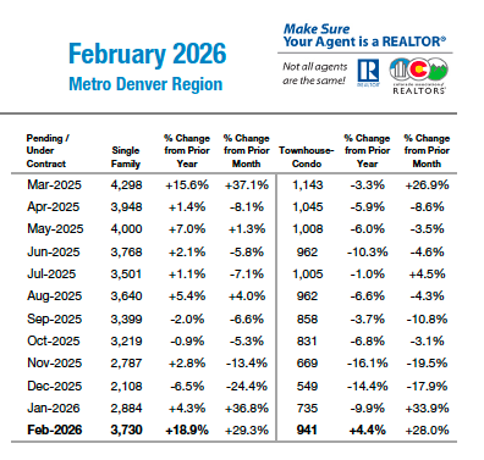
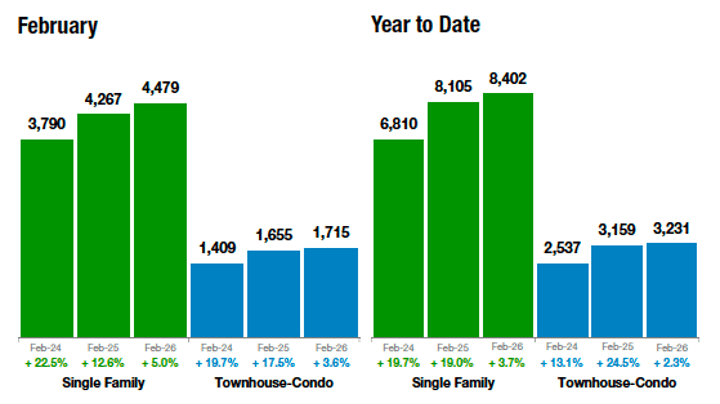
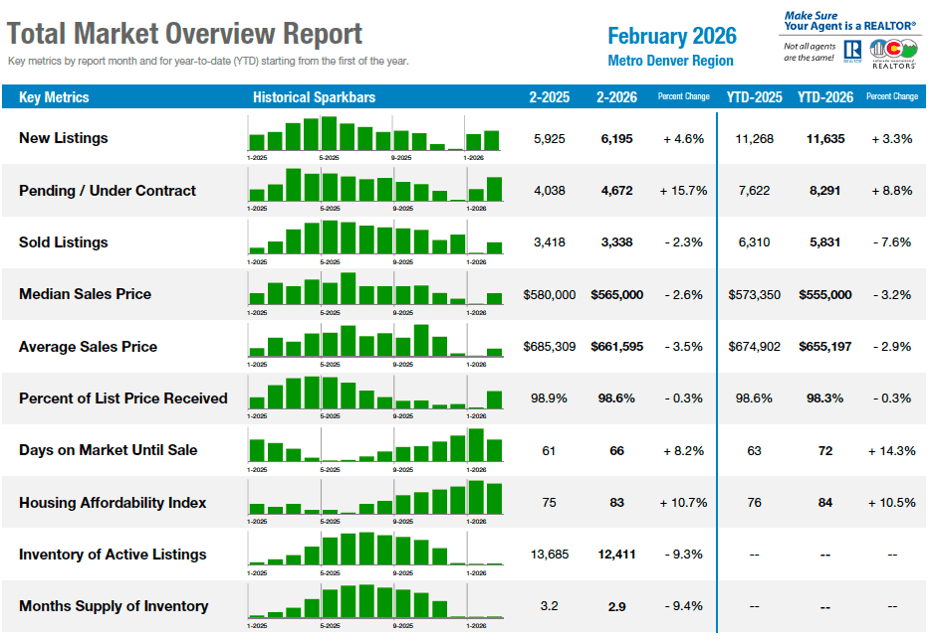
New listings across the seven-county Denver area rose 4.6% year-over-year to 6,195, while pending contracts jumped 15.7% to 4,672. Closed sales dipped 2.3% to 3,338, pointing to contract activity improving faster than closings something that can be “an early sign of stronger demand building beneath the surface, but not the kind of urgency that characterized prior-cycle markets,” according to Denver-area REALTOR® Cooper Thayer. “Buyers were more active throughout February but remain selective and highly payment-sensitive, stepping in where value, condition, and terms align.”
NEW LISTINGS – SEVEN COUNTY DENVER METRO AREA
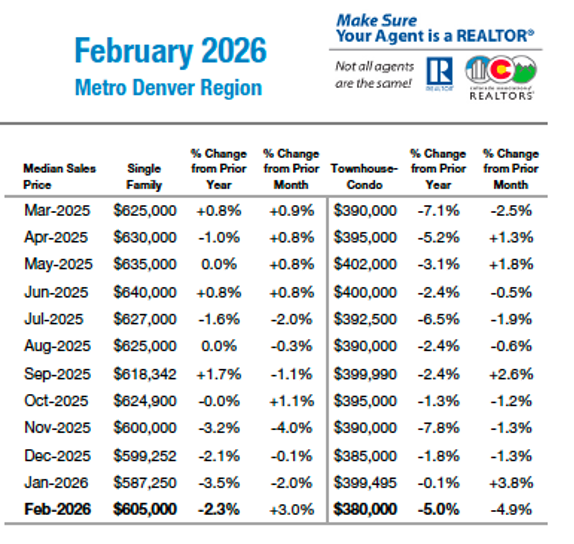
The recalibration continues with February’s median sales price of $565,000, down 2.6% from a year prior. In addition, homes took longer to sell, with average days on market rising to 66 as sellers received 98.6% of list price on average. At the same time, inventory remained below last year’s level with 12,411 active listings, equal to 2.9 months of supply. Homes priced realistically and presented well are still moving, while sellers anchored to prior expectations are facing more resistance and longer marketing timelines.
MEDIAN SALES PRICE – SEVEN COUNTY DENVER METRO AREA
Total Market Overview – Seven-County Denver Metro
STATEWIDE SUMMARY:
A similar pattern is emerging statewide, where new listings and pending contracts increased year-over-year as prices edged lower and average time on the market lengthened.
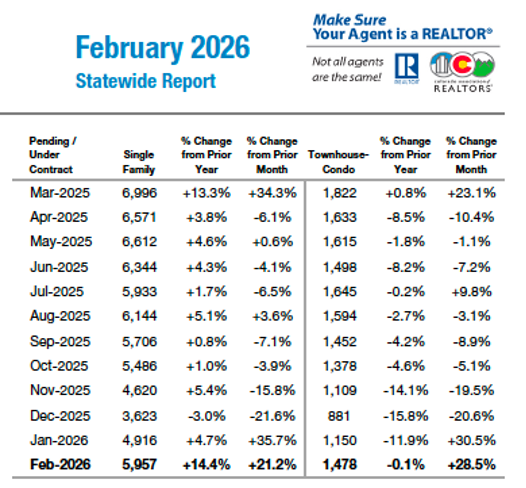
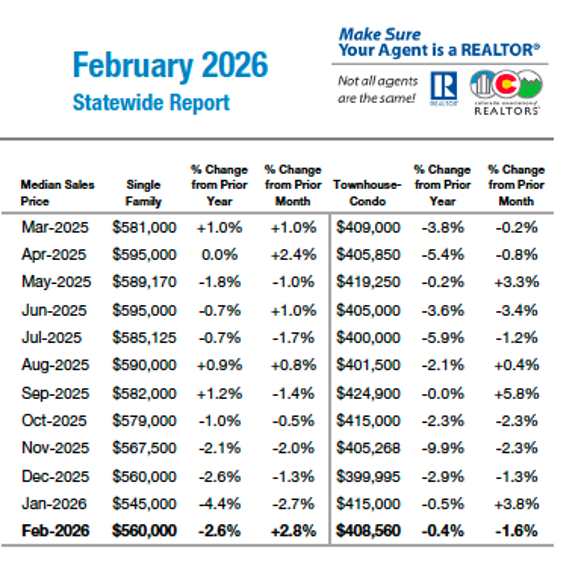
Statewide, new listings rose 5.6% year-over-year to 10,167, while pending contracts saw a nearly 12% increase to 7,571. February’s closed sales remained flat across the state compared to last year with 5,590. The median sales price slipped 1.8% from a year prior with sellers receiving an average of 98.3% of list price. Average days on market jumped 9.6% to 80 days compared to 73 days in February 2025.
NEW LISTINGS – STATEWIDE
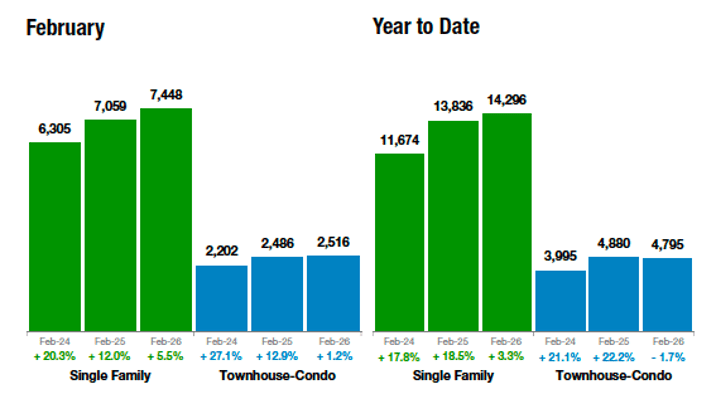
PENDING/UNDER CONTRACT – STATEWIDE
“March will be our first big test. Are sellers going to come back in force, at a measured pace, or not at all? Buyers cannot afford any further upward price creep, nor can they stomach potential prolonged multiple offer competition. Sellers must present well and price aggressively or risk lingering on the market. It’s a market that nobody seems to be comfortable with,” said Fort Collins-area REALTOR® Jared Reimer.
MEDIAN SALES PRICE – STATEWIDE
With interest rates remaining above the recent 6% threshold, coupled with broader economic uncertainties, including geopolitical tensions and rising energy prices, both buyers and sellers are approaching the market carefully as the spring season begins.
“The market will likely hinge on two factors: seller confidence and buyer affordability. With prices adjusting modestly and inventory still relatively tight in the single-family market, well-priced homes should continue to attract steady interest. However, buyers remain cautious, and sellers who price strategically and prepare their homes well will have the best chance of capturing early-season demand,” said Weld County-area REALTOR® Amy Tallent.
Total Market Overview – Statewide
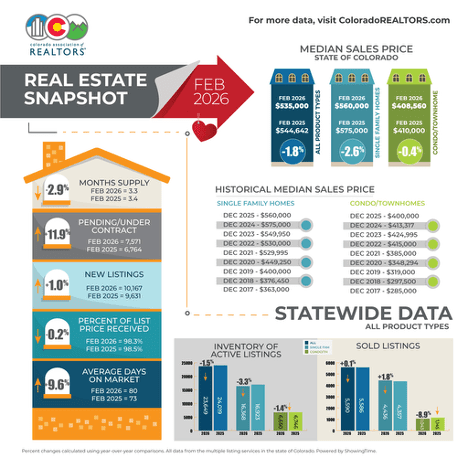
Colorado Housing Markets – February Snapshot
Based on analysis from REALTORS® working in markets across the state (for a more in-depth analysis by market, see full content in report):
Aurora – The Aurora, Centennial, Adams County, and Arapahoe County housing markets are showing mixed trends. While inventory has increased in some areas, the number of homes for sale remains relatively steady year over year. Median home prices, however, have dropped in most zip codes, making housing more affordable than it has been in the past five years. Biggest opportunities may be in the condo and townhome market, where prices have fallen and inventory has increased, giving buyers more choices and stronger negotiating power.
Boulder and Broomfield counties – The spring real estate market in Boulder and Broomfield counties is gaining momentum with encouraging signs for both buyers and sellers. Home prices remain similar to last year, while homes are spending about 89 days on the market, giving buyers more time to evaluate options. Well-priced homes—especially those under $800,000 in Boulder and $675,000 in Broomfield—are still attracting multiple offers. Meanwhile, condos and townhomes are slower to sell and seeing modest price declines due to rising HOA fees, creating added opportunities for buyers.
Colorado Springs –
February delivered an uptick in activity with home sales rising 4.1% year over year, though the broader market remains mixed. Home values declined 2.4%, inventory increased 12.1% and days on market rose for both single-family homes and townhomes, signaling softer pricing and more choices for buyers. Lower interest rates are helping support demand and builders are offering strong incentives. However, economic uncertainty, including a softening job market, rising debt levels, and global instability continues to create caution as the housing market moves through the year.
Denver Metro – The market showed stronger buyer engagement in February with new listings up 4.6% and pending contracts rising 15.7%, signaling improving demand even as closed sales dipped slightly. The median price fell 2.6% year over year to $565,000, and homes averaged 66 days on the market, reflecting a more negotiated environment. Single-family homes continue to lead activity, while condos and townhomes lag due to affordability pressures. With interest rates above 6% and economic uncertainty rising, realistic pricing and patience remain key.
Durango/LaPlata County – The housing market showed steady activity in February with single-family sales nearly identical to last year, while inventory is 18% higher and the median price rose 37%, driven by more high-end sales. Condo and townhome sales rebounded, doubling year over year, though inventory remains 37% higher than last year. Durango in-town sales were slow due to limited inventory, while Durango rural sales jumped 150%, as buyers looked for more affordable options outside city limits. The Purgatory resort market also saw increased condo activity.
Evergreen/Foothills – The foothills housing market showed renewed activity in February with increases in showings, new listings, and contracts, though many transactions are taking longer to close. In Evergreen, median detached home prices are around $940,000, with average prices just above $1 million, reflecting stability despite being slightly below 2024 peaks. Inventory growth is giving buyers more options and negotiating power. Mortgage rates remain the key factor influencing activity. If rates stabilize, the foothills market could see stronger sales momentum heading into the spring season.
Fort Collins – Many sellers held off listing ahead of the spring season, creating a slightly improved environment for buyers as lower interest rates supported affordability and prices remained stable. New and active listings declined across both single-family and attached homes, tightening supply. Median prices dipped slightly to $580,000 for detached homes and $416,000 for attached homes. With fewer listings and steady demand, competition could intensify if sellers don’t enter the market in greater numbers this spring.
Grand County – The early spring season delivers a more balanced outlook. Home values are slightly softer year over year but remain strong historically, generally ranging from the mid-$700,000s to low-$800,000s. Inventory has increased giving buyers more choices and negotiating power as homes take longer to sell. Sales activity remains steady, though bidding wars are less common than in recent years. Well-priced homes that show well are still selling, making strategic pricing and preparation key for sellers while buyers benefit from more time and flexibility.
Greeley – Greeley’s housing market remains active and balanced entering 2026, with steady demand and stable pricing. The median sale price reached $391,000, with homes averaging $397,540 and $214 per square foot, keeping the market relatively affordable along the Front Range. Inventory rose slightly to 180 active listings, while 112 homes closed and 113 went under contract in February. Homes are selling quickly, 17 days on market on average, and at about 99% of list price, reflecting strong buyer interest and sustainable 1.4% year-over-year price growth.
Mesa County – Mesa County’s housing market has had a challenging start to the year. Compared to last February, new listings rose slightly, but pending and closed sales fell 13.7%, with activity lower than in 2025 and 2024. Homes that did sell tended to be in higher price ranges, helped by slightly lower interest rates. The median sale price reached $416,250, with an average of $453,284. Most available homes are priced between $500,000 and $700,000, making interest rates a key factor influencing affordability and buyer activity.
Pagosa Springs – The housing market is seeing rising inventory, with new listings up 12.5% but sales slowed to 17 homes, down 32% year over year. Average price fell 19.4% to $696,670, while the median rose 10.8% to $695,000, reflecting strong activity in mid-priced homes and fewer high-end sales. Days on market increased to 136 days as inventory grows, particularly above the median price. Homes under the median are seeing strong buyer demand, while higher-priced properties face longer selling times and increased competition.
Pueblo County – Single-family listings rose nearly 10% year over year, increasing inventory to a 4.8-month supply. The average home price edged up to $329,000, with sellers receiving 97.9% of list price, while days on market dropped by seven days to 100, signaling improved movement. Although February sales dipped 3.2%, year-to-date activity remains ahead of 2025 after a strong January. Overall, the market remains balanced, with cautious buyers and stable interest rates shaping early-year conditions.
Steamboat Springs/Routt County – February 2026 saw a notable uptick in Steamboat Springs home sales, rising to 13 from just two a year earlier, though the average price declined to $2.4 million. Inventory reached 66 homes, representing a 4.6-month supply and about 99 days on market. Condo and townhome sales matched last year, but prices climbed, with the median up 10.3% to $917,500. Countywide, sales increased despite fewer new listings.
Summit, Lake and Park counties – Summit and Park counties housing markets remain steady despite shifting conditions. New listings declined, with single-family homes down 16.5% and condos/townhomes down 11.2%, while pending sales showed modest strength. Median single-family prices slipped slightly to $1.3 million, while attached homes rose 15.1% to $955,000. Inventory is gradually increasing, giving buyers more options as days on market rise. In Park County, sales remain modest but consistent, with buyers drawn by mountain views, open space and relatively more attainable prices near Summit County’s resort amenities.
Telluride – February 2026 showed higher total sales value but fewer transactions. Sales reached $72.1 million across 35 deals, an 8% increase in dollar volume but a 22% drop in total sales year over year. Compared to the five-year average, activity is still lower. Mountain Village continues to lead the market, with sales volume up 97%, while Telluride saw transactions fall 53% and sales value decline 26%. The rest of the county also experienced softer performance.
Vail – February brought a modest boost to the local real estate market despite economic uncertainty and the lowest snowpack in 47 years, which has reduced tourism and strained local businesses. Closed sales rose 24.5% year over year, though that reflects just 12 additional transactions, while pending sales also edged higher. Inventory increased 12.6%, with most listings above $1 million. While early-year performance is slightly stronger than 2025, the market’s outlook will depend on spring activity, broader economic conditions, and the ongoing drought impacting the region’s tourism-driven economy.
Weld County – The market entered 2026 with a mixed but stabilizing outlook. Single-family home sales rose 3.2%, though median prices fell 4.8% to $495,000 and homes are taking longer to sell, averaging 83 days. Inventory remains limited at 2.6 months of supply, supporting steady demand. The condo and townhome market saw larger slowdowns with both listings and sales down about 20% and prices dipping slightly. As spring approaches, buyer affordability and strategic pricing will likely determine which homes attract the strongest interest.
Taking a more in-depth look at some of the state’s local market data and conditions, the Colorado Association of REALTORS® Market Trends spokespersons provided the following assessments:
AURORA
“A new year brings a fresh look at what’s happening in the Aurora, Centennial, Adams County, and Arapahoe County real estate markets. Inventory has increased in many areas. Interestingly, it felt like there was a surge of new listings hitting the market in January and February however, the data tells a slightly different story. In most zip codes, the number of homes available for sale remained fairly steady both year over year and month over month.
“Pricing tells a different story. In nearly every zip code, with the exception of 80111, median home prices dropped noticeably. In fact, housing across Aurora, Arapahoe County, and Adams County is more affordable than it has been in the past five years,” said Aurora REALTOR® Sunny Banka.
Examples include:
- 80011 (Original Aurora):The median price for a single-family home is $412,000, down from $425,000 in January and $445,000 in December.
- 80013 (Central Aurora):The median price is $462,000, down more than $40,000 compared to one year ago and $13,000 lower than last month.
- 80015 (South Aurora):The median price is $550,000, down 4% compared to February 2025, but up $30,000 from just one month ago.
- 80016 (Southeast Aurora):The median price is $745,000, down 8% from 2025, down $10,000 from last month, and significantly below the May 2025 median of $812,000, which itself was already lower than the year prior.
“For buyers who have been waiting for an opportunity, this may be the perfect time to consider purchasing a luxury home in Aurora.
“The largest buyer opportunity right now may actually be in the condo and townhome market. Median prices in this segment have dropped sharply while inventory has increased across nearly every zip code,” added Banka.
- 80012 (Central Aurora):Median condo/townhome price is $191,000, down 34% from this time last year.
- 80015:Townhomes have a median price of $280,000, down 33% year over year.
“At the same time, condo and townhome inventory is up in every zip code, creating more options and stronger negotiating power for buyers.”
BOULDER/BROOMFIELD COUNTIES
“The spring real estate market in Boulder and Broomfield counties is beginning to gain momentum, bringing encouraging signs for both buyers and sellers. Buyers have been pleased to see that home prices in Boulder and Broomfield have remained about the same compared to this time last year, offering a sense of relief and affordability.
“Homes are currently spending more time on the market, averaging 89 days, giving buyers the opportunity to explore their options more carefully and make thoughtful decisions. This slower pace has helped restore balance to the market and reduced the urgency that defined previous years.
However, the market is not without pockets of intense activity. Certain well-priced and well-presented homes are once again attracting multiple offers and occasional bidding wars, particularly in high-demand price segments.
“Buyers appear to have adjusted to mortgage interest rates and are responding positively to this spring’s pricing environment. As a result, properties priced below the average price point of $800,000 in Boulder County and $675,000 in Broomfield County are selling at a noticeably faster pace. Many of these homes are receiving multiple offers and going under contract quickly.
“However, the townhome and condominium segment continues to lag behind the detached home market. Prices in this category have declined 5.6% in Broomfield County and 3.4% in Boulder County, largely due to rising homeowner association (HOA) fees driven by increased insurance premiums. These properties are taking over 100 days on average to sell, providing buyers with additional leverage, more time to evaluate options and opportunities to negotiate as sellers adjust prices to attract interest.
Overall housing inventory currently sits at approximately 2.5 months of supply, suggesting a relatively balanced market. Yet many buyers have been surprised by sudden bursts of competition for homes that are priced appropriately and show exceptionally well.
“The real estate markets in Boulder and Broomfield counties continue to reflect broader regional trends across Colorado, balancing moderated pricing with selective buyer demand as the spring homebuying season begins,” said Boulder/Broomfield-area REALTOR® Kelly Moye.
COLORADO SPRINGS
“February felt like the market had picked up, and local statistics supported that feeling. We posted a 4.1% year over year increase in sales.
“We also read numerous positive posts on social media, and many were asking if the sellers’ market was back. Despite the increase in actual sold inventory, our one-year change in values dropped 2.4% and we continued to add listings with a one-year change of +12.1%. Although homes did sell, and we had an increase in units sold, other indicators reflect softening home prices as inventory continues to build. Days on market also increased 9.8% for single-family homes and 24.3% for townhomes and condominiums. While some homes sold, overall, many sat while many other properties came to market.
“A report last month confirmed a 386,000 drop in December job openings, the lowest since September 2020. The job market continues to soften. We were also hit with negative news in the commercial market. Delinquencies on commercial mortgage-backed securities reached 12.3%, higher than the 2008 crisis. U.S. household debt hit new record highs as well and now sits at $18.8 trillion. And finally, we continue to see issues in the private equity markets. One hedge fund, Blue Owl Capital, halted investor redemptions at its retail private credit fund. Then shortly after, BlackRock did the same with one of its funds. Jamie Dimon stated that this felt like 2006/2007. Not something you want to hear coming out of the mouth of the JP Morgan Chase CEO.
“Overall, the softening of interest rates does seem to have helped with demand across our state. Buyers who can afford to buy have more inventory to choose from. New home builders continue to offer massive incentives to move their inventory. We currently have an issue with oil prices being on the rise, war in Iran and instability across the world. The news cycle is terribly busy, the economy is on the brink of dumpster fire, and the stock market seems to shrug most of this off. We should have quite a bit to talk about as we move through the year. My big take-way is the shadow banking world (hedge funds) are showing signs of stress, and we need to keep an eye on that sector,” said Colorado Springs-area REALTOR® Patrick Muldoon.
COLORADO SPRINGS
“In February, we noticed several indicators suggesting the single-family housing market is moving toward a more balanced state, benefiting both home buyers and sellers. The average price of homes decreased significantly, dropping 3.6% compared to both the previous month and the same month last year. However, sales surged by an impressive 21.4% month over month and 5.9% year over year. Additionally, the number of active listings increased 2.9% from the previous month and 20.7 % compared to the same month last year. Furthermore, the number of days homes spent on the market decreased from 74 days in January to 67 days in February,” said Colorado Springs-area REALTOR® Jay Gupta.
Key Data Points:
- Active Listings – Supply: February this year 2,926 homes compared to 2,425 last year and 2,843 in January.
- Sales – Demand: February this year 773 homes compared to 730 last year and 637 in January.
- Average Price: February this year $524,494 compared to $544,170 last year and $543,847 in January.
- Median Price: February this year $465,000 compared to $473,500 last year and $469,950 in January.
- Sales Volume: February this year $405,434,437 compared to $397,244,311 last year and $346,430,539 in January.
“The supply of homes remains healthy across all price tiers. The overall supply of single-family and patio homes was at 3.8 months, with 2.7 months for homes priced under $400,000, 3.7 months for those priced between $400,000 and $600,000, 4.4 months for homes priced between $600,000 and $1 million, and a generous 10.5 months for homes over $1 million.
“Homes priced between $400,000 and $600,000 dominated the sales, accounting for nearly 43% of all transactions, though this segment saw a 3% decline compared to the previous year. Properties priced under $400,000 accounted for 31.2% of transactions, while those priced between $600,000 and $1 million accounted for 22%. Luxury homes priced above $1 million comprised for 4% of total sales, down over 6% year over year.
“As inventory reached record levels, 31% of active listings in El Paso County and 21% in Teller County experienced price reductions. To avoid multiple price cuts, sellers must price their properties competitively from the outset. Additionally, properties must be well-maintained and presented attractively to draw in potential buyers,” added Gupta.
DENVER METRO (Seven County)
“The Denver Metro housing market showed a clearer pickup in buyer engagement in February, even as pricing remained soft and negotiation continued to define outcomes. New listings rose 4.6% year-over-year to 6,195, while pending contracts jumped 15.7% to 4,672. Closed sales, however, slipped 2.3% to 3,338, a gap that suggests contract activity is improving faster than completed closings. That divergence is often an early sign of stronger demand building beneath the surface, but not the kind of urgency that characterized prior-cycle markets. Buyers are active, yet they remain selective and highly payment-sensitive, stepping in where value, condition, and terms align.
“Pricing trends continue to reflect recalibration rather than renewed upward pressure. February’s median sale price came in at $565,000, down 2.6% from a year earlier, while the average sale price declined 3.5% to $661,595. Homes also took longer to sell, with average days on market rising to 66, and sellers received 98.6% of list price on average. At the same time, inventory remained below last year’s level at 12,411 active listings, equal to 2.9 months of supply. In other words, this is not an oversupplied market, but it is one where leverage is increasingly determined by execution. Homes priced realistically and presented well are still moving, while sellers anchored to older expectations are facing more resistance and longer marketing timelines.
“Single-family homes continue to carry most of the momentum, with pending contracts rising 18.9% year over year and inventory tightening to 2.5 months of supply, while the attached segment remains more constrained by affordability pressure, with closed sales down 12.2%, median prices down 5.0%, and average time on market stretching to 71 days. Looking ahead, the market also faces a higher level of uncertainty than it did just a few weeks ago. With global tensions rising, oil prices jumping, and interest rates remaining sticky above 6%, buyers and sellers alike are likely to stay cautious. If that uncertainty persists, expect the Denver metro market to continue rewarding patience, realistic pricing, and negotiated value over urgency or speculation,” said Denver County-area REALTOR® Cooper Thayer.
DURANGO/LA PLATA COUNTY
“Sellers were out in force again in February, following a busy January of single-family listings entering the market. Sold listings were just one sale off from last February, making for a year equivalent to what we experienced in 2025 with 61 sales this year-to-date vs 60 in 2025; and 95 new single-family listings YTD for both 2025 and 2026. The median price of single-family homes in La Plata County is up 37% over February 2025, influenced by almost double the number of high-end sales this February. There were 18% more single-family inventory presently than at this time last year.
“In the condo/townhome segment, it is good to see sales pick up after underperforming throughout much of 2025. Sales in this segment doubled to 26 from 13 in February 2025, while new listings are keeping pace with sales and helping with the correction. Still, there is 37% more condo/townhome inventory than a year prior. Days on market is down to 130 from the January high of 148 days.
“Of note, the Durango in-town, single-family market had a slow February with just two sales, but with seven pending listings, this number is expected to jump in March. This region has had 50% fewer sales year to date than at this time in 2025 but is mostly due to available inventory.
“Meanwhile, Durango rural has experienced a 150% jump in sales from February 2025, up 84% for the year to 15 sales. This can be attributed to both the lack of quality inventory available in-town Durango, as well as the price of that inventory, swaying current buyers to the more rural regions. Just escaping city limits by a few miles or minutes can result in large cost savings when purchasing a home in La Plata County.
“Our resort market near Purgatory has picked up with 33% more condo/townhome sales than February 2025 and two single-family sales compared with a quiet February 2025 with none. Months supply of inventory is down from its 10.9 months peak in January to 10.4 months,” said Durango-area REALTOR® Heather Erb.
EVERGREEN/MOUNTAIN METRO
“The foothills market showed clear signs of renewed activity in February, though transactions are still taking longer to reach closing. Showings, new listings, and contracts all increased across the region, reinforcing the sense among local agents that the market has become more active. At the same time, closed sales have not accelerated at the same pace, indicating that many transactions require more negotiation and time to close.
“Evergreen and Conifer continue to illustrate the overall stability of the foothills market even as conditions normalize from recent peak levels. In Evergreen, year-to-date median pricing sits near $940,000, with average pricing just above $1 million for detached homes. Price per square foot currently sits near $360, roughly 10% below the peak reached in 2024 but still well above pre-pandemic levels, suggesting the market is adjusting rather than declining.
“Across the broader foothills region, inventory has expanded modestly as more sellers enter the market ahead of the spring season. Buyers now have more options than during the tight inventory conditions of recent years, shifting some negotiating leverage back toward purchasers. Days on market have trended higher and list-to-sale price ratios have softened slightly, reinforcing a more balanced environment between buyers and sellers.
“Mortgage rates remain the most significant factor shaping buyer behavior. After dipping below 6% earlier this year, borrowing costs have shown renewed volatility amid broader economic uncertainty and rising energy prices. While rates remain below the peaks seen in 2023 and early 2024, the outlook for further declines has become less certain.
“For many agents across the foothills, the prevailing sentiment is that the market feels active even if transaction totals do not yet fully reflect that activity. Listings are attracting showings and contracts are being written, but transactions often require greater alignment between buyers and sellers to reach closing.
“Looking ahead, mortgage rates will likely remain the key variable influencing both sales activity and pricing across the foothills market in 2026. If borrowing costs stabilize near current levels, the increase in buyer engagement seen early in the year could translate into stronger sales during the spring season. However, further increases in rates could slow that momentum, reinforcing the cautious and negotiation-driven environment currently shaping many foothills transactions,” said Evergreen-area REALTOR® Julia Purrington Paluck.
FORT COLLINS
“Two months down and 10 more to go as REALTORS® in Fort Collins are hyper focused on inventory to gauge market direction in 2026. February was unique as sellers held back from jumping in the pool, waiting for warmer and more advantageous market conditions closer to the spring season. Across the board, buyers have a marginally better purchasing environment as lower interest rates have helped to increase affordability, while prices have remained steady.
“In the single-family detached home segment, new listings were down 15.6%, active listings down 16% and monthly supply was down 21.7% compared to last year. In 2025, the selling season started early, and it seems that sellers in 2026 are taking a more calculated approach. Median value dipped just slightly, down 1.3% to $580,000, as compared to February 2025. Days on market fell 4.4% to 87 days, confirming this year could be more competitive.
“The attached condo and townhome market tells a similar story, only at a greater magnitude. New listings were down 18.3%, active listings down 36.4% and monthly supply was down 34.4% compared to February 2025. Median value declined 1.1% to $416,000 compared to a year ago. Like the detached segment, days on market declined nearly 10%, showing that fewer listings and stable demand will drive up competition and accelerate the timeframe.
“March will be our first big test. Are sellers going to come back in force, at a measured pace, or not at all? Buyers cannot afford any further upward price creep, nor can they stomach potential prolonged multiple offer competition. Sellers must present well and price aggressively or risk lingering on the market. It’s a market that nobody seems to be comfortable with,” said Fort Collins-area REALTOR® Jared Reimer.
GRAND COUNTY
“Whether you’re thinking about buying your first Colorado mountain home, upgrading, or thinking about selling, a few clear trends are shaping how things are playing out this winter and into early spring across Grand County.
“Overall home values have been a bit softer compared to last year. Some large data sources show average or median pricing modestly down year-over-year, even as values stay strong compared to long-term historical levels. In certain reports, the median sale price has dipped slightly, while in other data shows prices roughly stable around the mid-to-upper $700,000 to low $800,000. This suggests the market isn’t crashing, it’s just not running away like it did in the peak seller markets of recent years.
“There’s more inventory than last year meaning buyers have more homes to choose from. Average days on market has stretched compared to recent tight market conditions, giving buyers a little more time and often more negotiating power, especially if a home has been on the market for a while or is overpriced. For sellers, that means pricing smartly and staging well is still crucial. Overpricing can lead to homes lingering on the market.
Sales volume through February looked steady, but not overly brisk. We had less snow and activity than normal on the slopes of Winter Park and Ski Granby Ranch. Sellers are unlikely to see multiple bidding wars on every listing like in the past but well-priced homes that show well are still selling.
If you’re a buyer in Grand County
- You don’t have to rush into a bidding war on every house you see.
- Take advantage of the longer decision window, check comps carefully, and make offers strategically. Many sellers are more open to negotiation than they were a couple of years ago.
- Getting pre-approved and working with local lenders and agents now can help you move quickly when the right home comes along.
If you’re a seller in Grand County
- This isn’t a panic market but it’s also not the ultra-hot, low-inventory market of a few years ago.
- Accurate pricing, strong photos, and prepping your property can make all the difference between a quick sale and a listing that lingers.
- Today’s buyers are savvy and they’re shopping across a range of price points and comparing options closely.
“Overall, Grand County’s early 2026 housing market feels balanced and pragmatic, not sliding, but not overheated either. Sellers who understand current pricing and buyers who are prepared with financing and flexibility are both finding opportunities. It’s a market where strategy matters more than speed, and where the right home at the right price still gets sold,” said Grand County-area REALTOR® Monica Graves.
GREELEY
“Greeley’s housing market is continuing to show steady demand and relatively stable pricing as we move into early 2026. While things have slowed a bit compared to the extremely competitive pandemic years, the market is still active with a healthy level of inventory and strong buyer interest. Overall, the market feels balanced right now, creating solid opportunities for both buyers and sellers.
“The median sale price for the month reached $391,000, with the average sale price around $397,540 and homes selling for approximately $214 per square foot. These figures suggest a market that remains relatively affordable compared with many other Front Range communities while still demonstrating stable price growth.
“Housing inventory in February included 180 active listings, with 139 new homes coming onto the market during the month. Despite the increase in available homes compared with previous years, the market continued to move at a healthy pace. February delivered 112 closed homes and another 113 under contract, as buyer activity remains strong and transactions continue to occur at a steady rate.
“Homes continue to sell quickly. Days on market was just 17 days, and sellers received an average 99% of their asking price, indicating that well-priced homes continue to attract strong interest. Even with a modest rise in inventory, these numbers suggest that demand remains healthy and buyers are prepared to act quickly when desirable homes become available.
“Looking at year-over-year trends, the market has experienced sustainable price growth. The median price increased 1.4% from $385,750 in February 2025 to $391,000 in February 2026. Rather than sharp price spikes, this gradual appreciation reflects a more stable and balanced market that supports long-term sustainability.
“Inventory has also risen slightly, with active listings increasing from 173 homes last year to 180 this year, giving buyers somewhat more selection than they had during tighter market conditions.
“For buyers, the slight increase in inventory provides a few more choices than in recent years, although competition can still be strong. Homes continue to move quickly, meaning buyers often need to be prepared to make competitive offers. Even so, Greeley remains one of the more affordable markets along Colorado’s Front Range,” said Greeley-area REALTOR® Liberty Montes.
MESA COUNTY
“It’s been a challenging early year for our housing market. Compared to February last year, new listings are up slightly however, pending sales and sold properties are down 13.7%. Looking back, pendings and sold sales were both lower in February 2026 than in 2025 and 2024, and just barely above 2023.
“Properties that did sell early this year have been in the higher price ranges thanks to the slight drop in interest rates. The median price was $416,250 and the average was $453,284.
“The largest percentage of available properties are in the $500,000 – $700,000 range for all property types which means lower interest rates are going to be a major factor for the average buyer in Mesa County,” said Mesa County REALTOR® Ann Hayes.
PAGOSA SPRINGS
“The housing market continues to show signs of higher inventory gains, up 12.5% with 54 new listings. However, our 17 sold listings were down 32% compared to the 25 sold February 2025. Average sales price compared to February 2025 was down 19.4%. February 2026 home sales were sluggish at 17 compared to 25 in 2025. Homes priced in the median sales range climbed in the number of homes sold, while homes priced higher than median and average sales prices declined. This factor represents the price sensitive buyers and falling average sales price. The median sales price climbed to $695,000, up 10.8% from February 2025, as some buyers adjusted their purchase expectations to higher prices.
Average Sales Price $696,670 (down 19.4%, over the 2025 price of $864,268)
Median Sales Price $695,000 (up 10.8%, over the 2025 price of $627,500)
Days on Market 136 (up 4.6%)
“With 194 current listings, including 158 homes, 36 townhomes/condos, a rising 55% are priced beyond the average and median sales prices. Pending February and current March sales indicated an uptick in buyers purchasing above $695,000. Historically, higher priced homes aggressively enter the market in April and May after the snow has melted, and home maintenance is accomplished. Pagosa Springs is already experiencing an early high inventory with more than 50 homes priced above $1 million. Total homes sold in 2025 in this price range was 60.
“Days on market will surely increase throughout 2026 if the higher inventory trend continues. Increased inventory presents concern for these sellers. They are competing for buyers and adjusting to the fact that their homes are on the market longer than most homes. Real estate brokers and sellers are working hard to secure showings with buyers. Sellers must have homes priced well, show-ready, well maintained and repairs completed and well staged. The are also looking at concessions and more frequent price adjustment analysis to make their home competitive in today’s market relative to high inventory. If more buyers in the higher price points do not engage in the market, then we will see a continuing average sales price decline and price adjustments.
“Spring inventory promises to arrive early for all price points as Mother Nature has given us a lighter volume of snow. The reality of home pricing in Pagosa Springs is that over half of the inventory is well over the current median home price. Homes priced under that threshold are receiving multiple and some above-list-price offers with active buyers in that price point and creating a sense of urgency for buyers. Buyers at higher price points have less sense of urgency due to increased inventory. Buyers continue to evolve into their purchase price and understand the value and beauty of rural southwest Colorado lifestyle living. Spring and summer buyers will set the Pagosa Springs market trend,” said Pagosa Springs-area REALTOR® Wen Saunders.
PUEBLO
“The Pueblo County housing market remained steady with slight signs of improvement. Comparing February 2025 to 2026, there was a near 10% increase in the number of listings of single-family homes from 299 to 328. Inventory of single-family home sits at a 4.8-month supply. Meanwhile, the average single-family home price rose from $326,500 to $329,000 as sellers received 97.9% of their list price. The most encouraging news came in the falling average number of days on market, down seven days to 100.
“Although we’ve enjoyed some optimism at the start the year, buyers remain cautious about entering the market. In February, the number of sold single-family homes fell 3.2% however, year to date numbers show we are still ahead of 2025, thanks to a strong January. Overall, buyers and sellers should rest assured the market is balanced and strong to start the new year as interest rates continue to hold steady as well,” said Pueblo-area REALTOR® David Ramirez.
Pueblo Housing Stat Highlights include:
Single-Family Homes: (Year over Year)
New Listings: 328 +9.7%
Median Sales Price $329,000: +0.08%
SOLD Listings: 149: -3.2%
Days on Market Until Sale: 100 Days: -6.5%
Months Supply of Inventory: 4.8 -7.7%
Single-Family Homes: (2026 Year to Date)
New Listings: 701 +6.2%
Median Sales Price: $299,000: -6%
SOLD Listings: 149: +2.9%
Days on Market Until Sale: 100 Days: +3.1%
STEAMBOAT SPRINGS/ROUTT COUNTY
“In February 2025, Steamboat Springs generated only two home sales with an average sales price of $3,112,500; February 2026 produced a marked increase with 13 sales at an average sales price of $2,402,038. Fifteen new listings came to market, equaling the prior year. With 66 homes currently on the market there is a 4.6-month supply, up from 3.9 a year ago. Sellers can expect about 99 days on the market before a sale.
“The condo/townhome market had the same number of transactions this year as last; however, the median price was up 10.3% to $917,500 and the average price was up 65.3% to $1,351,854. The multi-family segment of the market is where the new construction is happening, so it is not surprising that there is 43.5% more product for sale and 6.4-month supply of inventory. Sellers in Steamboat are receiving about 96% of their list price.
“In Oak Creek, the one sold home at $1.2 million was one more sale than last year. Going into March, only two homes have sold year to date, and one is under contract. Six new listings hit the market for a total inventory of 15 homes for sale and almost six-months supply of inventory.
“The Hayden market has only had three new home listings so far this year compared to eight last year. Like February 2025, the month delivered two sales with the average sales price down 8.1% to $625,000. There have been four closings in total so far with an average sales price $585,088. There are only 12 homes for sale accounting for a 3.9-month supply of inventory. Sellers can expect approximately 119 days on market until a sale.
“The first two months of the year for Routt County produced fewer new listings, yet an increased number of sales. It will be interesting to see what changes springtime in the Rockies brings to the real estate market,” said Steamboat Springs-area REALTOR® Marci Valicenti.
SUMMIT AND PARK COUNTIES
“If this winter has taught us anything, it is that Colorado mountain communities know how to adapt. While natural snowfall has been a little shy this season, the snowmaking teams at our local resorts have been phenomenal. The runs are groomed, the lifts are spinning, and visitors continue to arrive ready to enjoy everything the high country offers.
“In many ways, the real estate market is behaving the same way. Conditions may look a little different than the powder days of a few years ago, but the market is still carving steady turns.
“Across Summit and Park counties, the number of new listings dipped slightly compared to last year. Single-family home listings declined 16.5% while townhouse and condo listings were down 11.2%. Pending sales showed modest strength with 57 single-family homes and 90 townhomes or condos going under contract during the month.
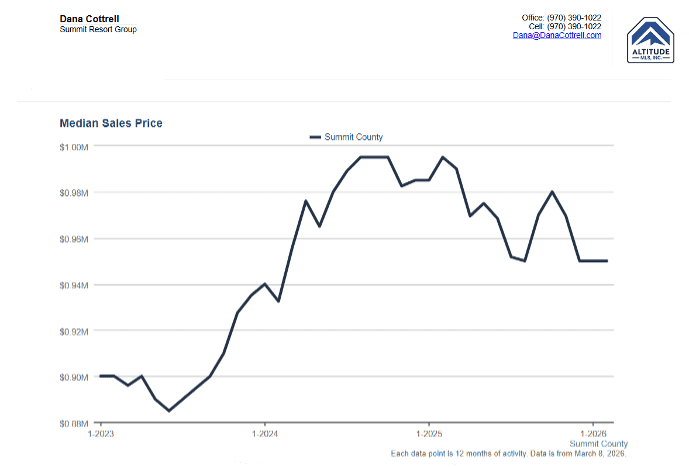
“Prices told two slightly different stories depending on property type. The median price for single-family homes eased just 1.5% to $1.3 million. Meanwhile the townhouse and condo market continued to climb with a 15.1% increase, reaching a median price of $955,000.
“Inventory continues to grow gradually, giving buyers more choices than they had in recent years. Active listings rose to 349 single-family homes and 562 townhomes and condominiums. This gradual increase is helping move the market toward a healthier balance between buyers and sellers.
“Buyers are also taking a little more time on the mountain this year. Days on market rose to 102 days for single-family homes and 139 days for multi-family homes. That is less a sign of weakness and more a return to normal market conditions where buyers can carefully evaluate their options before making a decision.
“In neighboring Park County, the market continues to move at its own steady pace. Six homes sold during February compared to eight last year, and new listings slipped slightly to 16 homes. The median price for the month came in at $412,500. As with many smaller markets, Park County numbers can swing from month to month depending on the mix of properties that sell.
“What remains consistent is the lifestyle appeal. Buyers seeking wide open spaces, mountain views, and a little extra breathing room continue to look toward Park County, especially those who want to stay close to Summit County’s resort amenities while finding more attainable price points.
“The takeaway for the mountain real estate market this winter is simple. Just like skiing a season with less natural snowfall, conditions may require a little more patience and a few adjustments, but the experience is still excellent. Buyers have more choices, sellers still benefit from strong long-term demand for mountain living, and the resorts continue to deliver outstanding conditions thanks to remarkable snowmaking and operations team.
“The lifts are spinning, the market is moving, and the Colorado high country remains one of the most sought-after places to live and invest,” said Summit-area REALTOR® Dana Cottrell.
Median sale price for all residential properties, including deed restricted properties from January 2023 through January 2026.
TELLURIDE/SAN MIGUEL COUNTY
“The overall county market for February 2026 has been improving in the dollar amount of sales with the number of sales continuing to drop. Dollar amount of sales was $72.1 million across 35 sales, up 8% in the dollar amount of sales year-over-year with a 22% decline in the number of sales. Compared with the five-year average pace, for January and February combined, the market is down 15% in dollar amount and down 23% in the number of sales.
“February showed that the Mountain Village continues to drive the market with the bimonthly number of sales flat at 21 and the year-to-date dollar amount of sales up 97% to $67.9 million. Telluride’s year to date deal count is down sharply at eight transactions, down 53% with the year-to-date dollars off 26% at $28.7 million. The remainder of the county is notably softer with the dollar amount of sales down 36% and the average price down 17%,” said Telluride-area REALTOR® George Harvey.
VAIL
“February was a pleasant surprise as it demonstrated some vitality despite macroeconomic news and the low snowpack which has reduced visitation in a significant fashion. We are still experiencing the lowest snowpack in 47 years which impacts the economy of our market across every segment. Obviously, the resort is being impacted significantly but the small businesses are being affected even more. The small businesses lack the capital reserves to cover the shortfall and many of them may not exist as the season ends.
“The current scenario impacts the upper end of the real estate market as visits are down and therefore, less second home buyers are available to maintain vibrancy in a key segment. The potential demise of some small businesses will impact the lower price niches as the jobs attached to those businesses disappear. When this occurs, we see a decline in local population which impacts the opening price point market.
“February was a stronger month than January for real estate which we believe was an adaption to the market and not necessarily a major sign of a future trend. As we wrap up the ski season over the next couple of months the trend will move accordingly.
“February was positive 24.5% in closed sales versus 2025. However, percentages can be a bit misleading in a small market like ours as it only represents 12 additional unit sales. On a year-to-date basis, closed sales are positive 1.8%. Pending sales are up 2.7% for the month versus 2025 and are up 7% year to date versus 2025.
“Inventory of active listings are up 12.6% and our 6.4 months of supply is up 12.3 %. Inventory is predominately in the $1million and above price points which coincides with the price niches that are generating the market sales performance.
“The market performance for the first two months is marginally better than 2025 and we will be watching closely the next two months to determine a trend as we take a short break in our shoulder season prior to the spring and summer market.
“The key negatives we must watch are macro-economic factors and what looks to be a major drought from the low snowpack. The drought looks to be a given and it has the potential of impacting the entire state as the mountains supply the water for the front range populace. The municipalities are working to create protocols to dramatically decrease water usage as the supply will not allow for normal water usage.
“The coming year is going to be impactful statewide to a degree not seen before,” said Vail-area REALTOR® Mike Budd.
WELD COUNTY
“The Weld County housing market started 2026 with a mixed but stabilizing outlook as both buyers and sellers adjust to shifting market conditions. February activity suggests that while new inventory is slowly entering the market, buyers remain price-sensitive and are taking slightly longer to make decisions compared to last year.
“In the single-family detached market, new listings were essentially unchanged year over year, increasing just 0.4%, while sold listings rose 3.2% for the month. Despite steady activity, pricing softened slightly as the median sales price declined 4.8% to $495,000, and the average sales price fell 4.5% to $555,305 compared to February 2025. Homes are also taking longer to sell, with days on market rising 10.7% to 83 days. Inventory levels declined 9.4%, bringing the months supply of inventory down to 2.6 months, indicating that while the market has cooled slightly, available homes remain limited relative to demand.
“The townhouse and condo segment saw more noticeable shifts. New listings fell 20.6%, and sold listings declined 20% compared to last February. Prices also softened modestly, with the median sales price decreasing 3.3% to $350,500, while the average sales price dropped 6.7% to $351,808. Homes in this segment spent slightly longer on the market as well, with days on market increasing 7.5% to 100 days. Inventory levels remained steady, but months supply increased to 4 months, giving buyers more options and slightly more negotiating room than in the detached segment.
“As Weld County heads into the spring selling season, the market will likely hinge on two factors: seller confidence and buyer affordability. With prices adjusting modestly and inventory still relatively tight in the single-family market, well-priced homes should continue to attract steady interest. However, buyers remain cautious, and sellers who price strategically and prepare their homes well will have the best chance of capturing early-season demand,” said Weld County-area REALTOR® Amy Tallent.
The Colorado Association of REALTORS® Monthly Market Statistical Reports are prepared by Showing Time, a leading showing software and market stats service provider to the residential real estate industry and are based upon data provided by Multiple Listing Services (MLS) in Colorado. The February 2026 reports represent all MLS-listed residential real estate transactions in the state. The metrics do not include “For Sale by Owner” transactions or all new construction. CAR’s Housing Affordability Index, a measure of how affordable a region’s housing is to its consumers, is based on interest rates, median sales prices and median income by county.
The complete reports cited in this press release, as well as county reports are available online at: https://www.coloradorealtors.com/market-trends/
###
CAR/SHOWING TIME RESEARCH METHODOLOGY
The Colorado Association of REALTORS® (CAR) Monthly Market Statistical Reports are prepared by Showing Time, a Minneapolis-based real estate technology company, and are based on data provided by Multiple Listing Services (MLS) in Colorado. These reports represent all MLS-listed residential real estate transactions in the state. The metrics do not include “For Sale by Owner” transactions or all new construction. Showing Time uses its extensive resources and experience to scrub and validate the data before producing these reports.
The benefits of using MLS data (rather than Assessor Data or other sources) are:
Accuracy and Timeliness – MLS data are managed and monitored carefully.
Richness – MLS data can be segmented
Comprehensiveness – No sampling is involved; all transactions are included.
Oversight and Governance – MLS providers are accountable for the integrity of their systems.
Trends and changes are reliable due to the large number of records used in each report.
Late entries and status changes are accounted for as the historic record is updated each quarter.
The Colorado Association of REALTORS® is the state’s largest real estate trade association representing over 23,000 members statewide. The association supports private property rights, equal housing opportunities and is the “Voice of Real Estate” in Colorado. For more information, visit https://www.coloradorealtors.com.