



Colorado housing market holds steady, but growing divide emerges between single-family and attached homes
Colorado’s housing market remained stable in July, but that stability camouflages an increasingly pronounced divide between single-family homes and condos and townhomes. Across both the seven-county Denver metro area and state, tighter inventory helped support single-family prices despite relatively flat sales activity, while attached properties faced weaker buyer demand, longer marketing times and softer pricing, according to the latest Market Trends Housing Report from the Colorado Association of REALTORS® (CAR). The conditions highlight markets where declining inventory is not a reliable measure of seller leverage. Property type, pricing and affordability play an increasingly important role in determining market conditions.
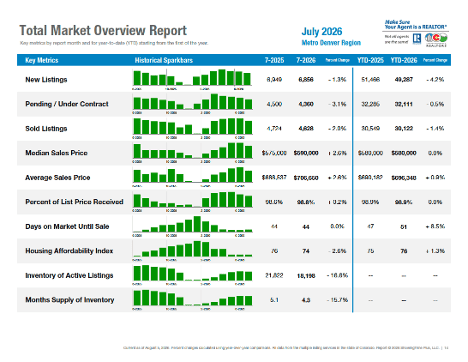
In the seven-county Denver metro housing market in July, there were 4,628 homes sold, down 2% year over year, while the median sale price increased 2.6% to $590,000 and active inventory fell 16.6% to 18,198 homes. Yet new listings, pending contracts and closed sales all declined, indicating that shrinking inventory reflects fewer sellers entering the market rather than accelerating buyer demand.
Active listings fell 19.3% to 12,704 and months’ supply dropped from 4.7 to 3.7, while pending contracts and closed sales were essentially flat. Despite little change in transaction volume, the median sale price rose 1.4% to $635,500. Single-family homes also sold relatively quickly, averaging 39 days on market.
Attached inventory declined 9.7%, but the segment still carried 6.4 months of supply. Pending contracts fell 12.4%, closed sales declined 8.1%, and the median price dropped 3% to $380,750. Attached homes averaged 63 days on market—24 days longer than single-family properties.
“The broader takeaway is that Denver metro remains stable, but that stability is increasingly dependent on what type of home is being sold,” said Denver County-area REALTOR® Cooper Thayer. “Fewer owners are bringing homes to market, which is tightening inventory overall, but the consequences are very different across segments. For single-family homeowners, constrained supply continues to insulate values even without stronger transaction volume. For attached sellers, lower inventory has not been enough to overcome weaker demand, longer marketing periods, more frequent price reductions, and greater affordability pressure. Buyers still have meaningful negotiating leverage across both segments, with concessions appearing in nearly two-thirds of July sales, but that leverage is especially visible in attached housing. For sellers, the headline decline in inventory should not be mistaken for a universal return of pricing power. Pricing, presentation, and an accurate understanding of the specific market segment remain decisive.”
Total Market Overview – Seven-County Denver Metro
The statewide Colorado housing market was also largely stable in July but, similar to the Denver-metro market, the data show a widening divide between single-family homes and condos and townhomes. With 7,934 homes sold across all property types in July, the results were unchanged from last July. Pending contracts dipped 0.3% and new listings increased 1.5%. The statewide median sale price held flat at $550,000, while the average price increased 3.3% to $726,149. Active inventory declined 7.8% to 34,694 homes, bringing overall months’ supply down from 5.2 to 4.8 months.
The single-family market saw July sales increase 0.6% to 6,317 and pending contracts rose 1.6% to 6,001. The median price increased 1.3% to $592,845, even as active listings fell 10.2% to 24,543 and months’ supply declined from 4.9 to 4.3. Homes averaged 53 days on market, only one day longer than last July.
Condos and townhomes faced greater pressure as contracts fell 10.5% to 1,458 and closed sales declined 3.8% to 1,480. The median sale price slipped 0.7% to $397,250, while homes took an average of 74 days to sell which is 11 days longer than last July and 21 days longer than single-family properties. Despite a 5.4% decline in active listings, attached housing carried 6.6 months of supply, compared with 4.3 months for single-family homes.
Total Market Overview – Statewide
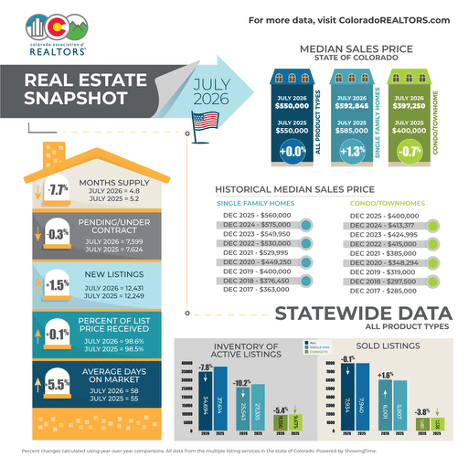
Colorado Housing Markets Snapshot – July 2026
Based on analysis from REALTORS® working in markets across the state
(for a more in-depth analysis by market, see full content in report below):
Aurora – Across Aurora, Centennial, Adams and Arapahoe counties inventory is down year over year but up from last month, while prices remain relatively steady. Centennial’s median home price rose 3.5% year over year to $710,000, while Adams County and Aurora sit at $507,000 and $520,000, respectively. Condos and townhomes remain strong entry points for buyers. Despite potential interest-rate increases, limited inventory should support pricing, with well-priced homes continuing to sell quickly.
Boulder and Broomfield counties – The Boulder and Broomfield housing markets remain steady with prices and inventory showing little change since the beginning of the year. Homes average 63 days on market in Boulder County and 45 days in Broomfield County, making accurate pricing essential for sellers. Condos and townhomes face greater challenges, with prices down about 4% this year. New Fannie Mae and Freddie Mac lending requirements could further limit qualified buyers and put additional pressure on condo prices.
Colorado Springs – The Pikes Peak housing market remained largely unchanged in July with median prices, sales and active listings near last year’s levels, though affordability concerns continue to weigh on buyers and sellers. Condos and townhomes face greater pressure, with new listings down 9.7% and pending sales down 9.5% amid rising HOA costs and tighter financing rules. With demand expected to remain slow through 2026, realistic pricing and local market expertise will be increasingly important.
Crested Butte/Gunnison – The Crested Butte and Gunnison market is tracking close to 2025 sales while dollar volume is higher due to increased luxury activity. Single-family inventory remains steady, but condo and townhome listings have surged, rising 29% region wide and more than doubling in Gunnison, creating opportunities for buyers. Price reductions are also increasingly common but rarely lead to immediate sales, underscoring the importance of pricing properties accurately from the start.
Denver Metro – The Denver-metro housing market remained stable in July but conditions varied sharply by property type. Overall inventory fell 16.6% while the median price rose 2.6% to $590,000. Limited supply continues to support single-family values, with the median reaching $635,500. Condos and townhomes face weaker demand, with prices down 3% and longer selling times. Buyers retain negotiating leverage as concessions appeared in nearly two-thirds of sales, making accurate pricing and market-specific strategies essential.
Durango/LaPlata County – The Durango-area housing market showed mixed results in July. Single-family sales fell 11% year over year, though they remain up 17% year to date, while median prices declined 11%. Condos and townhomes continued to outperform, with July sales up 33%, despite growing inventory. Purgatory Resort sales remain steady, but inventory and selling times have increased significantly. Rural Durango continues to outperform rural Bayfield, with year-to-date sales up 39% compared with 2025.
Evergreen/Foothills – The foothills housing market continued moving toward greater balance in July with buyers active but selective. Single-family sales fell 3.4% year over year but remain up 5.4% year to date, while inventory is near decade-high levels. Pricing remains relatively stable, though Evergreen and Conifer median prices are down 8%, partly reflecting a shift toward lower-priced sales. Homes offering the right combination of price, condition, location and convenience continue to sell most successfully.
Fort Collins – The Fort Collins housing market showed continued stability in July particularly for single-family homes. Despite fewer listings, single-family sales rose 13.3% year over year, and the median price increased 6.7% to $640,000. The attached market remained less consistent, with sales down 11%, though declining inventory and a $421,000 median price offered encouraging signs. Rising interest rates could pressure affordability and buyer demand heading into fall, making inventory, pricing and market activity important trends to watch.
Grand County – The Grand County housing market shifted toward buyers in July as inventory increased and negotiating leverage grew. Home values were down 1.4% year over year, while about 75% of sales closed below asking price. Winter Park, Fraser, Granby and Grand Lake remain desirable lifestyle markets, but buyers are increasingly focused on affordability, HOA fees and carrying costs. With more choices available, buyers can negotiate more effectively, while sellers must prioritize accurate pricing and strong property positioning.
Mesa County – The Mesa County housing market remained slow in July as inventory continued to grow while sales activity declined. Active listings have more than doubled compared with 2023, while year-to-date sales are down 6.7%, marking the lowest level in four years. The median price remains steady at $428,500, but homes are averaging 100 days on market. Buyers have more time and choice, while sellers increasingly need competitive pricing and market-ready properties to attract interest.
Pagosa Springs – The Pagosa Springs housing market remains highly segmented, with affordable, move-in-ready homes selling quickly while higher-priced properties face longer marketing times and greater competition. July’s median price was $637,000, down 4.6% year over year, while year-to-date sales are up 9.4%. Luxury homes are averaging 156 days on market, giving buyers greater negotiating power. With affordability still challenging and inventory elevated, competitive pricing, property condition and knowledgeable market guidance remain essential for buyers and sellers.
Pueblo County – The Pueblo County housing market showed signs of slowing in July with sales down 12.7% year over year and the median price falling 8.2% to $307,500. Homes are also taking longer to sell, averaging 102 days on market. Despite inventory declining 12.9% year to date, buyers remain selective and price-conscious rather than competing aggressively for limited supply. For sellers, accurate pricing from the start is increasingly critical as buyers prioritize value and wait for the right deal.
San Luis Valley – The San Luis Valley housing market remains highly localized in 2026. Rio Grande, Conejos and Mineral counties are showing strong sales growth, with year-to-date transactions up 32.8%, 100% and 60%, respectively. Saguache continues to see price appreciation, while Costilla has experienced increases in both listings and sales. Alamosa remains softer, with sales down 13.3%, median prices down 17.8% and longer marketing times, creating greater negotiating opportunities for buyers.
Steamboat Springs/Routt County –
Summit, Lake, and Park counties – The Summit, Park and Lake county housing markets delivered mixed results in July. Summit single-family sales rose 5% with prices largely steady, while condo sales declined 5.7% despite significant price gains. Park County sales remained flat as new listings increased 30%, while Lake County continued to experience volatility typical of a smaller market. Across the region, luxury remains prominent, with 43% of active listings priced above $1 million and buyers finding greater choice in select segments.
Telluride – The Telluride-area housing market posted a standout July with $102 million in sales volume, 69% above the five-year average, and 43 closings, up 30% year over year. Through July, dollar volume is 23% ahead of 2025 despite 7% fewer transactions, reflecting strength in the luxury market. Middle- and lower-priced properties face greater pressure from price reductions and rising borrowing costs, highlighting an increasingly divided market influenced by broader economic conditions.
Weld County – The Weld County housing market continued moving toward greater balance in July. New listings fell 6.8% year over year, closed sales declined 4.3% and the median price softened 2.7% to $500,000. Inventory also fell 12.2%, keeping supply relatively constrained. Homes that sold moved faster and received an average of 99.1% of list price, showing that well-priced properties still attract buyers. With buyers increasingly selective, strategic pricing and presentation remain essential for sellers.
Taking a more in-depth look at some of the state’s local market data and conditions, the Colorado Association of REALTORS® Market Trends spokespersons provided the following assessments:
AURORA
“For Aurora, Centennial, Adams County and Arapahoe County, the news is about the same. Inventory is down year over year however, it is up month over month. The median price is down month over month but is up slightly year over year.
“The median home price in Centennial has increased 3.5% from last year to a new median price of $710,000. For buyers, the good news is that the median home price is down slightly from June. With inventory down nearly 25% across all zip codes, home prices should stay steady. The best prices can be found in Adams County with a median price of $507,000 and in Aurora with a $520,000 median.
“Interest rates are anticipated to go up in September, and it’s possible that we will see home prices drop slightly however, with less inventory, I would be surprised if we see large drops in pricing.
“The best dollar value remains in the condo/townhome market. In Aurora, there are currently 1048 single-family residential listings. In Aurora, there are 732 active condo/townhome listings. The median price of a condo/townhome is $308,000 in Aurora and $430,000 in Centennial. Condos and townhomes are an excellent way to get into the market and right now, sellers are competing for buyers.
“Home ownership remains the easiest way to gain long term wealth. There are many sound lender deals out there and some sellers are willing to offer concessions to help buy down interest rates. It is a good time for buyers in many cases but important to know, the good ones still go fast. If sellers have their properties priced well and in good condition, they could be gone in just a couple of days,” said Aurora REALTOR® Sunny Banka.
BOULDER/BROOMFIELD COUNTIES
“The housing market isn’t exactly making headlines — and that may be the headline. The market isn’t crashing. It’s not booming, either. It’s chugging along. In Boulder and Broomfield counties, prices and inventory remain remarkably steady, with little measurable change since the beginning of the year. A modest number of homes are coming onto the market, and buyers are purchasing at roughly the same pace. Homes are taking an average of 63 days to sell in Boulder County and 45 days in Broomfield County. Prices are essentially flat, holding near where they started the year.
“For sellers however, the market is delivering a clear message: last year’s appreciation is not today’s pricing strategy. Sellers who price based on what they think their home should be worth are often sitting on the market for months — or not selling at all. In a market this measured, accurate pricing matters more than ever, making the guidance of an experienced REALTOR® a critical part of a successful sale.
“The condo and townhome market is facing a tougher road. Prices in that segment are already down approximately 4% since the beginning of the year, and new changes from Fannie Mae and Freddie Mac could add another layer of pressure. As of August 3, new lending rules make it more difficult for some condo projects to qualify for conventional financing. That could shrink the pool of qualified buyers for buildings that don’t meet the new standards, putting additional pressure on prices and making the financial health of a condo association more important than ever,” said Boulder/Broomfield-area REALTOR® Kelly Moye.
COLORADO SPRINGS
“The housing market continued to plug along in July across the Pikes Peak region, remaining essentially unchanged from last July in median price, sales and active listings. Still, the market feels slower to most agents, and this year’s business feels harder than last year. There is more tension, more anxiety—just more. I often joke that it takes the energy of five transactions from five years ago to close one today. Buyers and sellers both contribute to the disconnect: buyers continue to feel the pressure of unaffordability, while sellers often believe their homes are worth more than the market will support.
“The overall economy feels fragile, and most clients I work with agree with that statement. Everyday goods and services are too expensive. It takes more money for far less stuff. This is all creating real pressure and it is felt in our industry along with others. Social media shows the strain as well. Just food inflation is up 27.3% since 2021. Financial pressure is part of the overall trend and until consumers feel confident in their future, I worry the trend will continue to be a very stagnant real estate market.
“The real pressure in real estate right now is in the townhome and condo market. An area that was once considered entry level housing has now become almost a toxic asset as HOAs have to deal with ever increasing insurance costs and now Fannie Mae and Freddie changes their finance rules on condos. We can see this play out locally when we see new listings for townhome/condos down 9.7% and pending sales decreased 9.5%. I have a number of condos and townhomes on the market and the price reductions on those to get them sold while we try to compensate for HOA dues that have gone up 100% in some instances is a real issue.
“The remainder of 2026 is likely going to be slow as school starts, summer winds down and we head into the holidays. Sellers will have to be realistic to get their homes sold knowing buyer demand is slow and buyers continue to head to renting homes because home buying along with all other costs have become so unaffordable since 2020. REALTORS® are going to have to be very good at educating the public on their particular area and how that local economy is going or they will have listings with no buyers. I personally am hunkering down for what appears to be a long, cold winter in real estate” said Colorado Springs-area REALTOR® Patrick Muldoon.
CRESTED BUTTE/GUNNISON
“The real estate market in the Crested Butte and Gunnison area has been interesting in 2026. Sales continue to track very close to 2025 and dollar volume is up quite a bit due to more high-end sales. We anticipate more activity in August and September which are our busiest months for closings so that could push us ahead of last year, but it remains to be seen.
“Heading into the summer there was an expectation of increased inventory and that this inventory would create more sales as buyers who have been waiting on the sidelines step up to the plate when they see something they like. This has not come to be in quite the way we thought it would. The number of single-family homes for sale is hovering around the same number we had last summer. In some areas it is up one or two and in some areas it is down one or two, but nothing substantial. The condo and townhome market is where we are seeing a large increase in the number of properties for sale. In the overall Gunnison Crested Butte Association of Realtors area, the number of condos for sale is up 29%. In the north end of the valley that number is up 56%. In the Gunnison area it is up 106%! Since these represent the opportunity to get into the real estate market at the most affordable prices, the number of condos and townhomes under contract is also up and I would expect that to continue to rise through the coming months.
“It is getting more common to see price reductions on properties that have not had the interest they were hoping for. Since June 1, 2026, 186 properties have offered price reductions. Of those, 18 are now under contract and two have sold. Unfortunately, that tells us that reducing the price after the market tells you it is too high does not result in success very often. It is important to price your property honestly from day one and not wait to hear from the market that you got it wrong. Properties are still selling within 10% of the asking price when priced correctly so don’t miss out on the ‘new kid on the block’ momentum by asking more than your REALTOR® recommends. Now is the time to work with an expert to give you guidance through this complicated market,” said Crested Butte-area REALTOR® Molly Eldridge.
DENVER METRO (Seven County)
“July made the Denver-metro housing market’s split increasingly difficult to ignore. At the total-market level, conditions still look remarkably stable: 4,628 homes sold, down 2% from last July, homes averaged the same 44 days on market, and sellers received 98.8% of list price. Active inventory however, fell 16.6% to 18,198 homes, while the median sale price increased 2.6% to $590,000. Ordinarily, substantially lower inventory paired with higher prices would suggest strengthening seller leverage. The underlying numbers tell a more complicated story. New listings declined 1.3%, pending contracts fell 3.1%, and closed sales declined 2%, suggesting the inventory reduction is being driven more by fewer sellers entering the market than by accelerating buyer demand. The single-family market is where that constrained supply is having the clearest effect: active listings fell 19.3% to 12,704, months’ supply dropped from 4.7 to 3.7, and the median sale price increased 1.4% to $635,500, even as pending contracts and closed sales remained essentially flat. Single-family values are not being pushed higher by a resurgence in demand; limited supply is simply providing enough support to keep pricing remarkably resilient.
“The attached market is moving in the opposite direction. Condo and townhome inventory declined 9.7% from last year, but the segment still carried 6.4 months of supply in July, compared with just 3.7 months for single-family homes. Pending contracts fell 12.4%, closed sales declined 8.1%, and the median sale price dropped 3% to $380,750. Homes took an average of 63 days to sell, 24 days longer than the average single-family home. Nearly half, 49.8%, of attached homes sold in July had undergone a price reduction, compared with 36.5% of single-family sales. Concessions were also widespread across the market, appearing in 62.7% of July sales, with a typical concession of $9,750, or about 1.7% of the sale price. Attached properties were slightly more likely to include a concession, 64.3% compared with 62.2% of single-family sales, but the size of those concessions was more telling: the typical attached concession represented 2.1% of the sale price compared with 1.5% for single-family homes.
“The broader takeaway is that Denver metro remains stable, but that stability is increasingly dependent on what type of home is being sold. Fewer owners are bringing homes to market, which is tightening inventory overall, but the consequences are very different across segments. For single-family homeowners, constrained supply continues to insulate values even without stronger transaction volume. For attached sellers, lower inventory has not been enough to overcome weaker demand, longer marketing periods, more frequent price reductions, and greater affordability pressure. Buyers still have meaningful negotiating leverage across both segments, with concessions appearing in nearly two-thirds of July sales, but that leverage is especially visible in attached housing. For sellers, the headline decline in inventory should not be mistaken for a universal return of pricing power. Pricing, presentation, and an accurate understanding of the specific market segment remain decisive,” said Denver County-area REALTOR® Cooper Thayer.
DURANGO/LA PLATA COUNTY
“July was a sluggish month for single-family sales, which are 11% lower year over year, but expected given our higher-than-normal sales in previous months and our dip in pending contracts in June. Sales are still +17% in number year to date. The median price has dropped 11% year over year, pointing to both buyers choosing less expensive homes and a reduction in home value. Inventory is creeping up, meaning more choices for buyers, more competition for sellers, and thus pressure for each seller to make their listing stand out, whether its condition or incentives.
“The condo and townhome markets are continuing to have a banner year. Sales are up 33% year over year in July and up 22% year to date. Inventory continues to enter the market quicker than it is being absorbed by buyers though, leading to a growing supply of homes. Most of the county’s condo/townhome sales are in-town Durango, where there is now a six-month supply of inventory.
“Our Purgatory Resort area is having a year as strong as 2025, with little changing in the amount of sales. The median prices have dropped, reflecting that buyers are choosing less expensive inventory and with some price depreciation. The amount of time it takes a home to sell has increased significantly with the amount of inventory now on the market, rising to almost 17 months of inventory of single-family homes and 15 months of condo/townhomes currently available for sale.
“In other regional news, we continue to see rural Durango outperforming rural Bayfield in 2026. While both areas saw fewer sales in July year over year, rural Durango was less affected overall and has seen 39% more sales year to date than in 2025. Both areas saw the median decrease, -3% year over year in rural Durango and -16% in rural Bayfield,” said Durango-area REALTOR® Heather Erb.
EVERGREEN/MOUNTAIN METRO
“The Colorado foothills housing market continued to settle into a more balanced rhythm in July. Buyers remain engaged and overall sales activity has held up well this year, but the market is increasingly separating homes that offer strong value from those that do not. Today’s buyers have choices, and they are taking advantage of them.
“Across the broader foothills market, July single-family sales declined 3.4% from last year, while year-to-date sales remain 5.4% ahead of 2025. Perhaps more significant is inventory and days on market appear to be stabilizing at a healthier level. While active listings declined from last July, inventory remains near a decade-long high, giving buyers considerably more choice than they had during the exceptionally tight markets of recent years.
“That combination of healthier inventory and steady sales activity is helping balance the market with increasingly stable pricing. Monthly median prices continue to fluctuate, particularly in higher-priced foothills communities where sales mix can significantly affect the numbers but, rolling price-per-square-foot trends have been relatively flat. Rather than broad appreciation or a significant decline, the data increasingly points toward a market where individual property characteristics are determining outcomes.
“That choice is showing up clearly in buyer behavior. Showing activity remains healthy, but the widening gap between median and average marketing time suggests two very different experiences for sellers. Across the foothills, the rolling median is approximately 22 days in MLS, while the average is roughly twice that, with even wider gaps in Evergreen and Conifer. Homes that connect with buyers are still moving, while listings that miss on price, condition or location can linger considerably longer.
“Pricing tells a similar story. Price reductions are helping some homes generate renewed interest, but a reduction does not necessarily end the negotiation. Buyers with more choices are often negotiating again when they write the offer and, in some cases, seeking additional concessions or adjustments following inspection. Getting the initial price right remains important, but today’s sellers also need to be prepared for continued negotiation throughout the transaction.
“Evergreen and Conifer provide an especially interesting look at the changing market. Combined year-to-date sales are up 8%, even as the year-to-date median sales price has declined 8%. A closer look shows that part of the price decline reflects a changing mix of transactions rather than a uniform decline in property values. More activity is occurring at lower price points, while the very top of the luxury market has been quieter. At the same time, rolling price-per-square-foot figures have remained relatively stable.
“That distinction matters in a foothills market where a relatively small number of high-end transactions can move average and median prices considerably. Prices are normalizing but changing buyer preferences and sales mix are contributing alongside actual price adjustments. Buyers continue to favor homes offering the strongest combination of location, condition and value.
“Location is also playing a larger role. Homes closer to Evergreen, Conifer and major commuting routes are generally competing more effectively for buyers than comparable properties farther out. When inventory was scarce, buyers often had to compromise on location. With more choices available today, convenience and proximity to community amenities have regained importance.
As summer progresses, the foothills market is becoming more segmented and increasingly dependent on the individual property. Buyers remain active, but they are willing to wait for the right home, while sellers who understand where their property fits within today’s market are having the greatest success.
“For now, the Colorado foothills market is best described as balanced, active and increasingly selective, with enough inventory to give buyers choices and enough demand to reward sellers who get the fundamentals right,” said Evergreen-area REALTOR® Julia Purrington Paluck.
FORT COLLINS
“The Fort Collins real estate market saw another strong month in July as some stability seems to be sticking around which is a welcomed sign for consumers and real estate professionals alike. While the market isn’t as hot as the weather in these dog days of summer, it is still progressing and trending nicely as we head into the back half of 2026.
“Single-family homes in Fort Collins did a lot with a little. While new listings were down 5.4% from July 2025 and total active listings were down 11.4% over the same period, we were able to eek out 247 sales, up 13.3% from last year. Sellers will be happy to see that median value hit $640,000; while not a record, it is still 6.7% higher than July 2025 figures. Inventory levels are pulling back from their peaks and should begin to decline and follow seasonal trends. Buyer demand has remained stable, eating away at most of the inventory, creating a generally healthy balance in the single-family market.
The attached market fared relatively well, after having a few shaky months. It appears that the condo and townhome market is less stable but not completely scattered. New attached listings were down 21% and total active listings were down 28% from July 2025 levels. There were just 56 attached sales in July, down 11% from the same period last year. There are some silver linings to the data: monthly supply dropped to 4.0, which is indicating a much more balanced market moving forward, and median value popped up to $421,000 after some lightly depressed months. Days on market is creeping up near 100, which is indicative of the need for patience among home sellers, along with ‘right pricing’ their listing from the start.
“Affordability improved in both single family and attached markets in July however, with interest rates rising nearly three-eighths of a percentage point in the month of July, August affordability may begin to retreat. Sales figures and median values are also likely to be impacted as buyers, already strapped for cash, are squeezed a bit tighter. The real test will come after kids are back in school and the buzz of the summer wanes. While we still expect good activity, we are watching inventory closely, along with interest rates and buyer demand moving forward,” said Fort Collins-area REALTOR® Jared Reimer.
GRAND COUNTY
“Heading into July, Grand County inventory had already climbed to 522 homes for sale, up from 456 at the end of May, with 134 new listings arriving during June. The typical home value was about $757,900, down 1.4% year over year, while homes were taking about 29 days to go pending.
“One of the most important numbers for sellers is the sale-to-list relationship. The most recently reported ratio was about 97.9%, and roughly 75% of sales were closing below the asking price. Only about 7% were selling above list.
“Winter Park and Fraser remain among Grand County’s strongest lifestyle markets because buyers are purchasing access to skiing, trails, restaurants, and the resort experience—not simply square footage. Well-positioned condos, townhomes, and newer properties can still generate attention, but buyers are becoming increasingly sensitive to HOA costs, insurance, rental potential and overall monthly carrying costs.
“Granby continues to offer one of the broader ranges of opportunities—from primary residences to second homes and Granby Ranch Ski Resort properties. Buyers comparing Winter Park and Fraser often discover they can purchase considerably more home in Granby, which keeps the market attractive when affordability matters.
“Grand Lake remains a highly lifestyle-driven market. Lake access, views, walkability to town, proximity to Rocky Mountain National Park and quality renovations can make an enormous difference. It’s also a market where averages can be misleading because the mix ranges from smaller cabins and condos to significant lakefront and luxury properties.
“So, July 2026 wasn’t about Grand County losing value—it was about buyers gaining leverage. More homes are competing for attention. Buyers have time to compare Winter Park with Fraser, Granby with Grand Lake, and one condo development against another. That means sellers can still succeed, but pricing correctly from day one has become much more important.
“For buyers, this is one of the more interesting environments we’ve seen in several years. Instead of competing simply to win the property, buyers can increasingly negotiate price, inspection items, furnishings, and seller concessions.
“Grand County remains a lifestyle market. The mountains, lakes, skiing, and recreation haven’t changed. What has changed is the balance of power between buyer and seller,” said Grand County-area REALTOR® Monica Graves.
MESA COUNTY
“Mesa County inventory continues to grow and, with 115 active listings, we are more than double the active listings at this time in 2023. However, that is not reflected in sales volume. During July there were 249 sales of single-family homes and 34 condo/townhomes. That leaves total sales for 2026 down 6.7% year to date, the least amount of sold listings year to date in the last four years.
“The median price is holding at $428,500, and the average in July was $494,571. Average days on market has grown to 100, which means sellers have to be more market ready and priced well, and buyers have a better opportunity to consider a property without having to react immediately. It continues to be a slow market here and is challenging for both sellers and buyers,” said Mesa County REALTOR® Ann Hayes.
PAGOSA SPRINGS
“Buyer, seller and real estate professional engagement has never been more critical in today’s real estate environment. Median and average sales price buyers are struggling to purchase as most listings are entering the market beyond their affordability budget. Increased inventory of active listings and months’ supply of inventory are attributed to most listings inventory well over the median and average sales prices. The median to average sales price buyers pounce upon new listings, especially if they are move-in ready and have been seasonally maintained. Inventory in homes priced at or below the median and average prices and including homes with market price reductions-bringing homes into those price points are absorbed quickly. Price adjustments are not of abundance in the ‘comfort price point,’ as the main inventory exists in the higher price points. Like any home, buyers in all pricing structures gravitate to those homes that are competitively priced and in updated condition. Competitive pricing and home condition are the key to keeping sale time short.
“As the larger number of luxury higher priced ($1 million-plus) home inventory (82 homes) lingers on the market for longer periods, days on market and months of inventory have climbed to an average of 156 days (YTD). With the even larger number of homes priced $800,000-$2 million-plus, and apparently less buyers proceeding with caution toward a purchase, sellers must compete for a buyer. Buyers leisurely compare options, ask questions, and move at a slower and more thoughtful pace because of the high number of homes to choose from. Due to a sprinkling of showings and longer days on market, open houses and price corrections have set record numbers and are pacing with the lack of market demand for luxury-priced homes.
July Median Sales Price $637,000 (-4.6%) | $617,500 (year-to-date)(+9.9%)
July Average Sales Price $730,164 (+2.1%) | $726,702 (year-to-date)(+2.8%)
Months Supply 10 (same as July 2025)
“Compared to home pricing in other Colorado resort towns, Pagosa Springs’ home prices consistently remain strong and surging toward new highs. Local buyers are still finding housing affordability a major obstacle. Sellers who desire to find a replacement or move-up home in the median sales price are experiencing the same. Some sellers are cashing out of their second homes. This added some summer inventory gains. However, it depleted those equity buyers out of the Pagosa Springs real estate market.
477 New Listings (YTD 2026, up 7%)
221 Pending Sales (YTD 2026, up 3.3%)
198 Sold Listings (YTD 2026, up 9.4%)
“Cash sales continue to keep home sales prices strong as higher interest rates have little effect on cash buyers. Relative to higher monthly mortgage and not enough buyers, some home prices will continue to decelerate for sellers desiring to sell before the climbing average days on market. With the last quarter typically not as robust with buyer activity, the onset of winter home showing demands and a sale before the new year -more price adjustments will appear in the coming months. Less motivated sellers will remove their home from the market after listing expiration with anticipation of 2027 may be a better year to sell.
“Land inventory has climbed to 379 parcels. However, land buyers are moving at a much slower purchase pace than previous years -creating longer days on market, price adjustments and record lower sales volume numbers. Higher water/sewer district connection fees, escalation in well and septic systems rates and higher rural building costs are also discouraging land buyers who desire to build now. Higher land prices and increased water/sewer connection fees are also discouraging local home builders from placing new construction homes into the market, as their prices are hovering well beyond local purchase affordability. Most land sales are buyers purchasing land (securing a price while still semi affordable) with the anticipation of building in later years.
“Historically, the coming months inventory is not strong. Waiting for an interest rate dramatic drop can lead to missed opportunities and even higher home prices for buyers. Buyers and sellers have discovered that engaging with their real estate agent to understand the current market data is critical to achieve what they want to accomplish,” said Pagosa Springs-area REALTOR® Wen Saunders.
PUEBLO COUNTY
“The Pueblo County single-family home market is showing some interesting signs of a slowdown in 2026. In July, new listings were down 9.4% from last year, while sold listings dropped a more noticeable 12.7%. The median sales price fell 8.2%, from $334,950 to $307,500, and the average sales price declined 3.1% to $328,802. Homes are also taking a little longer to sell—102 days on market compared with 92 days last July. So, while buyers have fewer homes to choose from, they also appear to be taking their time. Apparently, ‘I’ll think about it’ has become a legitimate strategy.
“Year-to-date, the story is similar. Sales are essentially flat, down just 0.9%, while the median price is down 4.7% to $305,000 and homes are averaging 103 days on market. Meanwhile, inventory has actually fallen 12.9%, from 1,011 homes to 881, and months of supply has dropped from 6.0 to 5.4 months. That combination raises an important question: If there are fewer homes for sale, why are prices falling and homes taking longer to sell? The answer may be that today’s buyers are more selective, more price-sensitive, and less willing to chase a home simply because inventory is limited. In this market, pricing a home right from the beginning may be more important than ever—because buyers aren’t necessarily waiting for the perfect house; they’re waiting for the right deal,” said Pueblo-area REALTOR® David Ramirez.
SAN LUIS VALLEY
“The San Luis Valley real estate market continues to vary significantly by county in 2026, with some areas experiencing substantial increases in sales while others are seeing softer pricing and longer marketing times.
“Rio Grande County remains one of the strongest markets for transaction activity, with year-to-date single-family sales up 32.8%, from 61 sales in 2025 to 81 this year. The median sales price remains steady at $350,000, while available inventory has tightened, with July inventory down 18.7% and months’ supply falling 34.5% to 7.6 months. Conejos County has seen an especially notable increase in sales, with year-to-date closings doubling from 14 to 28. The year-to-date median sales price also climbed 11.8% to $285,000, while days on market improved slightly to 133 days.
“July itself was particularly quick for closed properties, averaging just 23 days on market compared with 122 days last July. Mineral County is also seeing stronger sales activity, with year-to-date closed sales up 60% and the median sales price increasing 16.2% to $453,000. Inventory has tightened considerably, with July inventory down 29.2% and months’ supply dropping from 10.2 months to 5.2 months. Saguache County has maintained the same number of year-to-date sales as last year at 44, while the median sales price has climbed 18.1% to $362,500 and average sales price is up 6.3%. New listings are nearly even with last year, down just 2.5% year to date, although homes are taking longer to sell, averaging 117 days on market compared with 94 last year.
“Costilla County is showing increased activity and more choices for buyers, with year-to-date new listings up 30.4% and sales up 19%. Prices remain relatively stable year to date, with the median sales price down just 2.1% to $235,000, while days on market have improved significantly, falling 25.6% to 125 days.
“Alamosa County is experiencing a slower 2026, with year-to-date new listings down 19.5%, sales down 13.3%, and the median sales price down 17.8% to $259,000. Homes are also taking longer to sell, with year-to-date days on market increasing 51.7% to 135 days and July months’ supply rising to 8.6 months.
“Overall, July’s numbers point to a highly localized San Luis Valley market: Rio Grande, Conejos and Mineral counties are seeing notable strength in sales activity, Saguache continues to demonstrate price growth, Costilla is seeing increased inventory and transactions, while Alamosa has shifted toward conditions that may provide buyers with greater negotiating power,” said San Luis Valley-area REALTOR® Megan Bello.
STEAMBOAT SPRINGS/ROUTT COUNTY
“Single-family sales in July 2026 mirrored July 2025 at 15 transactions, 30 new listings (vs. 34 the year before) and months’ supply at 9 months. The difference was the variety of homes that sold resulting in reduced median and average sale prices of $1.619 million and $2.205 million respectively. The average days on market until a sale was 72, copying the year-to-date stat and three days shy of where we were in 2025. With 121 homes on the market, 36 of them are listed above $5 million with a median list price of $9,212,500.
“New listings in Steamboat for multi-family were also similar to last year however, the trend is 16.2% less condos/townhomes new to the market than last year. Even with less inventory, more units sold in July and we’ve seen 15% more transactions this year. Like single-family, the median and average sales prices were less than July 2025, but year-to-date prices are up likely due to closings at the newly completed condo development, The Amble. Days on market until a sale are also comparable at 76 days, yet the months’ supply of inventory sits at 7.6 months.
“Activity in the rest of Routt County is lackluster with Hayden now showing a 14.3-month supply. Only one sale occurred for the period, a 40-acre ranch for $825,000. With 33 homes for sale, sellers who really want to sell sooner than later need to adjust their pricing and expectations. The activity in the Oak Creek/Stagecoach areas is like July 2025 with new listings, days on market and number of homes for sale. There have been more sales for the year, so months’ supply is less than previous at 8.2 months and the median and sales prices are also higher showing $980,000 and $1,391,042 correspondingly. Lastly, the Steamboat Lake/Clark region is quiet with one new listing coming on the market and one sale for the month at $850,000. Fourteen homes are on the market presenting a 7-month supply. The month of July historically has good buyer traffic and it will be interesting to see the August results,” said Steamboat Springs-area REALTOR® Marci Valicenti.
SUMMIT, PARK AND LAKE COUNTIES
“This July brought a mixed but active market: Summit County single-family sales edged higher while condo sales dipped, Park County held steady, and Lake County’s small market continued to show just how dramatically a few sales can move the numbers,” said Summit-area REALTOR® Dana Cottrell.
Summit County – July 2026 compared to July 2025
Single-Family Homes
- Number of Sales: Up 5%
- Average Price: $2,115,218, up 0.7%, with a year-to-date average price of $2,375,065
- New Listings: Up 4.3%
Summit’s single-family market remained remarkably steady on price, while inventory declined 13.7% from last July.
Multi-Family Homes
- Number of Sales: Down 5.7%
- Average Price: $1,234,162, up 43.2%, with a year-to-date average price of $1,050,876
- New Listings: Up 16.1%
The large increase in average condo price stands out, while the median price rose a more moderate 19.9% to $935,000.
Park County – July 2026 compared to July 2025
- Number of Sales: No change, with 16 sales in both years
- Average Price: $659,250, down 1.9%, with a year-to-date average price of $635,764
- New Listings: Up 30%
Park County’s median price told a somewhat different story than its average, rising 25.5% to $725,000. Inventory also increased 4.6% to 206 homes.
Lake County – July 2026
- Number of Sales: 16
- Average Price: $573,063
- Active Listings: 91
“Across Summit, Park, and Lake counties, 1,136 residential listings are currently on the market, ranging from an $70,000 mobile home in Park County to a $25 million Breckenridge home. More than 43% of all active listings are priced above $1 million, including 67 properties over $5 million. The average residential list price across the region is $1,622,875.
“In July, 144 residential properties closed, ranging from a $90,000 mobile home in Park County to a $6,300,000 home in Breckenridge. Approximately 53% of all sales closed above the $1 million mark, while 44% were cash purchases. Another 267 properties are currently under contract.
“July’s numbers are a little like a mountain trail: the market isn’t moving in one straight line. Summit County single-family homes showed steady sales and pricing, while its multi-family market posted substantial price gains despite fewer closings. Park County offered buyers more new inventory, and Lake County remained a small market where every transaction can make a noticeable difference. As summer reaches its peak and the wildflowers give way to the first hints of fall, buyers have more choices in some segments—but desirable mountain properties continue to command attention. In Colorado’s high country, both the scenery and the real estate market reward those who know where to look,” said Summit-area REALTOR® Dana Cottrell.
TELLURIDE/SAN MIGUEL COUNTY
“July was the clearest breakout month of 2026. County wide volume reached $102.09 million – the first July above $100 million in the last six years and 69% above the last five-year average. The 43 closings were also 30% more than in July 2025. Through seven months, the Telluride area (Sam Miguel County) has produced $494.09 million across 229 transactions. Dollar volume is now 23% ahead of last year despite 7% fewer transactions. Our market at the upper end is very healthy with an ample amount of wealthy and ultra-wealthy buyers. However, the rest of the market has seen a lot of price reductions in the middle to lower price ranges. Those buyers are more likely to need a loan and with interest rates increasing slightly every month this year to 6.67% for a 30-year fixed rate loan.
“Warren Buffet thinks the U.S. stock markets are overpriced and that is a warning. Warren has rarely been wrong. For better or worse, all real estate markets are tied to the overall economy. I’ve practiced real estate brokerage during the Great Recession and the pandemic boom and did not see either coming,” said Telluride-area REALTOR® George Harvey.
WELD COUNTY
“Weld County’s housing market in July showed a continued shift toward a more balanced and measured market compared with this time last year. Single-family new listings were down 6.8%, while closed sales decreased 4.3%. The median sales price also softened 2.7% to $500,000, and the average sales price declined 3.2% to $549,241. At the same time, homes that did sell were moving a little faster, with the average days on market dropping from 60 to 54 days. Sellers continued to receive, on average, 99.1% of their list price, showing that well-priced homes are still attracting serious buyers.
“One of the most notable changes is that inventory actually decreased 12.2% from July 2025, with 1,371 homes available for sale compared with 1,562 last year. Months of supply also fell from 3.7 to 3.3 months, suggesting that while buyers have more negotiating room than they did in the highly competitive years, the market is not experiencing an overwhelming amount of available housing. “Overall, July’s numbers point to a market where buyers are becoming more selective and sellers need to be strategic with pricing and presentation, but opportunities remain for both sides. Year-to-date, Weld County has seen 5.1% fewer new listings and 3.8% fewer closed sales, while the median sales price is down 3.7% from the same period last year,” said Weld County-area REALTOR® Amy Tallent.
The Colorado Association of REALTORS® Monthly Market Statistical Reports are prepared by Showing Time, a leading showing software and market stats service provider to the residential real estate industry and are based upon data provided by Multiple Listing Services (MLS) in Colorado. The July 2026 reports represent all MLS-listed residential real estate transactions in the state. The metrics do not include “For Sale by Owner” transactions or all new construction. CAR’s Housing Affordability Index, a measure of how affordable a region’s housing is to its consumers, is based on interest rates, median sales prices and median income by county.
The complete reports cited in this press release, as well as county reports are available online at: https://www.coloradorealtors.com/market-trends/
###
CAR/SHOWING TIME RESEARCH METHODOLOGY
The Colorado Association of REALTORS® (CAR) Monthly Market Statistical Reports are prepared by Showing Time, a Minneapolis-based real estate technology company, and are based on data provided by Multiple Listing Services (MLS) in Colorado. These reports represent all MLS-listed residential real estate transactions in the state. The metrics do not include “For Sale by Owner” transactions or all new construction. Showing Time uses its extensive resources and experience to scrub and validate the data before producing these reports.
The benefits of using MLS data (rather than Assessor Data or other sources) are:
Accuracy and Timeliness – MLS data are managed and monitored carefully.
Richness – MLS data can be segmented
Comprehensiveness – No sampling is involved; all transactions are included.
Oversight and Governance – MLS providers are accountable for the integrity of their systems.
Trends and changes are reliable due to the large number of records used in each report.
Late entries and status changes are accounted for as the historic record is updated each quarter.
The Colorado Association of REALTORS® is the state’s largest real estate trade association representing over 23,000 members statewide. The association supports private property rights, equal housing opportunities and is the “Voice of Real Estate” in Colorado. For more information, visit https://www.coloradorealtors.com.