



Colorado housing market tips toward buyers as sales decline, prices hold firm
Slower demand and longer selling times giving buyers greater negotiating power, putting pressure on sellers to price realistically as the market heads into fall
ENGLEWOOD, CO – Colorado’s August housing market shifted further in favor of buyers as slowing demand drove down sales and extended marketing times, even as home prices and overall inventory remained relatively stable. Closed sales fell 14.3% across the seven-county Denver metro area and 11.3% statewide giving buyers greater negotiating leverage and putting increased pressure on sellers to price realistically from the outset, according to the latest Market Trends Housing Report from the Colorado Association of REALTORS® (CAR).
Seven- County Denver-metro area
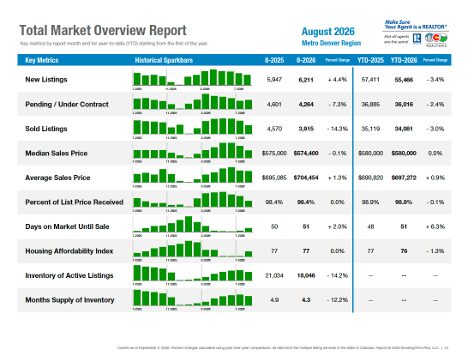
The seven-county Denver metro housing market shifted further in buyers’ favor in August as new listings increased 4.4% year over year while pending contracts fell 7.3% and closed sales dropped 14.3%. Despite softer demand, prices remained remarkably stable, with the median sale price essentially unchanged at $574,400. Active inventory also declined 14.2% from last year, underscoring that greater buyer leverage is being driven less by excess supply than by weaker demand.
Single-family homes continue to outperform attached properties, with August sales down 13.3% and median prices flat at $622,500, compared with a 18% decline in townhouse-condo sales and a 3.8% drop in median price to $375,000. Overall, buyers have more negotiating power and less urgency, putting greater pressure on sellers to price realistically from the outset.
“Across the seven-county Denver metro area, the imbalance between supply and demand has become increasingly difficult to miss. The disconnect is that a large share of sellers still appear to be entering the market with expectations better suited to a stronger demand environment, then adjusting only after buyers fail to respond,” said Denver-area REALTOR® Cooper Thayer. “Interestingly, the shift toward buyers has happened without the kind of inventory glut or broad price deterioration people often associate with a buyer’s market. Buyers are in control right now, and the sellers who accept that before they list are likely to have a much easier path than those who spend the first several weeks of their listing waiting for a market that no longer exists.”
Total Market Overview – Seven-County Denver Metro
Statewide
Statewide, the housing market continues to favor buyers with slowing sales and longer days on market as home prices remained stable. Across all property types, new listings increased 2.4% year over year while pending contracts fell 3.7% and closed sales dropped 11.3%. Despite the pullback in buyer activity, the statewide median sale price held steady at $550,000, while homes took an average of 65 days to sell, up 8.3% from a year ago. Active inventory fell 6.2% to 34,488 properties and, as a result, months’ supply of inventory also declined from 5.1 to 4.8 months with reduced buyer demand.
The divide between single-family and attached homes remains significant. Single-family sales fell 10.8% in August however, the median price slipped just 0.7% to $585,845 and inventory declined 8.3%. Townhome-condo sales fell 16.1%, with the median price down 0.6% to $400,000 and average days on market rising nearly 16% to 80 days.
Overall, the market remains balanced from an inventory standpoint, but slower demand, longer selling times, and slowing transaction volume are delivering greater buyer leverage and requiring sellers to be increasingly realistic about pricing and market conditions.
“Sellers are being asked to stay patient as homes took an average of 108 days to sell, up 13.7% from last year,” said Pueblo REALTOR® David Ramirez. “In other words, buyers appear to continue saying, ‘We like it… but we’re going to think about it for a while.’ Despite fewer homes being available, buyers aren’t exactly stampeding through the front door. So, if inventory is shrinking, prices are softening, and homes are taking longer to sell, are Pueblo buyers becoming more selective, or are sellers still pricing at yesterday’s market while buyers are shopping in today’s?” asked Ramirez.
Total Market Overview – Statewide
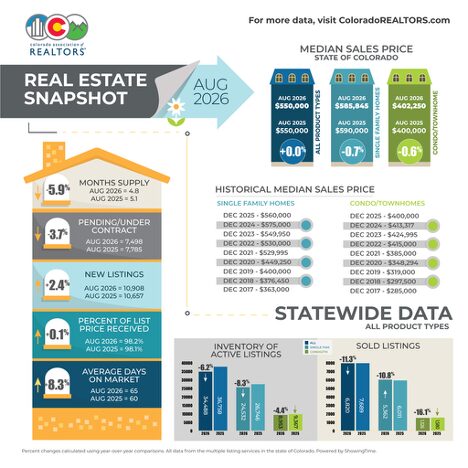
Colorado Housing Markets Snapshot – August 2026
Based on analysis from REALTORS® working in markets across the state
(for a more in-depth analysis by market, see full content in report below):
Aurora – The Aurora/Centennial market continues to favor buyers, with fewer buyers, abundant inventory and mortgage rates above 7%. Buyers have more choices and negotiating power, including opportunities for price reductions and seller concessions. Prices are down 3% to 13%, depending on ZIP code, with Aurora’s median at $525,000. Condos and townhomes also offer strong value. Sellers must adjust expectations: homes need to be competitively priced, well maintained and positioned to stand out in today’s market.
Boulder and Broomfield counties – Boulder and Broomfield housing markets continue to slow amid higher interest rates, affordability challenges and economic uncertainty. Boulder County listings are down about 10%, while prices remain flat and well-priced homes are selling in about 62 days at 98.5% of asking price. Broomfield is seeing more inventory but similarly flat prices as buyers remain cautious. Condos and townhomes remain the weakest segment, with values down about 5% this year as high HOA fees compound affordability concerns. Strategic pricing and seller patience remain critical.
Colorado Springs – While the median sales price is down just 1.1%, sales have fallen 7.1% across the Pikes Peak region, reflecting the affordability pressures weighing on buyers and the broader economy. Homes are seeing fewer showings, more price reductions and, in many cases, being pulled from the market. More buyers are finding renting to be the more affordable option and are willing to wait for either rates or prices to come down. This is no longer a seller’s market. Sellers need to price realistically for today’s conditions or be prepared for their homes to sit.
Crested Butte/Gunnison – August brought a five-year high for closings in the Crested Butte and Gunnison markets, but the outlook remains mixed. Crested Butte sales are up nearly 9% year over year, with dollar volume nearly 30% higher, while Gunnison sales remain about 20% below last year. Inventory is up across both markets, pending sales are down and properties are taking longer to sell. Buyers have more choices and negotiating leverage, while sellers need to price competitively as ski season approaches.
Denver Metro – Buyers have firmly gained control of the Denver metro housing market as weakening demand gives them more leverage on price and terms. August new listings rose 4.4% year over year, while pending contracts fell 7.3% and closed sales dropped 14.3%. Despite the shift, the median price remained essentially flat at $575,000. Sellers who adjust quickly are faring better: nearly 46% of August closings involved a price reduction and 61% included concessions. With mortgage rates near 7%, buyers are likely to remain selective, making realistic pricing and obvious value increasingly important for sellers heading into the fall.
Durango/LaPlata County – La Plata County’s market slowed considerably in August, with single-family sales down 38% year over year, though year-to-date sales remain 6% higher. Affordability continues to divide the market, as higher prices, mortgage rates and ownership costs constrain lower- and middle-priced buyers while luxury and cash buyers remain active. Inventory is rising, giving buyers greater leverage and making condition, value and seller concessions increasingly important. With pending activity weak, the market’s shift toward buyers is expected to continue into fall.
Evergreen/Foothills – The Colorado foothills housing market continued moving toward more normalized conditions in August, with healthier inventory, steady buyer interest and increasingly selective purchasing decisions. Months’ supply edged up to 3.2 months, giving buyers more choice and negotiating leverage, while homes priced and positioned well continued to sell relatively quickly. Pricing is showing signs of adjustment, with price per square foot down roughly 3% to 4% year over year. Conditions vary significantly by price, location and property condition, particularly across Evergreen and Conifer. Overall, buyers remain engaged, but greater choice is making accurate pricing and compelling value increasingly critical for sellers.
Fort Collins – The Fort Collins market remains steady heading into the traditionally slower fall season, with declining inventory helping support stable prices. Single-family listings fell 14% from last August, while the median price dipped just 1.8% to $637,500. Attached inventory declined 23%, while the median rose 5.4% to $390,000. Looking ahead, affordability and buyer demand remain key concerns as mortgage rates near 7%. Sellers should price carefully and prioritize condition as increasingly cautious buyers seek move-in-ready homes.
Grand County – Grand County continued its shift toward a buyer’s market in August, with elevated inventory, longer selling times and greater negotiating power. The median single-family price rose 31% to more than $1.3 million, while attached-home prices fell 12.3% to $515,000 and median market time reached 71 days. Conditions vary across the county, with Winter Park remaining relatively balanced while Granby and Grand Lake favor buyers. Despite greater price sensitivity, demand for the mountain lifestyle remains strong, with buyers increasingly focused on property condition, location, HOA fees, insurance, rental potential and overall carrying costs.
Mesa County – August activity in Mesa County remained sluggish, with pending sales down 9.2% and closed sales falling 16.3%, marking nine consecutive months below last year. Despite slower sales, median and average prices increased, while active inventory reached 1,195 homes, representing a five-month supply. Most price ranges posted declining sales, with gains limited to two single-family categories and one condo category. Heading into the slower fall and holiday season, near-term improvement remains uncertain.
Pagosa Springs – August brought renewed momentum to Pagosa’s housing market, with pending sales jumping 24.3% and year-to-date activity moving ahead of 2025. However, buyers remain cautious amid higher interest rates and living costs. The median price fell 8.8% to $540,000, while the average rose 5.7% to $818,258. Luxury homes remain especially challenged, with elevated inventory and longer market times. Overall, sellers must remain competitive on pricing and concessions, while patient buyers continue seeking value and affordability.
Pueblo County – Pueblo County’s housing market continued to cool in August, with new listings down 11.7%, sales falling 16.4% and the median price declining 3.2% to $299,900. Homes also took longer to sell, averaging 108 days. Despite inventory dropping 12.7% from last year, buyers remain cautious and selective. Are buyers more discerning, or are sellers still pricing for yesterday’s market rather than today’s conditions?
San Luis Valley – The San Luis Valley housing market remained highly varied in August, with several counties posting stronger sales despite price-conscious buyers. Year-to-date sales increased 82% in Conejos County, 50% in Mineral County and nearly 30% in Rio Grande County. Mineral and Saguache also recorded solid price gains, while Alamosa saw slower sales and a lower year-to-date median. Overall, the numbers reinforce the importance of looking beyond monthly swings to longer-term trends in the Valley’s smaller rural markets.
Steamboat Springs/Routt County – Routt County’s housing market continues to normalize, with homes selling but taking considerably longer to move. Inventory remains elevated, giving buyers more choices and negotiating room. Steamboat Springs sales remain resilient, with year-to-date single-family transactions up 15%, while lower median prices largely reflect fewer ultra-luxury sales. Oak Creek and Stagecoach are seeing stronger demand, while Hayden has softened. Overall, the market is not retreating but returning to a more measured pace after several exceptionally strong years.
Summit, Lake, and Park counties – High-country housing activity remained varied in August, with trends shaped by location, property type and price point. Summit County single-family sales rose 18.4% year over year, while average prices held steady at $2.16 million. Multi-family sales declined 4.1%, but average prices jumped 14.1% to $1.13 million. Nearly half of Summit County’s active listings exceed $1 million, while 64% of August sales topped that mark. Overall, growing inventory is giving buyers more choices while competition among sellers increases.
Telluride – The Telluride region continued its yearlong trend of fewer sales at higher prices in August. Year-to-date sales volume reached $602.3 million, up 18% from 2025, while transactions fell 8% to 265. The average sale price climbed nearly 30% to $2.27 million. August was heavily influenced by the $38 million Hidden Rock Ranch sale, which accounted for roughly 35% of San Miguel County’s monthly volume. Telluride’s year-to-date sales volume is up 56%, while Mountain Village remains nearly flat.
Weld County – Weld County’s housing market slowed in August, with single-family sales down 16.5% and the median price dipping to $499,900. Sellers still received an average 99.2% of asking price, signaling continued demand for well-priced homes. Condos and townhomes faced greater pressure, with listings and sales falling sharply and days on market rising. Overall, buyers remain active but selective, making realistic pricing and patience increasingly important.
Taking a more in-depth look at some of the state’s local market data and conditions, the Colorado Association of REALTORS® Market Trends spokespersons provided the following assessments:
AURORA
“August continued a trend we’ve seen throughout much of 2026 in the Aurora/Centennial market: far fewer buyers than sellers and an abundance of inventory. With mortgage rates above 7%, combined with rising insurance costs, metro district fees, HOA fees, and property taxes, today’s buyers are understandably cautious. Those who are in the market have choices, allowing them to pursue the best homes at the best prices and often negotiate seller concessions to help with closing costs or buy down their interest rate.
“Many sellers are still expecting a market that simply doesn’t exist today. If you want or need to sell, price is critical and condition is just as important. Buyers generally don’t want to assume solar obligations, repaint, replace flooring, or take on significant repairs after closing. Homes that require substantial work need to be priced accordingly, and sellers looking to investors should expect offers well below traditional market value.
“With interest rates above 7%, we can expect these conditions to continue in the near term. Home prices typically don’t increase during the fourth quarter, and motivated sellers may need to make additional price reductions. That could create some excellent opportunities for buyers. Of course, a meaningful decline in mortgage rates could change the equation.
“Across Aurora and Centennial, prices are down roughly 3% to 13%, depending on the ZIP code. The median single-family price is $600,000 in Arapahoe County and $514,000 in Adams County, with median days on market ranging from 38 to 48 days. Aurora’s median price is $525,000, with 1,088 single-family homes currently available across the city’s ZIP codes.
“Condos and townhomes continue to offer significant value, with motivated sellers generally willing to negotiate on both price and terms.
“The bottom line: buyers, this is your opportunity. Don’t be afraid to negotiate on price or ask for concessions. Sellers need to recognize that this is not the market of a few years ago. To compete today, a home needs to stand out on price, condition, and location,” said Aurora REALTOR® Sunny Banka.
BOULDER/BROOMFIELD COUNTIES
“In Boulder and Broomfield counties, rising interest rates, an uncertain international climate, and a serious affordability problem are putting the brakes on the housing market. Yet somehow, Boulder and Broomfield are still hanging in there – barely.
“Boulder County listings are down about 10%, while home prices remain flat since the beginning of the year. The good news: homes that are priced right are still selling. The average home is spending about 62 days on market and selling for 98.5% of its asking price, a testament to good REALTOR® advice and sellers willing to listen when the market tells them to price strategically. The listing agent’s job has become much more about pricing correctly from day one.
“Broomfield is telling a similar story. There are more homes available for buyers, but prices remain flat as the market continues to hobble along. Buyers have more choices, but they aren’t exactly rushing to the checkout counter. A general lack of urgency permeates the market with qualified buyers hanging out on the sidelines.
“The biggest trouble spot continues to be condos and townhomes, where values have dropped about 5% so far this year. With affordability already a huge hurdle, particularly for first-time buyers, this segment of the market should be enjoying some activity. But instead, high HOA fees are making them even tougher to sell. Buyers aren’t just looking at the mortgage payment anymore; they’re looking at the entire monthly bill, and HOA fees can be a deal breaker.
“For now, the Boulder and Broomfield markets aren’t crashing, but they aren’t exactly cruising either. It’s a market where pricing matters and patience might matter even more,” said Boulder/Broomfield-area REALTOR® Kelly Moye.
COLORADO SPRINGS
“The statistics do not tell the entire story. We may show only a 1.1% drop in the median sales price for all properties, and a slight uptick in active properties, but the real grind comes when we get into the 7.1% drop in sales for all properties in the Pikes Peak Region. That result carries over into a lot of other areas of the economy where we are feeling real pressure.
“The housing market has become a ghost town with many homes getting little to no showings and then getting pulled from the market.
“Colorado Springs has made the news cycles with our housing economy. One X post by Jason Lewris stated that a staggering 16.8% of the listings now are below what the owner originally paid and more than 50% of all listings have seen price reductions. We’re seeing Colorado Springs become a rental market with rents delivering a more affordable option over buying. Pending sales nationwide fell 2.3% month over month in July which is the second lowest on record. Housing has an issue, and that issue is nationwide affordability.
“The craziest part of the Colorado Springs market is that we went from one of the hottest real estate markets in the nation to a market now experiencing 55.3% of our inventory going through price reductions and still not selling. Nationwide, homebuyer demand is at record lows. The housing market is showing signs of cracking. Either rates drop, or house prices continue to drop. I believe that housing takes a bow and buyers are on hold until it does. Sellers, price the house right or expect it to sit and not sell. It is no longer your market, and you need to be aware of that,” said Colorado Springs-area REALTOR® Patrick Muldoon.
COLORADO SPRINGS
“In Colorado Springs, summer ended with a record-high supply of single-family and patio homes in the month of August since August 2012, totaling 4,297 homes and up 326% from August 2021, 5 years ago. High supply, rising mortgage rates, and affordability challenges drove a decline in sales and led to price reductions in 51.2% of active listings in El Paso County and 36.3% in Teller County. Average and median sales prices also fell 3.3% and 2.1% year over year, respectively, but compared to August 2021, have escalated 9.7% and 4.4%, respectively. Monthly Sales volume also shrank 15.5% month over month, 7.3% year over year, and 41.6% compared to August 2021.
“The current number of active listings provides buyers with a wider selection of homes to find one that meets their preferences and criteria. However, buyers should assess each home’s condition, location, price, and terms. Even in this market, some sellers are listing their homes at realistic prices and are receiving multiple offers, sometimes exceeding the asking price. Therefore, buyers should use this information carefully and avoid applying a single month’s market data universally to every home,” said Colorado Springs-area REALTOR® Jay Gupta.
Key Data Points in August 2026 for single family/patio homes:
- Active Listings – Supply: 4,297 homes, compared to 4,317 in July (down 0.5% MOM) and 4,139 last year (up 3.8% YOY).
- Sales – Demand: 996 homes compared to 1,136 in July (down 12.3% MOM) and 1,039 last year (down 4.1% YOY).
- Average Price: $547,521 compared to $568,633 in July (down 3.7% MOM) and $566,443 last year (down 3.3% YOY).
- Median Price: $470,000 compared to $494,950 in July (down 5.0% MOM) and $480,000 last year (down 2.1% YOY).
- Sales Volume: $545,331,728 compared to $645,708,996 in July (down 15.5% MOM) and $588,535,088 last year (down 7.3% YOY).
- Days on the Market (DOM): 49 days compared to 48 in July and 43 days last year.
Current supply of single-family and patio homes is at 4.3 months across all price ranges. Generally, four to six months’ supply is considered good. However, for the higher-priced tier homes, six to eight months’ supply is more desirable. Breakdown of the current supply by price tier:
- Homes priced under $400,000 have 3.6 months’ supply,
- Homes priced between $400,000 and $600,000 have 3.9 months’ supply,
- Homes priced between $600,000 and $1 million have 5.0 months’ supply,
- Homes priced over $1 million have 8.6 months’ supply.
Looking at the sales by price tier:
- Homes priced under $400,000 accounted for 27.7% (0.0% change YOY),
- Homes priced between $400,000 and $600,000 represented 44.5% of all sales (down 2.9% YOY).
- Homes priced between $600,000 and $1 million made up 22.7% (down 3.0% YOY).
- Luxury homes priced above $1 million comprised 5.1% (down 31.1% YOY).
“In the current highly competitive market with plentiful supply, 51,2% of active listings in El Paso County and 36.3% in Teller County had price reductions in August. To achieve the highest possible sale price in the shortest time and avoid multiple price cuts, sellers ought to price their properties realistically from the start. Additionally, properties need to be well-maintained and show attractively to draw and wow potential buyers,” added Gupta.
CRESTED BUTTE/GUNNISON
“As we head into what are typically the busiest months of the year for closings in the Crested Butte and Gunnison markets, could the sales in August be the start of a trend? After a slower start to the summer, the number of closings was the highest we have seen in August in the past five years. However, all signs do not point to ending the year on an upswing. While there is more for sale this year than last year at this time, pending sales are down and need to make up quite a bit of ground to equal last fall, especially in the Crested Butte area.
“Sales in the Crested Butte area are up over last year with almost 9% more sales and nearly 30% more dollar volume. Average and median prices continue to be higher than last year for both single-family homes and condos and townhomes. Also up are the number of homes and condos for sale and the average days on market. Currently, there are 51 properties under contract in the area compared with 91 at this time last year.
“Sales in the Gunnison area continue to lag behind last year, down about 20% overall. Average and median prices are down slightly as well. There is more for sale in this area as well so there are opportunities for buyers here. Pending sales are down slightly to 29 compared to 32 in 2025.
“Buyers have more to choose from and more leverage as properties stay on the market longer, so sellers would do well to price correctly from the start and not ‘test the market’ before reducing. Prices are relatively stable so ‘bargains’ are hard to find, but if you are willing to do some upgrades or have a less-than-ideal location/view, you may find that sellers need to be open to negotiation to make a sale. We are seeing more price reductions as summer comes to a close and there is still plenty of time to buy your mountain getaway or home before ski season,” said Crested Butte-area REALTOR® Molly Eldridge.
DENVER METRO (Seven County)
“Buyers are in control of the Denver metro market, but many sellers have yet to accept that or adjust accordingly. Across the seven-county Denver metro area, the imbalance between supply and demand has become increasingly difficult to miss. August brought 6,211 new listings, up 4.4% from last year, while pending contracts fell 7.3% and closed sales declined 14.3%. Redfin estimates there are roughly 16,000 sellers in the Denver metro competing for only about 10,000 buyers, a nearly 65% imbalance that helps explain why buyers have so much more leverage right now. That does not mean homes have suddenly stopped selling or that values are collapsing. In fact, the median sale price has remained almost perfectly flat year over year at about $575,000. What has changed is the leverage within the transaction. Buyers have enough options, and little enough competition from one another, that they can afford to wait for the right home, the right price, and the right terms rather than chasing whatever happens to be available.
“The disconnect is that a large share of sellers still appear to be entering the market with expectations better suited to a stronger demand environment, then adjusting only after buyers fail to respond. Among homes that closed across the metro area in August, nearly 46% had undergone a price reduction, roughly 61% included a seller concession, and about 78% involved at least one of the two. The difference in timing is particularly telling: homes that eventually reduced their asking price spent roughly two months on the market before going under contract, compared with only about 10 days for homes that never reduced. By the time those reduced listings ultimately closed, their median net sale price after concessions was roughly 8% below the original asking price. That does not mean every seller needs to price aggressively below the market, but it does show the cost of starting at too aspirational a number for buyers to support. Too many sellers are still waiting for the market to prove them wrong before they adjust.
“Interestingly, the shift toward buyers has happened without the kind of inventory glut or broad price deterioration people often associate with a buyer’s market. Active inventory is actually lower than it was a year ago, yet buyers are behaving with less urgency because demand has weakened even faster. That is why prices can remain relatively stable while buyers simultaneously gain substantially more negotiating power. The adjustment is showing up through the mechanics of individual transactions rather than a dramatic decline in prices: longer marketing times, more reductions, more concessions, and more willingness from buyers to simply move on when the value is not there. This is still a functional housing market, but it is one in which sellers increasingly must compete for buyers rather than the other way around.
“The move in mortgage rates back toward 7% last week will likely reinforce that dynamic heading into the fall. Most of the homes that closed in August went under contract before the latest spike in borrowing costs, so we have not yet seen its full effect in the closing data. Higher payments will not eliminate demand, but they make an already selective buyer pool even more price-sensitive and place additional pressure on sellers to create obvious value. I still do not see the setup for a broad housing correction, particularly with prices holding and overall supply remaining relatively constrained, but I do expect the market to continue rewarding sellers who recognize where the leverage sits. Buyers are in control right now, and the sellers who accept that before they list are likely to have a much easier path than those who spend the first several weeks of their listing waiting for a market that no longer exists,” said Denver County-area REALTOR® Cooper Thayer.
DURANGO/LA PLATA COUNTY
“August sales numbers in La Plata County made July’s sluggishness look like a banner month. Single-family home sales were down 38% year over year, but remain up 6% in number year to date as our slow summer was preceded by a warmer and busier-than-usual spring.
“The K-shaped economy, which is becoming a hot term for 2026, is one of the more visible features of the current market. The lower- to middle-priced segments of our market are made up of buyers who are pushed out by high home prices, high mortgage rates, and increasing costs of insurance, HOA, and utilities, while buyers in the higher end of the market feel good enough about real estate as an investment that they move forward with buying a home.
“Case in point: In-town Durango is thought to be the most expensive place to purchase in the area outside of the resort. What’s incredible is the price of the homes selling outside this area. The single-family median price in rural Durango in August was $1.3 million. For all of La Plata County, the single-family median price was $855,000. In Bayfield, a less expensive town in the area, there were 0 sales in August. Rural Bayfield’s average price was $1.07 million. Thirty-eight percent of all our residential sales this year were cash purchases.
“In the lower- and middle-priced segments of the market, sellers are currently finding, especially in rural areas, buyers harder to find or seemingly impossible to woo. Buyers, thinking harder than ever about the entire package of home maintenance needed, ongoing costs, and price, will not move forward unless they find a home that has a high amount of value. Sellers offer concessions, price reductions, and more to bring in buyers that seem more distant than they have been at any time post-COVID. Whether buyers have a malaise hanging over them about the cost of our market, or if they are merely waiting for ‘Sellers to catch up and see that they are no longer the ones driving the proverbial real estate bus,’ is yet to be seen.
“The median overall and in most individual regions are higher YTD. This is not a reflection of the market as a whole, but rather that the homes being sold are not the homes with deferred maintenance or in need of remodels-they are the homes without ongoing issues and with lots of inherent value to buyers, as well as the higher-priced segment doing better than the lower segment.
“Inventory continues to climb, but La Plata County has 30% fewer single-family homes on the market than pre-COVID. Condo/townhome inventory is back to pre-COVID levels. The condo and townhome markets had a slower month YOY but are still up 14% YTD, and have a growing supply of inventory, making these markets seem slower than ever to sellers, with a six-month supply in town and eight months overall in the county.
“Our Purgatory Resort area has an equivalent amount of sales YTD, but inventory has reached 18 months for single-family homes and 15 months for condos, not a great feeling for sellers in the market.
“Looking at pending contracts, we won’t hold out hope for a bump in September, as is sometimes the case. Rate increases made that possibility almost impossible. While 2026 shouldn’t end much lower in number or price than 2025, the balance of the market has shifted quite a bit over the year,” said Durango-area REALTOR® Heather Erb.
EVERGREEN/MOUNTAIN METRO
“The Colorado foothills housing market continued its return to more normalized conditions in August, but the headline numbers only tell part of the story. Inventory remains healthy, buyers are still looking, and sales activity has held relatively steady year to date. However, beneath that stability the market is becoming increasingly segmented by price, location and property condition.
“Inventory remains elevated by longer-term standards but appears to be stabilizing after several years of growth. Rolling 12-month active listings are about 8% higher than a year ago, while our months’ supply of inventory increased modestly from three to 3.2 months. This remains below the four-to-seven months generally considered a balanced market but represents considerably more choice than buyers experienced during the inventory-starved years earlier this decade.
“There are multiple reasons for that healthier supply. Some homeowners remain reluctant to give up historically low mortgage rates, while others can no longer postpone moves driven by changing family or financial circumstances. Higher insurance, maintenance, and other carrying costs can also influence decisions to sell, particularly for second homes and investment properties. The result is not a flood of inventory, but a market with enough choices that buyers no longer have to compromise as readily.
“Buyer activity remains present, although more deliberate. Showings per listing have declined only modestly from last year, and the median number of showings required to reach a pending contract has actually improved slightly. At the same time, the gap between median and average marketing time continues to widen. The rolling median is 21 days compared with an average of 46 days, suggesting two very different experiences for sellers. Homes that connect with buyers can still move relatively quickly, while those that miss on price, condition or location can linger considerably longer.
“That divide is becoming increasingly visible in negotiations. Price reductions are helping some properties generate renewed interest, but a reduction does not necessarily end the negotiation. Buyers with more choices may still negotiate below the adjusted asking price and seek additional concessions through inspection or financing. The data supports some of that movement: homes continue to close relatively close to their final list price, while the larger gap between original asking price and closing price reflects adjustments made along the way.
“Pricing itself is also beginning to show clearer signs of normalization. Monthly median prices can fluctuate significantly in the foothills, where a relatively small number of luxury transactions can move the numbers. Rolling price-per-square-foot trends provide a steadier view, and both average and median price-per-square-foot are now approximately 3% to 4% below a year ago. Sales mix still contributes to the headline numbers, but the longer-term data increasingly suggests that some genuine price adjustment is occurring as well.
“Evergreen and Conifer illustrate just how segmented the market has become. Evergreen sales remain healthy year to date, but available inventory is distributed very differently across price points. Inventory below $1 million has grown substantially, while supply in portions of the $1 million-plus market has tightened. Conifer shows another pattern, with more sales activity concentrated below $1 million. These differences reinforce why broad averages are becoming less useful when evaluating an individual foothills property.
“Location remains equally important. Buyers who once had to compromise because so few homes were available can now compare commute, condition, updates, insurability and proximity to community amenities alongside price. Homes that offer the strongest overall value continue to attract attention, while properties farther from town, requiring significant work, or priced above current buyer expectations can experience a very different market.
“As the foothills move toward fall, the market is not signaling a dramatic downturn, but neither is it simply holding flat. It is adjusting. Inventory has returned to healthier levels, buyers remain engaged, and transactions continue to happen, but pricing and expectations are becoming more disciplined.
For sellers, the individual property increasingly determines the outcome. For buyers, greater choice is creating opportunities to be patient and negotiate. The Colorado foothills market remains active and balanced, but perhaps more than at any point in recent years, value is being determined one home at a time,” said Evergreen-area REALTOR® Julia Purrington Paluck.
FORT COLLINS
“The Fort Collins real estate market is comfortably treading water as we wrap up the traditional selling season and head into the less active ‘ber’ months. Whether it was the oppressive heat, squeezing in last minute vacations, or prepping for back to school, home sellers were not as active in August, with inventory down across the board. Zooming out, it is healthy to see new listings and total active listings to pull back as we head into months with slower buyer demand. If the opposite were true, inventory would creep up over the fourth and first quarters, potentially driving prices lower. With inventory receding, prices should remain stable – as is the trend over the last four-plus years.
“In the single-family market, new listings were down 14% and total active listings were down 13% as compared to August 2025. Median value only pulled back 1.8% to $637,500, still very much in line with the stable prices we’ve experienced over the last handful of years. Home sales dropped nearly 11% and pending sales dropped nearly 14%, but with fewer homes available to sell, this was inevitable. All in all, the single-family market is faring well.
“The attached market had similar trends, although the magnitude of some of the key metrics was a bit more pronounced. New listings were only down 2.7% as compared to August 2025, but total active listings were down 23%. Keep in mind, many attached homes in this segment are condos or townhomes for college rentals, so after the CSU move-in timeframe has passed, if a home is not sold, it might be pulled from the market. On a positive note, median value is up 5.4% to $390,000 in the attached market, showing there is some stability in pricing. Condos and townhomes have been on a bit of a rollercoaster ride in the last few years, and I’m hoping that with the right guidance and context, sellers of these units will feel a bit more comfortable with the market for the remainder of 2026.
“Affordability and buyer demand are going to be the two most important metrics moving forward in 2026. With interest rates shooting up, when most buyers hoped they would be falling, a comfortable monthly payment may be out of reach. Sellers need to be sensitive to this, especially when pricing their listings. Additionally, buyers do not want the headache or expense of any projects, especially in the entry level and move-up markets. Condition is key. With rates near 7%, buyers will proceed with extreme caution – be prepared,” said Fort Collins-area REALTOR® Jared Reimer.
GRAND COUNTY
“August continued the trend we have been seeing across Grand County this summer: buyers are active, but more selective and carry more negotiating power than they did a few years ago. Inventory remains elevated, properties are generally taking longer to sell, and pricing matters more than ever.
“With a headline that would read, ‘More choice, more negotiation and an opportunity for both sides,’
we can now classify Grand County overall, as a buyer’s market in August, with homes selling at roughly 97% of asking price.
“There is still some encouragement for sellers, as we are still having closed transactions. This is not a pinned-up mountain resort market. It is a market that is now based more on the buyer’s needs. Buyers are looking for a specific type of property, whether it is a ski in ski out condo, that can earn income, or a single-family home in Grand Lake bought as a legacy family home, for years to come.
“For Grand County overall, the median single-family home was up 31% to just over $1.3 million, but attached homes decreased 12.3% to $515,000. Listing prices of combined type properties was about $847,000, essentially flat from a year earlier. Median market time reached 71 days, and active inventory was roughly 4% higher than a year ago.
“The gap between what a seller is asking and where properties are actually selling is important. Earlier summer data also showed roughly 75% of Grand County sales closing below asking price, reinforcing the idea that buyers have regained negotiating leverage.
“Winter Park remains one of the strongest lifestyle markets. August’s median sold price was approximately $1.24 million, although the mix of properties sold can cause that number to move dramatically month to month. There were 199 properties listed for sale, with median market time of 67 days and an approximate 98% sale-to-list ratio. We can safely say that Winter Park can be characterized as a balanced, rather than a clear buyer’s market like the overall Grand County market.
“The important story here isn’t simply price. Buyers are still willing to pay a premium for the Winter Park lifestyle and the skiing, trails, restaurants, proximity to the resort and newer properties, but they are paying much closer attention to HOA dues, insurance, rental potential, and total carrying costs.
“Granby is giving buyers considerably more choice. The August median sold price was approximately $680,000, while the median asking price was around $869,000. Inventory reached 402 listings and median days on market increased to 80 days. We can easily classify Granby, as a buyer’s market.
But there is an interesting bright spot within Granby: condominiums. Local MLS reporting indicated Granby condo unit sales were running approximately 36% ahead, with overall condo sales volume up about 28%. This suggests buyers are responding to the relative affordability of attached properties and resort-oriented opportunities.
“Grand Lake may be the most interesting story in August sales. Median sold price was $603,500, median asking price about $725,000, and median market time around 75 days. Buyers had substantial negotiating room with the August sale-to-list ratio was approximately 95%, which shows that sellers are pricing high but buyers are negotiating and getting an average of 5% discount. Yet, underneath those softer pricing numbers, activity has been strong. Local MLS reporting showed Grand Lake single-family unit sales running more than 25% higher and sales volume approximately 31% higher. That’s an important distinction: lower median prices don’t necessarily mean buyers have disappeared. In this case, more homes are changing hands.
“Grand County has moved from a market of urgency to a market of opportunity. Buyers don’t feel the same pressure to grab the first acceptable property. They can compare Winter Park with Fraser, Granby with Grand Lake, and a condo with a single-family home. They can evaluate HOA costs, insurance, rental potential and condition and negotiate when a property has been sitting.
“For sellers, that means the strategy has changed. You can’t simply price based on what your neighbor received two or three years ago. The properties winning today are the ones that show well, are positioned correctly from the beginning and give buyers a compelling reason to choose them over the growing competition.
“People are still buying the mountain lifestyle. They’re simply becoming much more disciplined about what they buy and what they’re willing to pay for it. The mountain lifestyle continues to drive demand, but August confirms that Grand County is now a market where pricing, condition, location, and carrying costs matter just as much as the views,” said Grand County-area REALTOR® Monica Graves.
MESA COUNTY
“August activity in Mesa County still wasn’t enough to push the market into positive territory. Compared with last August, new listings were the only metric showing improvement, while pending sales fell 9.2% and closed sales declined 16.3%. That marks nine consecutive months in which closed sales have trailed last year.
“Despite slower activity, both median and average sales prices increased. Meanwhile, growing inventory has pushed the number of active listings to 1,195, representing roughly a five-month supply at the current pace of sales.
“Activity also remains uneven across price points. Only two single-family price ranges and one condo price range posted increases in sales, while all others declined. As we move into the typically slower fall and holiday season, the question is whether buyer activity will improve or the market will continue along its current path,” said Mesa County REALTOR® Ann Hayes.
PAGOSA SPRINGS
“August delivered some of the best news of 2026 for Pagosa-area home sellers, with pending sales jumping 24.3% and helping year-to-date activity move 4.8% ahead of August 2025, with 263 homes pending so far this year. After several sluggish months, the anticipated summer buyers arrived, drawn to Pagosa’s rural lifestyle and natural beauty. More than 40 homes went under contract in August, and that momentum has carried into September, with 15 homes pending by mid-month.
“Pricing, however, continues to tell a more nuanced story. The August median sales price fell 8.8% to $540,000 as buyers gravitated toward lower-priced properties. Year to date, the median remains strong at $610,000 compared with $570,000 a year ago. The August average sales price increased 5.7% to $818,258, while the year-to-date average reached $739,096, up 2.9%.
“The luxury market continues to face significant challenges. Just seven homes priced at $1 million or more went pending in August, and only 39 luxury properties have sold so far in 2026 compared with 60 during all of 2025. With more than 82 homes currently listed above $1 million, sellers face considerable competition, longer marketing times and the possibility their property may not sell this year. Overall months’ supply climbed to a 2026 high of 10.4 months, while year-to-date days on market reached 133.
Second-home sellers may have greater flexibility and less urgency to sell, creating opportunities for buyers who have a broad selection of inventory and time to make more deliberate decisions. Across the market, buyers appear increasingly patient and selective, particularly as higher mortgage rates, economic uncertainty and rising living expenses weigh on purchasing decisions.
“Activity below $650,000 also continues to trail 2025 levels. As prices have increased, some buyers seeking homes below $550,000 have shifted toward condominiums, townhomes, manufactured homes or single-family properties requiring updates. Even so, inventory is moving slowly, as buyers increasingly expect either the right property, the right price or meaningful seller incentives before making a commitment.
“Affordability remains especially challenging below $600,000. Buyers who wait for the “perfect” home may eventually see it come to market, only to find that higher prices and borrowing costs have pushed it beyond their budget. Meanwhile, cash buyers continue to provide support for home values because they are largely insulated from higher mortgage rates.
“Whether 2026 sales ultimately match 2025 remains to be seen as the market moves toward winter. What is clear is that today’s Pagosa market requires sellers to continually evaluate pricing, positioning and strategy. Price adjustments and seller concessions are increasingly common tools for attracting buyers, while buyers also need to regularly reassess their options and purchasing power.
“For both sides, patience, realistic expectations, strong communication with their real estate professionals and a willingness to adjust as conditions change will be essential to keeping the market moving through the remainder of 2026,” said Pagosa Springs-area REALTOR® Wen Saunders.
PUEBLO COUNTY
“Pueblo County’s single-family real estate market in August 2026 showed a market that is cooling, but certainly not disappearing. New listings fell 11.7% from August 2025, with 271 homes coming to market, while sold listings dropped an even larger 16.4% to 143. The median sales price slipped 3.2% to $299,900, although the average sales price climbed 7.9% to $335,242, suggesting that the mix of homes selling may be leaning toward higher-priced properties.
“Sellers are being asked to stay patient as homes took an average of 108 days to sell, up 13.7% from last year. In other words, buyers appear to continue saying, ‘We like it… but we’re going to think about it for a while.’
“The most interesting part of the August numbers may be the inventory story. There were 897 homes available, down 12.7% from last year, and the market had 5.5 months of supply, down 9.8%. Year-to-date, Pueblo County has seen 2,409 new listings, down 5.1%, and the median sales price sits at $305,000, down 3.9%, while homes are averaging more days on market. Despite fewer homes being available, buyers aren’t exactly stampeding through the front door. So, if inventory is shrinking, prices are softening and homes are taking longer to sell, are Pueblo buyers becoming more selective, or are sellers still pricing at yesterday’s market while buyers are shopping in today’s?” asked Pueblo-area REALTOR® David Ramirez.
SAN LUIS VALLEY
“The San Luis Valley housing market continued to show significant differences from county to county in August, with several areas posting stronger sales activity even as buyers remained price conscious. In Alamosa County, single-family sales increased 80% from last August, with nine homes sold compared with five, while the median sales price rose 12.1% to $325,000. Year-to-date, however, the median remains down 14.9% at $268,000 and homes are taking considerably longer to sell, averaging 135 days on market compared with 92 last year.
“Conejos County recorded three August sales, unchanged from last year, while its median price increased 8.7% to $250,000. The bigger story is year-to-date activity, with 31 sales through August compared with just 17 during the same period in 2025, an 82.4% increase, while the year-to-date median price has risen 4% to $260,000.
“Costilla County saw 16 new listings in August, up 45.5%, but only three sales, and its unusually low $89,000 monthly median reflects the very small number of transactions. Year-to-date figures provide a broader picture, with 29 sales, up 11.5%, and a median price of $235,000, down just 4.1% from 2025.
“Mineral County continued to stand out on pricing, with two August sales at a median price of $640,000, up 32% year over year. Through August, sales are up 50% to 18 transactions, and the median price has climbed 17.8% to $489,000, while available inventory fell 30.4% from last August and months of supply dropped from 12 to 4.9.
“Rio Grande County remained one of the Valley’s most active markets, recording 28 new listings and 10 sales during August. While the monthly median price declined 28.7% to $412,000, year-to-date sales have jumped 29.6%, from 71 to 92, and homes sold faster in August, averaging 100 days on market compared with 144 last year.
“Saguache County posted eight August sales, up 14.3%, with a median price of $327,500. Year-to-date, the county has recorded 52 sales, and its median price has risen 15.4% to $356,500, while the average sales price is up 8% to $360,347.
“Overall, August’s numbers reinforce that there is no single trend defining the San Luis Valley market: some counties are experiencing substantial increases in transaction volume, others are seeing price growth, and longer marketing times remain a factor in several areas. With smaller rural markets, individual monthly sales can create dramatic percentage swings, making year-to-date trends particularly important when evaluating market direction,” said San Luis Valley-area REALTOR® Megan Bello.
STEAMBOAT SPRINGS/ROUTT COUNTY
“As the dog days of summer give way to fall, Routt County’s market is telling a consistent story across Steamboat Springs, Hayden, Clark, and the Oak Creek/Stagecoach corridor: homes are still selling, but they are taking meaningfully longer to do it. In Steamboat Springs, single-family days on market more than doubled year-over-year in August (43 to 101), and townhome/condo days on market nearly doubled from July to August alone (76 to 123) even as sold counts held up. Inventory across the county’s core markets remains elevated relative to a year ago, with months-supply readings mostly in the seven-to-nine-month range – a level that typically favors buyers with more negotiating room and time to decide.
“Pricing tells a more nuanced story. Single-month medians swing widely on small sample sizes. Year-to-date Steamboat Springs single-family median pricing is down 16.8% through August- but is it really? Zeroing in on Steamboat Springs single-family homes that closed in the first eight months of 2025 and 2026 sharpens the view. Seventy-nine homes sold between January and August 2025; 91 sold in the same window this year — 15.2% more transactions, not fewer. What changed was the mix. The Jan–Aug 2025 window included eleven closings above $5 million, among them two of the largest single-family sales for that year. This year’s window has only three sales above $5 million. Set those ultra-luxury outliers aside and the market underneath looks considerably steadier.
“Meanwhile, Oak Creek and Stagecoach single-family sales are up nearly 28% against a 17.6% drop in new listings – demand is clearly outpacing new supply in the county’s more attainable, ski-town-adjacent corridor. Hayden single-family sales, by contrast, are down close to 35% on essentially flat new-listing volume, and months-supply has nearly doubled to 12.5.
“Fifty-three properties in Routt County went under contract in August, including seven units at The Cottonwoods Condominiums (a local’s housing development, built 2026), ranging from $307,000 to $382,000. At the other end of the spectrum, two 2026-built luxury condos went pending: a walk-to-ski for $5 million and a downtown location at $6.74 million. If this pipeline closes at a similar pace to August, expect September’s closed-sales report to show resilient pricing alongside continued lengthening in days on market.
“The clearest theme of the summer is a market normalizing after several red-hot years rather than one in retreat. What has changed is the pace — buyers may have more listings to consider and more time to decide than they did a year ago,” said Steamboat Springs-area REALTOR® Marci Valicenti.
SUMMIT, PARK AND LAKE COUNTIES
“August in the high country is a month that can’t quite decide what season it wants to be. Warm afternoons still feel like summer, while cooler mornings and the first hints of gold remind us that change is coming. The real estate market had a similar feel this August. Buyer activity remained strong in some segments, prices continued to hold or climb in others, and growing choices in parts of the market gave buyers more room to be selective. Like the changing season, this isn’t one market moving in one direction, but a collection of trends shaped by location, property type and price point,” said Summit-area REALTOR® Dana Cottrell.
Summit County – August 2026 compared to August 2025
Single-Family Homes
- Number of Sales: Up 18.4%, from 38 to 45
- Average Price: $2,163,893, up 0.7
- Year-to-Date Average Price: $2,335,959
- New Listings: Up 5.1%
Multi-Family Homes
- Number of Sales: Down 4.1%, from 97 to 93
- Average Price: $1,132,616, up 14.1%
- Year-to-Date Average Price: $1,064,236, up 16.5%
- New Listings: Up 11%
Park County – August 2026 compared to August 2025
- Active Listings: 448
- Active Single-Family Listings: 448
- Single-Family Sales: 42
- Average Sales Price: $543,376
- Year-to-Date Sales: 323
- Year-to-Date Average Price: $596,312
Lake County – August 2026
- Active Listings: 102
- Active Single-Family Listings: 91
- Single-Family Sales: 5
- Average Sales Price: $485,782
- Year-to-Date Sales: 179
- Year-to-Date Average Price: $655,601
“Summit County has 913 residential listings currently on the market, ranging from a $19,000 mobile home to a $25 million luxury home in Breckenridge. More than 49% of all active listings are priced above $1 million, including 62 properties over $5 million. The average residential list price across the region is $1.8 million.
“In August, 144 residential properties closed, ranging from a $110,000 mobile home to a $9.75 million home in Breckenridge. Approximately 64% of all sales closed above the $1 million mark, while 40% were cash purchases. Another 224 properties are currently under contract.
“As the last long days of summer give way to crisp mornings and golden hillsides, the August market reminds us that change doesn’t necessarily mean slowdown. Buyers have choices, sellers have competition, and opportunities continue to emerge across our mountain communities. In a market this varied, success is less about following the crowd and more about understanding where the opportunities are. After all, in the mountains and in real estate the best view often comes after the climb,” added Cottrell.
TELLURIDE/SAN MIGUEL COUNTY
“August sales for Telluride, Mountain Village and the region continue the same trend since January this year. Fewer sales with bigger prices. Year to date through August the dollar amount of sales was $602.3 million, up 18% over 2025 at this time with 265 transactions, down 8%. The average sales price for 2026 so far is $2.27 nearly 30% above last year at this time. August was heavily influenced by the sale of Hidden Rock Ranch on Hasting Mesa for $38 million. It is a 1500-acre ranch in a very private location with extensive luxury improvements. This transaction was approximately 35% of all San Miguel County’s dollar amount of sales for August. The Town of Telluride dollar amount of sales is up 56% for the year with the Mountain Village dollar amount of sales being nearly flat for the year,” said Telluride-area REALTOR® George Harvey.
WELD COUNTY
“Weld County’s housing market experienced a noticeable late-summer slowdown in August, with fewer new listings and closed sales compared to last year. Single-family sales fell 16.5%, while the median price declined modestly to $499,900. However, sellers still received an average of 99.2% of their asking price, showing that well-priced homes continue to attract serious buyers.
“The townhouse and condo market faced greater pressure, with new listings down 32.7%, sales down 17.8%, and homes taking an average of 82 days to sell. Overall, buyers remain active but selective, and homes are requiring more patience, thoughtful pricing, and strong presentation. With inventory also lower than last August, Weld County is not experiencing an oversupply of homes, but rather a slower and more deliberate market on both sides,” said Weld County-area REALTOR® Amy Tallent.
The Colorado Association of REALTORS® Monthly Market Statistical Reports are prepared by Showing Time, a leading showing software and market stats service provider to the residential real estate industry and are based upon data provided by Multiple Listing Services (MLS) in Colorado. The August 2026 reports represent all MLS-listed residential real estate transactions in the state. The metrics do not include “For Sale by Owner” transactions or all new construction. CAR’s Housing Affordability Index, a measure of how affordable a region’s housing is to its consumers, is based on interest rates, median sales prices and median income by county.
The complete reports cited in this press release, as well as county reports are available online at: https://www.coloradorealtors.com/market-trends/
###
CAR/SHOWING TIME RESEARCH METHODOLOGY
The Colorado Association of REALTORS® (CAR) Monthly Market Statistical Reports are prepared by Showing Time, a Minneapolis-based real estate technology company, and are based on data provided by Multiple Listing Services (MLS) in Colorado. These reports represent all MLS-listed residential real estate transactions in the state. The metrics do not include “For Sale by Owner” transactions or all new construction. Showing Time uses its extensive resources and experience to scrub and validate the data before producing these reports.
The benefits of using MLS data (rather than Assessor Data or other sources) are:
Accuracy and Timeliness – MLS data are managed and monitored carefully.
Richness – MLS data can be segmented
Comprehensiveness – No sampling is involved; all transactions are included.
Oversight and Governance – MLS providers are accountable for the integrity of their systems.
Trends and changes are reliable due to the large number of records used in each report.
Late entries and status changes are accounted for as the historic record is updated each quarter.
The Colorado Association of REALTORS® is the state’s largest real estate trade association representing over 22,000 members statewide. The association supports private property rights, equal housing opportunities and is the “Voice of Real Estate” in Colorado. For more information, visit https://www.coloradorealtors.com.